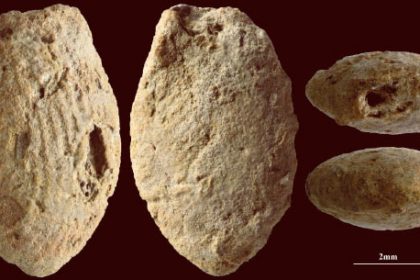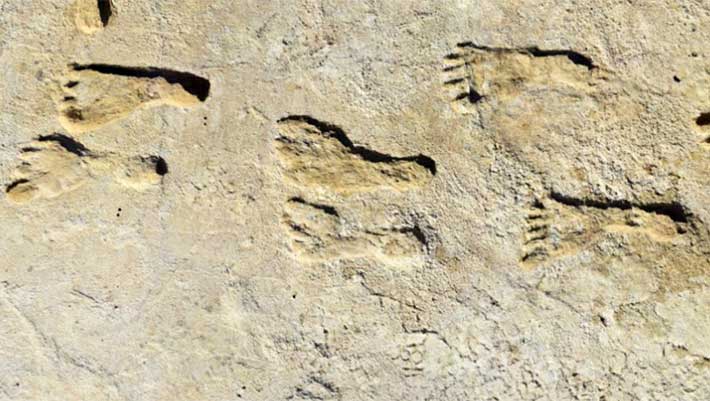
The identification of human imprints at White Sands, New Mexico, with an estimated age ranging from 21,000 to 23,000 years, represented a significant advancement in comprehending the initial human settlement of the Americas. However, this research faced scrutiny concerning the dependability of the materials employed in radiocarbon dating, specifically seeds from the common aquatic plant Ruppia cirrhosa and pollen from conifers. A subsequent investigation spearheaded by Vance Holliday, a researcher at the University of Arizona, introduces a third chronometric indicator—ancient sediment from paleolake Otero. This new analysis congruently places the age of the mud samples between 20,700 and 22,400 years old.
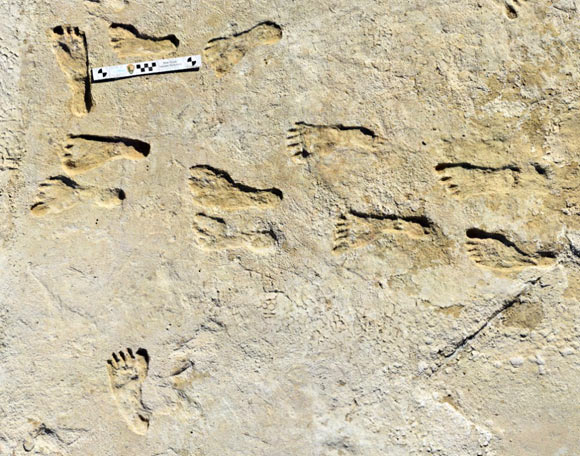
The ancient human footprints found at White Sands National Park in New Mexico, the United States. Image credit: Bennett et al., doi: 10.1126/science.abg7586.
Prevailing scientific consensus historically posited that human migration into North America occurred approximately between 16,000 and 13,000 years ago.
Conversely, the White Sands footprints suggest human presence in the region dated to between 23,000 and 21,000 years ago, a temporal framework that challenges established notions of early cultural development in North America.
This dating positions the prints to be roughly 10,000 years more ancient than remains discovered nine decades prior near Clovis, New Mexico. The Clovis site lent its name to an assemblage of artifacts long regarded by archaeologists as representative of the earliest recognized culture on the continent.
For the past four years, critical perspectives have been raised against the two prior studies, primarily asserting that the ancient seeds and pollen found within the sedimentary strata used for dating were not definitive indicators.
“The consistency of the evidence is remarkable. We reach a point where dismissing this entire dataset becomes exceedingly difficult,” stated Dr. Holliday.
“As articulated in the publication, it would be an extraordinarily improbable coincidence if all these converging dates presented a coherent but erroneous narrative.”
In epochs past, the area now known as White Sands was characterized by a system of lakes that subsequently desiccated.
Aeolian processes then sculpted the gypsum deposits into the extensive dunes that characterize the landscape today.
The imprints were unearthed within the dried beds of a watercourse that once fed into one of these ancient lacustrine environments.
“A portion of the historical narrative has been eradicated by wind erosion; that segment is irrevocably lost. The remainder lies concealed beneath the world’s largest accumulation of gypsum sand,” Dr. Holliday commented.
In pursuit of additional data, Dr. Holliday and his collaborators returned to White Sands in 2022 and 2023, excavating a new series of trenches to conduct a more granular examination of the paleolake bed stratigraphy.
“There is a peculiar sensation when one observes the footprints firsthand in their original context,” remarked Jason Windingstad, a doctoral candidate at the University of Arizona.
“It becomes apparent that this discovery essentially refutes everything we have been taught regarding the initial human colonization of North America.”
The research team acknowledges that their current study does not directly address a question posed by dissenters since 2021: the absence of any discernible artifacts or settlement evidence left by the individuals who created the tracks.
“This is a pertinent inquiry. A subset of the footprints documented in the 2021 investigation were part of trackways that would have required only a few seconds to traverse,” the authors noted.
“It is entirely plausible to infer that hunter-gatherer groups would exercise caution, minimizing the abandonment of any resources during such brief excursions.”
“These populations subsisted by utilizing their tools and supplies, and they were situated far from readily accessible sources of replacement materials.”
“They were not prone to casually discarding artifacts. It strikes me as illogical to anticipate discovering a field of refuse.”
The outcomes of the team’s latest investigation are published in the esteemed journal Science Advances and can be accessed via the following link: new results.
_____
Vance T. Holliday et al. 2025. Paleolake geochronology supports Last Glacial Maximum (LGM) age for human tracks at White Sands, New Mexico. Science Advances 11 (25); doi: 10.1126/sciadv.adv4951