While China has historically been posited as a prime region for the initial domestication of wild boars (Sus scrofa), pinpointing the precise genesis of this process has remained an intricate challenge. A recent investigation by archaeologists involved the meticulous analysis of mineralized dental plaque, known as calculus, from pigs unearthed at two early Neolithic settlements in the Lower Yangtze River basin of Southern China: Jingtoushan, dating back 8,300 to 7,800 years, and Kuahuqiao, from 8,200 to 7,000 years ago. The findings strongly suggest that these pigs were partaking in foodstuffs and refuse associated with human activity, including thermally processed starchy vegetation and human whipworm (Trichuris trichiura) ova, which were likely ingested through food preparation practices and contact with contaminated materials.

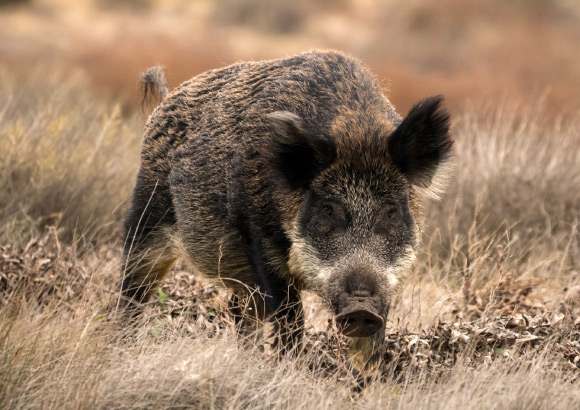
The wild boar (Sus scrofa). Image credit: Elşad İbrahimov / CC BY-SA 4.0.
The domestication of various animal species, notably pigs, is frequently correlated with the Neolithic era, a period marked by humanity’s profound shift from nomadic foraging to settled agricultural lifestyles, commencing approximately 10,000 years ago.
Wild boars are formidable, untamed creatures that generally exist in solitary fashion, often inhabiting woodlands where they meticulously forage for sustenance from the ground cover.
These animals are characterized by their larger cranial structures and buccal cavities, alongside more substantial dentition, when contrasted with their domesticated counterparts.
“While the majority of wild boars exhibit inherent aggression, a subset displays more amiable temperaments and a reduced apprehension towards humans, traits that might facilitate their cohabitation with people,” stated Dr. Jiajing Wang from Dartmouth College.
“Proximity to human populations afforded them readily available food sources, thereby diminishing the necessity for them to sustain their more robust physical conditioning.”
“Over protracted periods, their physical dimensions diminished, and their brains also underwent a reduction in volume, estimated at approximately one-third.”
For the purpose of investigating the domestication of pigs and other fauna, archaeologists have traditionally relied on the comparative analysis of skeletal dimensions and morphologies to chart evolutionary changes across time.
“However, this methodology can present difficulties, as the observed decrease in body mass likely occurred at a later stage in the domestication continuum,” Dr. Wang elaborated.
“What is more probable to have preceded these physical alterations were shifts in behavioral patterns, such as a decline in aggression and an increased propensity for tolerating human presence.”
Consequently, for the present investigation, Dr. Wang and her collaborators employed an alternative methodology, meticulously documenting the dietary habits of pigs throughout their life cycles by examining the molar teeth of 32 porcine specimens.
Through a detailed microfossil examination of the pig dentition, the researchers scrutinized the dental calculus recovered from two of the earliest known human habitation sites, dating back over 8,000 years at Jingtoushan and Kuahuqiao, situated in the Lower Yangtze River region of South China.
The research team successfully identified a collective total of 240 starch granules. Their analysis revealed that the pigs had consumed thermally processed foodstuffs, specifically rice and yams, in addition to an unidentifiable tuber, acorns, and various wild grasses.
“These plant species were prevalent in the regional environment during that historical epoch and were also discovered within human encampments,” Dr. Wang remarked.
Previous archaeological findings have confirmed the presence of rice at both locations, with evidence of extensive rice cultivation identified at Kuahuqiao. This inland site offers superior access to freshwater resources compared to the coastal locale of Jingtoushan.
Additional scholarly inquiries have also substantiated the existence of starch residues within grinding implements and ceramic vessels excavated from Kuahuqiao.
“It is reasonable to infer that pigs did not possess the capacity for cooking their own meals, thus suggesting they likely obtained sustenance from humans, either through direct provisioning or by foraging on discarded human victuals,” Dr. Wang posited.
Furthermore, the presence of human parasite ova, specifically those of the whipworm—a parasite capable of maturing within the human digestive tract—was also detected within the pig dental calculus.
These ova, characterized by their yellowish-brown, football-like morphology, were discovered in 16 of the analyzed pig dental specimens.
It is highly probable that the pigs ingested human excrement or consumed water or food items contaminated by such fecal matter.
“The well-documented propensity of pigs to consume human refuse provides supplementary corroboration for the hypothesis that these animals were likely cohabiting with humans or maintained an unusually close association with them,” Dr. Wang observed.
The scientific team also undertook a statistical evaluation of the dental structures from the Kuahuqiao and Jingtoushan porcine specimens, which indicated that a subset exhibited diminished tooth dimensions, bearing a resemblance to those observed in contemporary domesticated pig populations in China.
“It is plausible that wild boars were drawn to burgeoning human settlements as individuals began to establish permanent residences and cultivate their own food sources,” Dr. Wang suggested.
“These established communities generated substantial quantities of waste, which served as an attractant for scavengers seeking nourishment, thereby initiating selection pressures favoring animals amenable to coexisting with humans.”
Within the broader context of animal domestication, this particular process is designated as a commensal pathway, wherein the animal is attracted to human settlements rather than humans actively soliciting the animals’ proximity.
The collected data also lend support to the notion that early interactions encompassed domestic pigs under active human stewardship, indicating a prey pathway within the domestication sequence.
“Our research elucidates that a segment of the wild boar population initiated the initial phase of domestication by scavenging human waste products,” Dr. Wang asserted.
“The findings also illuminate the probable correlation between the domestication of pigs and the transmission dynamics of parasitic ailments within early settled human societies.”
This scientific investigation was formally published in the esteemed journal, the Proceedings of the National Academy of Sciences.
_____
Jiajing Wang et al. 2025. Early evidence for pig domestication (8,000 cal. BP) in the Lower Yangtze, South China. PNAS 122 (24): e2507123122; doi: 10.1073/pnas.2507123122