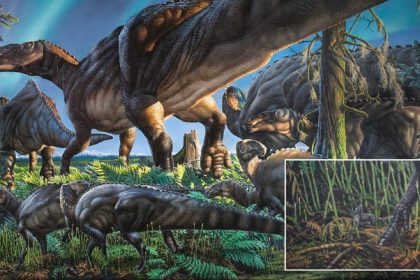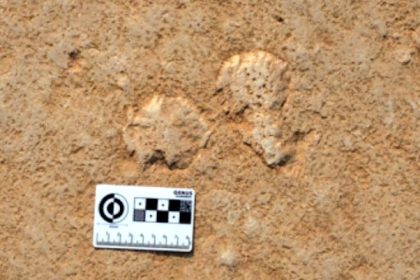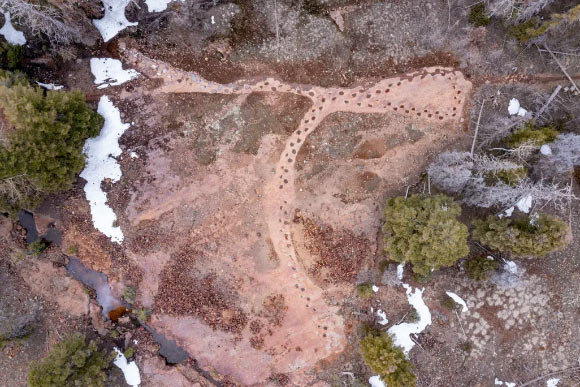
Researchers specializing in paleontology have undertaken an exhaustive analysis of a remarkably extensive sauropod trackway situated at the West Gold Hill Dinosaur Tracksite in Colorado, USA. Their findings suggest that the colossal dinosaur responsible for these imprints may have exhibited a limping gait.
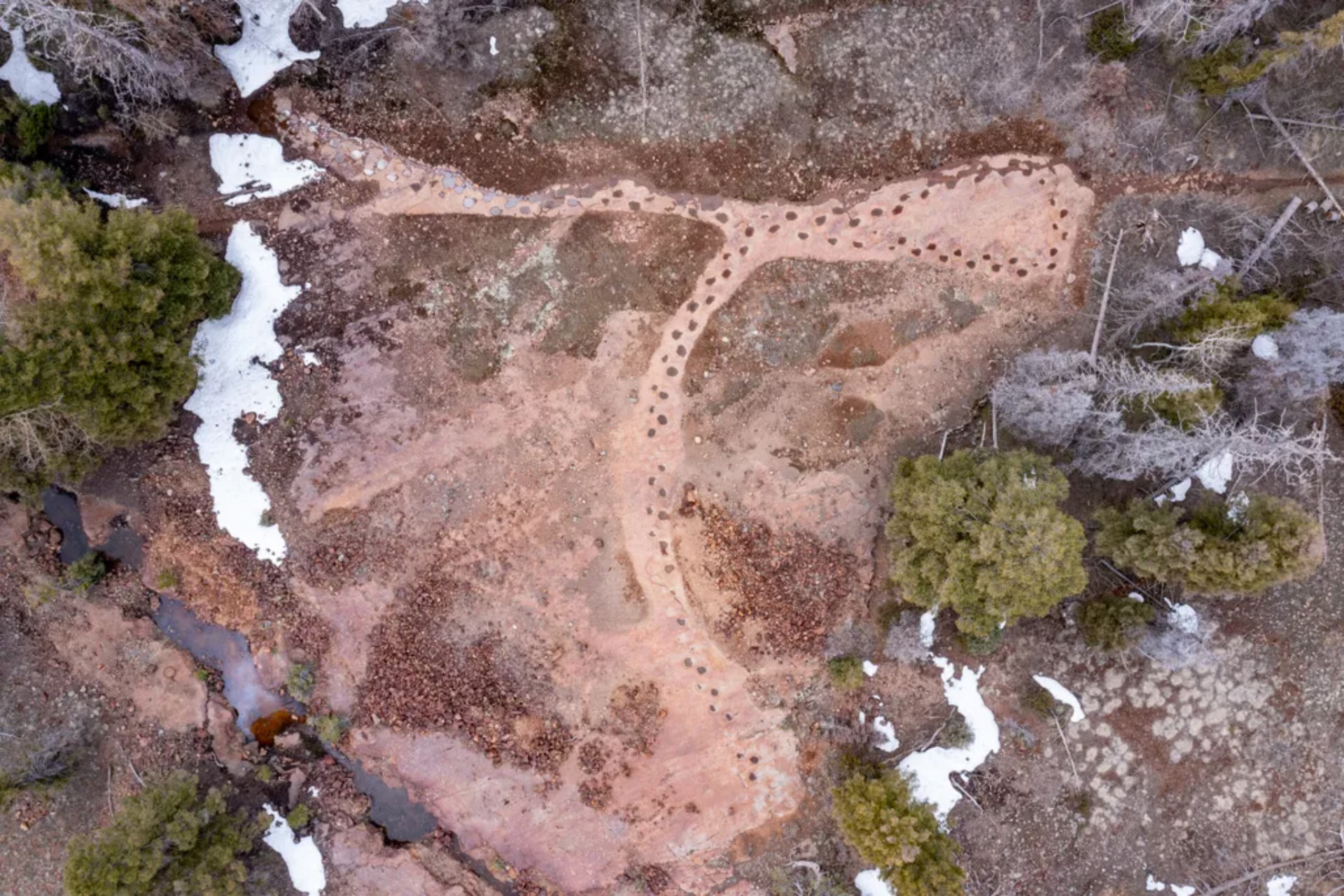
Aerial view of the West Gold Hill Dinosaur Tracksite in Colorado, the United States. Image credit: USDA Forest Service.
A paleontologist from the University of Queensland, Anthony Romilio, along with his associates, meticulously examined over 130 individual footprints spanning a trackway measuring 95.5 meters in length, dating back 150 million years.
“This trace fossil originates from the Late Jurassic epoch, a period when long-necked dinosaurs, such as Diplodocus and Camarasaurus, were indigenous to North America,” stated Dr. Romilio.
“The distinctiveness of this trackway lies in its complete, circular trajectory,” he added.
“Although the precise motivations behind the dinosaur’s curvilinear path remain speculative, this trackway provides an exceptionally rare opportunity to investigate how a gargantuan sauropod navigated a sharp, looping turn before reorienting to its original course of movement.”
“The sheer magnitude of the West Gold Hill Dinosaur Tracksite necessitated the adoption of a novel investigative methodology,” commented Paul Murphey, a paleontologist affiliated with the San Diego Natural History Museum.
“Documenting these footprints from ground level proved to be a considerable challenge due to the extensive dimensions of the trackway,” he explained.
“We deployed drones to capture the entirety of the trackway in exceptionally high resolution,” Murphey revealed.
“Utilizing these aerial images, we were able to generate an intricate three-dimensional model, which subsequently underwent digital analysis in the laboratory with centimeter-level precision.”
The resultant virtual model facilitated a reconstruction of the sauropod’s locomotion across the entire length of the trackway.
“It became evident from the outset that this creature initiated its journey towards the northeast, executed a complete circuit, and concluded by facing the identical direction from which it began,” Dr. Romilio elucidated.
“Within the confines of this looped path, we identified subtle yet consistent indicators of its behavior.”
“One of the most discernible patterns observed was a fluctuation in the width between the left and right footprints, transitioning from relatively narrow intervals to distinctly broader ones.”
“This variation in step placement, from narrow to wide, demonstrates that footprint width can naturally change during a dinosaur’s locomotion. Consequently, abbreviated trackway segments exhibiting seemingly uniform widths might present an inaccurate depiction of its typical ambulation style,” he cautioned.
“Furthermore, we detected a slight but consistent disparity in the lengths of the left and right steps, amounting to approximately 10 centimeters (4 inches).”
“It is difficult to definitively ascertain whether this difference is attributable to a limp or simply a persistent preference for one limb over the other,” Dr. Romilio noted.
“Numerous extensive dinosaur trackways exist globally, to which this analytical approach could be applied to retrieve behavioral insights that were previously unattainable,” he concluded.
The research team’s findings have been disseminated in the academic journal Geomatics, accessible via the following link.
_____
Anthony Romilio et al. 2025. Track by Track: Revealing Sauropod Turning and Lateralised Gait at the West Gold Hill Dinosaur Tracksite (Upper Jurassic, Bluff Sandstone, Colorado). Geomatics 5 (4): 67; doi: 10.3390/geomatics5040067