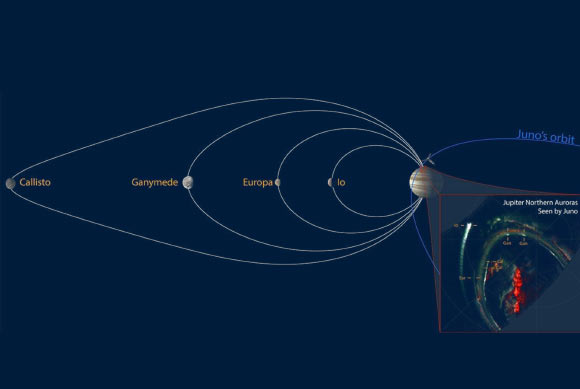
The gas giant, Jupiter, is home to the most luminous and stunning auroral displays observed within our Solar System. In the vicinity of its polar regions, these ethereal light phenomena provide invaluable insights into the planet’s dynamic interplay with the solar wind and its moons, which are influenced by Jupiter’s potent magnetic field. Distinctly different from Earth’s auroras, Jupiter’s four largest satellites generate their own unique emanation signatures within the planet’s atmosphere. These moon-induced auroral manifestations, often termed satellite footprints, elucidate the specific ways in which each moon engages with its immediate space environment.
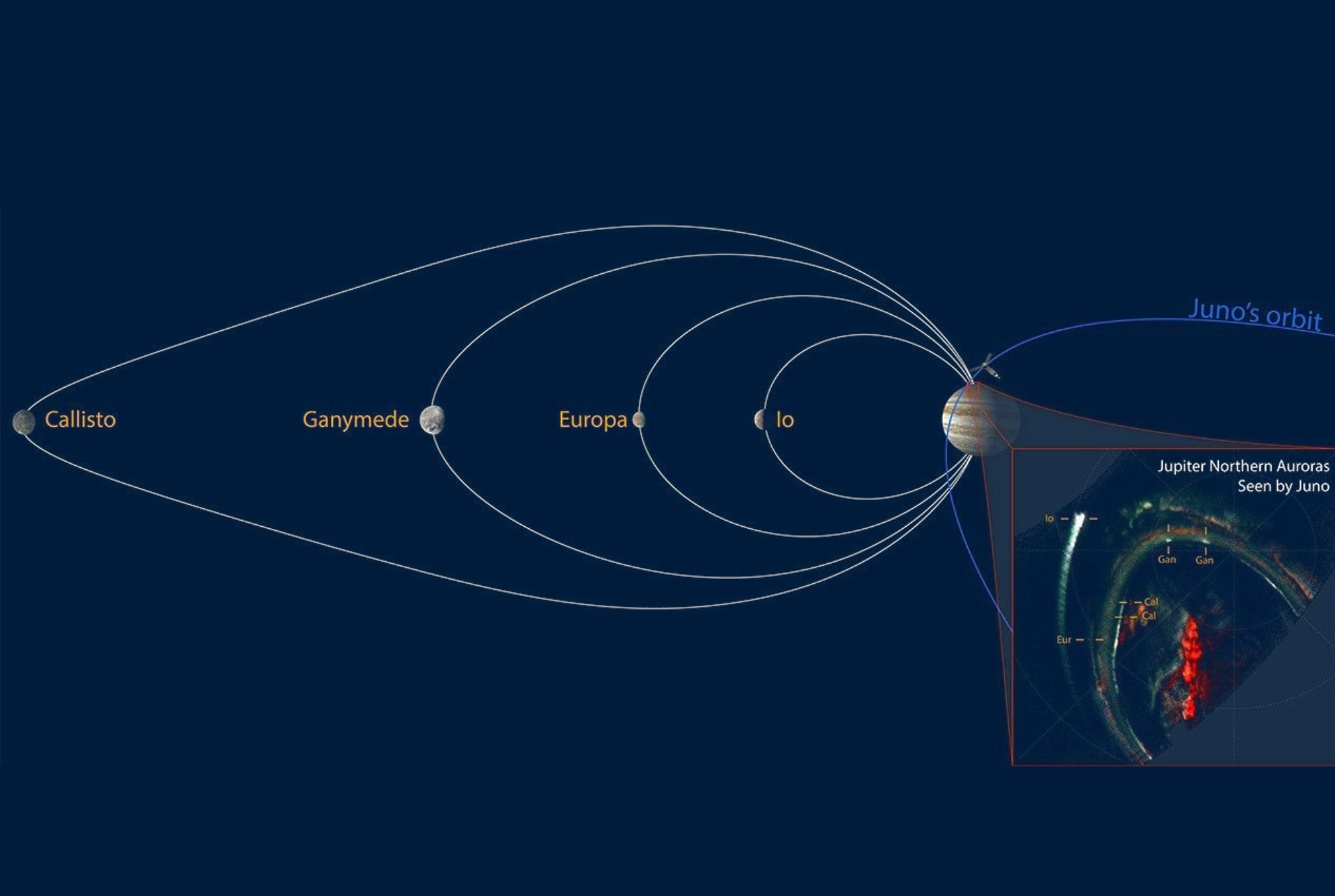
Juno capturing the marks on Jupiter of all four Galilean moons; the aurorae related to each are labeled Io, Eur (for Europa), Gan (for Ganymede), and Cal (for Callisto). Image credit: NASA / JPL-Caltech / SwRI / UVS Team / MSSS / Gill / Jónsson / Perry / Hue / Rabia.
Prior to the pioneering Juno mission by NASA, it had been established that three of Jupiter’s four major satellites, collectively known as the Galilean moons—Io, Europa, and Ganymede—were responsible for producing these characteristic auroral emissions.
However, Callisto, the outermost of the Galilean moons, remained an enigma in this regard.
Despite repeated observational efforts employing the NASA/ESA Hubble Space Telescope, Callisto’s auroral signature proved recalcitrant to detection. This difficulty stemmed from both its inherent faintness and its frequent superpositioning upon the more intense main auroral oval, the prominent zone where Jovian aurorae are typically observed.
The Juno spacecraft, which has been diligently orbiting Jupiter since 2016, furnishes remarkably detailed, close-range perspectives of these polar light phenomena.
Nevertheless, to effectively capture an image of Callisto’s auroral footprint, the primary auroral oval necessitates a temporary displacement or abatement while the polar region is under observation.
Furthermore, to fully leverage Juno’s suite of instruments dedicated to studying electromagnetic fields and energetic particles, the spacecraft’s orbital path must align to traverse the magnetic field lines that establish a connection between Callisto and Jupiter.
These two crucial conditions converged fortuitously during Juno’s 22nd orbital pass around the colossal planet in September 2019. This alignment enabled the observation of Callisto’s auroral footprint and yielded a valuable dataset encompassing the particle populations, electromagnetic waves, and magnetic field characteristics associated with this interaction.
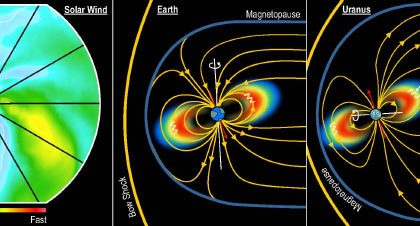
Jupiter’s magnetic field extends significantly beyond the orbits of its major moons, delineating an expansive domain known as the magnetosphere. This region is continuously influenced and reshaped by the solar wind, a stream of charged particles emanating from the Sun.
Analogous to how solar disturbances on Earth can extend the reach of auroras to lower latitudes, Jupiter’s auroral displays are also subject to the Sun’s activity.
In September 2019, a substantial, highly dense solar stream impacted Jupiter’s magnetosphere. This event temporarily shifted the auroral oval towards Jupiter’s equator, thereby revealing a subtle yet discernible signature linked to Callisto.
This groundbreaking discovery definitively confirms that all four Galilean moons contribute to the auroral activity on Jupiter’s atmosphere. It further establishes that Callisto’s auroral footprints are generated and sustained through mechanisms similar to those of its inner counterparts, thereby completing the comprehensive depiction of auroral signatures from the entire Galilean satellite family.
“Our findings substantiate the electrodynamic linkage between Callisto and Jupiter,” stated Dr. Jonas Rabia, a researcher affiliated with the Institut de Recherche en Astrophysique et Planétologie and CNRS, alongside his collaborators.
“This interaction will undergo further in-depth scrutiny by NASA’s JUICE mission, which was successfully launched in April 2023. This mission will conduct repeated investigations of Callisto and its surrounding environment, facilitating a more precise characterization of Callisto’s interaction with Jupiter’s magnetosphere.”
“The reported in situ measurements and remote observations provide the final pieces for the comprehensive visual representation of Galilean moon auroral footprints, resolving the long-standing question of whether Callisto’s electromagnetic interactions differ fundamentally from those of the three inner Galilean satellites.”
“The observed parallels, both in the structure of the auroral emissions and the characteristics of the sampled electrons, suggest the operation of a universal physical principle governing moon-planet and planet-star magnetospheric interactions. This principle holds relevance for other binary systems throughout the Solar System and beyond, which are predominantly observable via remote sensing.”
The research team’s findings are detailed in their publication, released this week in the esteemed journal Nature Communications.
_____
J. Rabia et al. 2025. In situ and remote observations of the ultraviolet footprint of the moon Callisto by the Juno spacecraft. Nat Commun 16, 7791; doi: 10.1038/s41467-025-62520-4