The SPHEREx (Spectro-Photometer for the History of the Universe, Epoch of Reionization, and Ices Explorer) space observatory, a pioneering initiative by NASA, has successfully concluded its inaugural comprehensive infrared survey of the entire celestial sphere. This monumental undertaking, utilizing observations gathered from May to December 2025, has produced a spectral map distinguished by 102 distinct color bands. Although these infrared wavelengths are imperceptible to the human visual spectrum, they are profoundly abundant throughout the cosmos. By meticulously examining the complete sky through this extensive array of infrared light, scientists are poised to address profound cosmological inquiries. These include deciphering the influence of an exceptionally early cosmic event—occurring within the initial fraction of a trillionth of a trillionth of a second post-Big Bang—on the three-dimensional arrangement of hundreds of millions of galaxies. Furthermore, the collected data will facilitate an in-depth analysis of galactic evolution across the Universe’s 13.8 billion-year temporal span and illuminate the distribution of essential elements for life within our own Milky Way Galaxy.
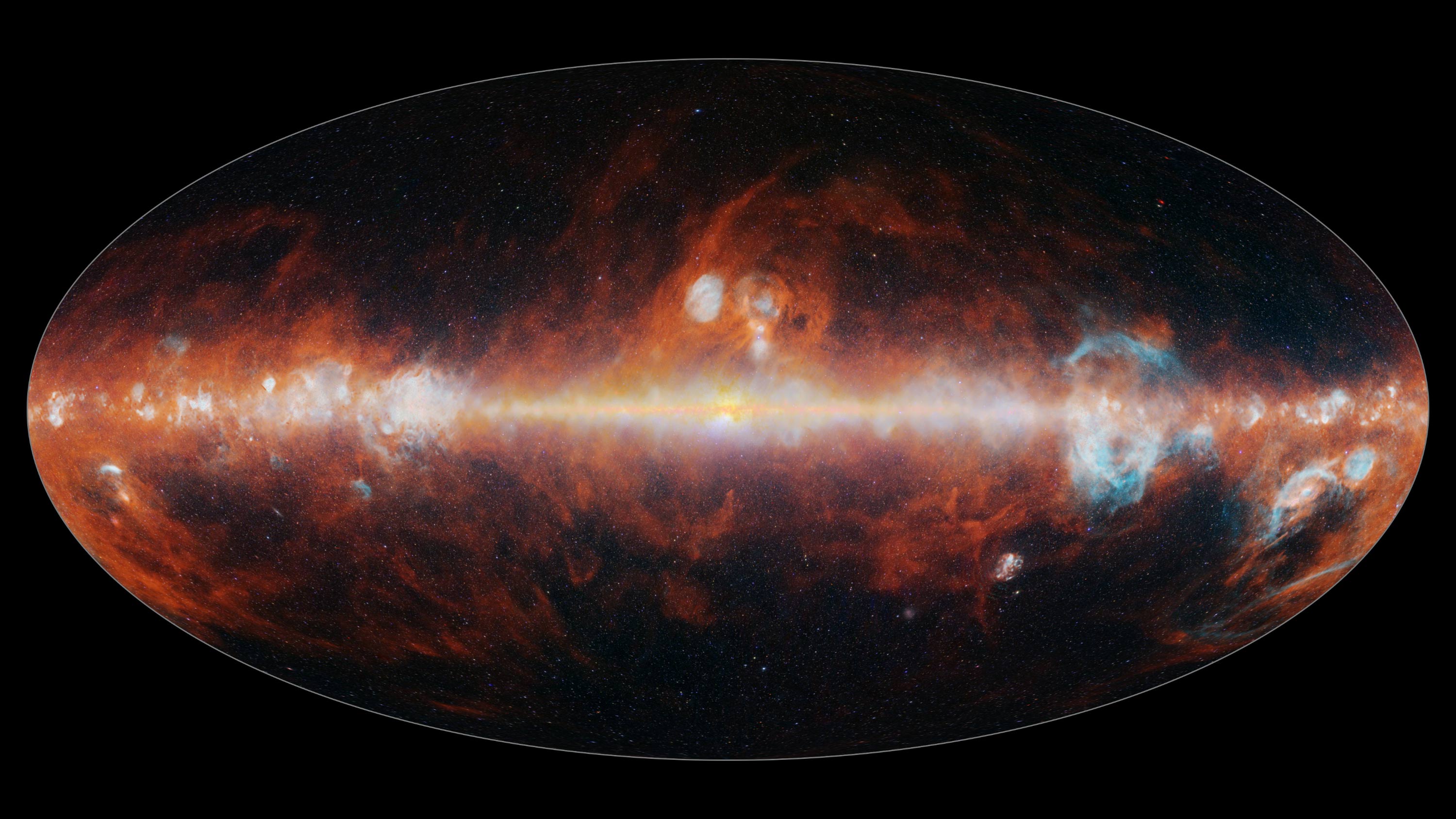
This infrared image from SPHEREx features a selection of colors emitted primarily by stars (blue, green, and white), hot hydrogen gas (blue), and cosmic dust (red). Image credit: NASA / JPL-Caltech.
The SPHEREx observatory, executing approximately 14.5 orbits around Earth daily, traverses the planet from north to south, encompassing the polar regions.
On a daily basis, the telescope captures about 3,600 images, meticulously documenting a single circular strip of the celestial expanse. Concurrently, as the Earth progresses in its orbit around the Sun, the observational perspective of SPHEREx continuously shifts.
Following a six-month observational period, the spacecraft has successfully surveyed the cosmos in every conceivable direction, thereby compiling a comprehensive 360-degree mosaic of the entire sky.
This mission, under the purview of NASA’s Jet Propulsion Laboratory in Southern California, commenced its sky-mapping operations in May and finalized its initial all-encompassing sky rendition in December.
Over its stipulated two-year primary mission duration, the observatory is scheduled to undertake three additional full-sky scans. The amalgamation of these successive maps is anticipated to significantly enhance the precision and sensitivity of the resulting measurements.
“The sheer volume of invaluable data that SPHEREx has amassed in a mere six months is truly astounding—data that will prove exceptionally potent when integrated with the findings from our other missions to deepen our comprehension of the Universe,” remarked Dr. Shawn Domagal-Goldman, Director of NASA Headquarters’ Astrophysics Division.
“Effectively, we now possess 102 unique maps of the entirety of the sky, each rendered in a distinct spectral band and offering novel insights into the celestial objects it observes.”
“I anticipate that virtually every astronomer will discover elements of profound significance within this dataset, as NASA’s diverse missions empower global scientific endeavors to unravel fundamental questions concerning the universe’s genesis and its subsequent transformation into a habitable environment for humanity.”
“SPHEREx represents a meticulously engineered mid-sized astrophysics mission that is delivering groundbreaking scientific discoveries,” stated Dave Gallagher, Director of NASA’s Jet Propulsion Laboratory.
“It stands as an exemplary illustration of our capacity to translate ambitious concepts into tangible realities, thereby unlocking unprecedented avenues for exploration and discovery.”
Each of the 102 distinct colors observed by SPHEREx corresponds to a specific infrared light wavelength, with each wavelength providing a unique spectrum of information regarding galaxies, stars, nascent planetary systems, and other cosmic phenomena.
For instance, dense interstellar dust clouds, integral to the formation of stars and planets within our Galaxy, exhibit robust emission at particular wavelengths while remaining entirely obscured—and thus invisible—at others.
The analytical process of dissecting light from a celestial source into its constituent wavelengths is known as spectroscopy.
While a limited number of prior missions, such as NASA’s Wide-field Infrared Survey Explorer, have also conducted comprehensive sky surveys, none have accomplished this feat across such an extensive number of spectral bands as SPHEREx.
In contrast, while the James Webb Space Telescope, a collaborative effort between NASA, ESA, and CSA, is capable of performing spectroscopy with a considerably larger number of light wavelengths than SPHEREx, its observational field of view is thousands of times more restricted.
The remarkable efficacy of SPHEREx stems from its synergistic combination of broad spectral coverage and an expansive field of view.
“SPHEREx’s defining characteristic is its ability to capture the entire sky in 102 distinct colors on a recurring basis approximately every six months,” explained Dr. Beth Fabinsky, SPHEREx Project Manager at NASA’s Jet Propulsion Laboratory.
“This represents an extraordinary quantity of data acquisition within a compressed timeframe.”
“I believe this technological capability positions us as the ‘mantis shrimp’ of telescopic instruments, analogous to its remarkable multicolor visual perception system combined with an exceptionally wide field of vision.”