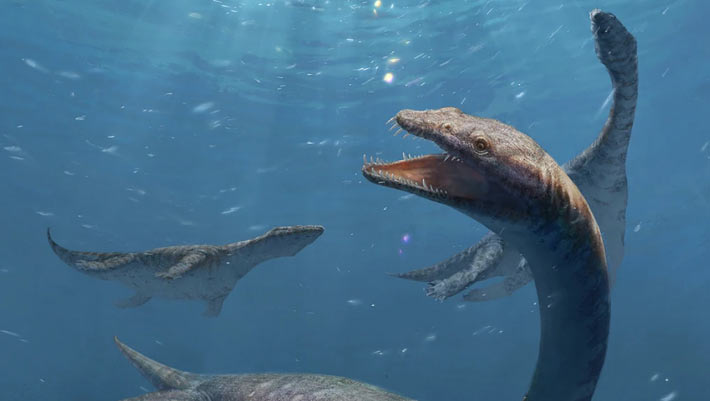
A team of paleontologists, spearheaded by researchers from the Institute of Vertebrate Paleontology and Paleoanthropology at the Chinese Academy of Sciences, has identified that the remarkably elongated neck of the species *Lijiangosaurus yongshengensis* comprised 42 cervical vertebrae.
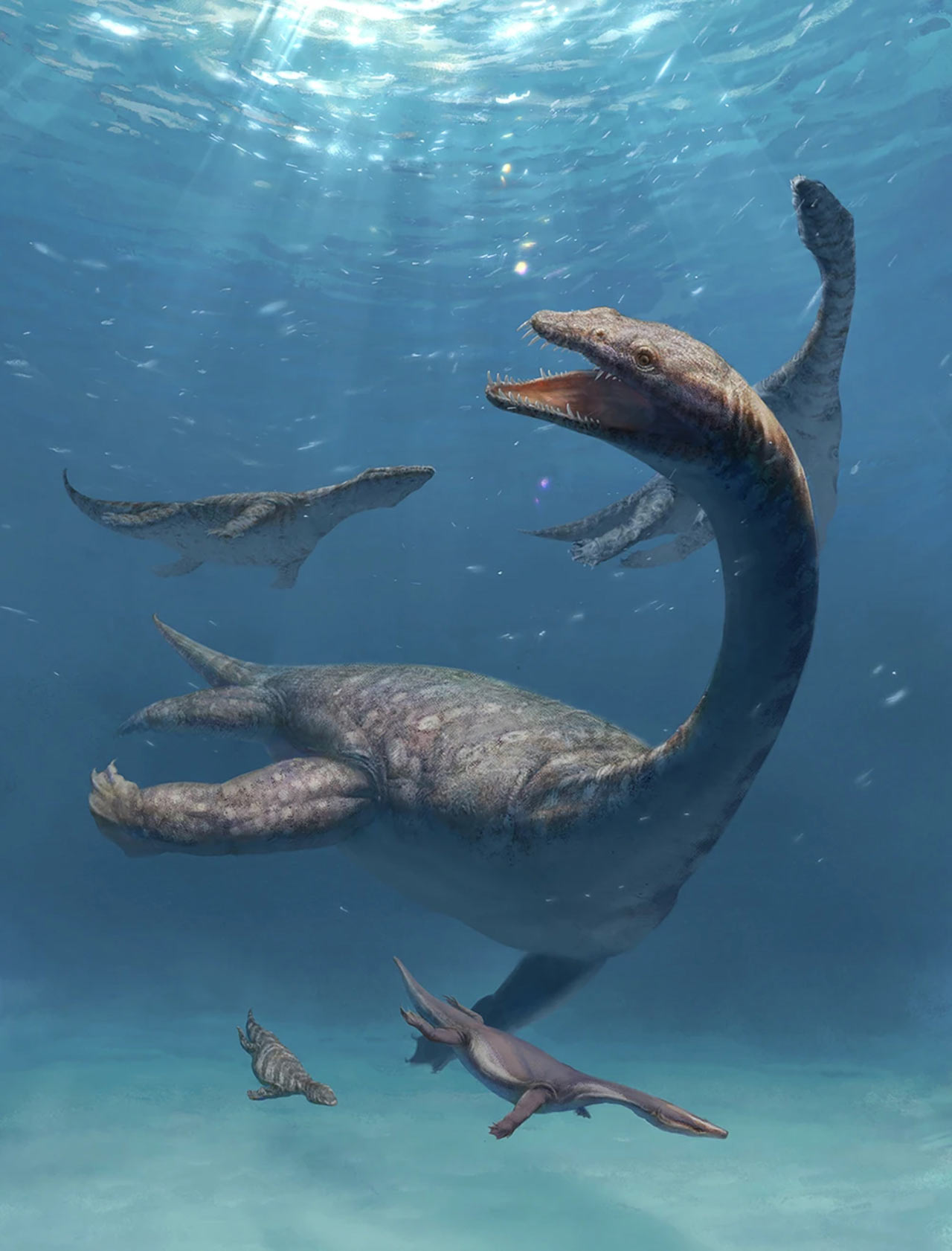
Reconstruction of nothosaurs approximately 240 million years ago, showcasing the concealed diversity found in southwestern China: *Lijiangosaurus yongshengensis* (centrally positioned), *Nothosaurus yangjuanensis* (top left), *Nothosaurus luopingensis* (top right), *Brevicaudosaurus jiyangshanensis* (bottom left), and *Lariosaurus hongguoensis* (bottom right). Credit for the image: Kelai Li.
The ancient marine reptile, *Lijiangosaurus yongshengensis*, lived during the Middle Triassic epoch, flourishing in oceanic environments between 247 and 241 million years ago.
This prehistoric creature belonged to the lineage of nothosaurs, a distinct group within the marine sauropterygian reptiles.
Nothosaurs were capable of reaching lengths of up to 7 meters (23 feet) and propelled themselves through the water using a set of four fin-like appendages.
Their cranial structures were flattened, featuring a complex arrangement of thin, conical teeth specifically adapted for capturing prey such as fish and squid.
“Sauropterygia emerged as a significant clade of marine reptilian fauna during the Early to Middle Triassic periods, maintaining their prominence as integral components of the Mesozoic marine ecosystem for roughly 180 million years,” stated the study’s principal investigator, Dr. Qinghua Shang, along with his colleagues.
“The ancestral sauropterygians encompass groups like placodonts, pachypleurosaurs, nothosaurs, and early pistosaurs.”
“A well-recognized lineage of extinct reptiles, plesiosaurs, represents a later branching off from pistosaurs within the broader Sauropterygia classification.”
“In the context of systematic paleontology, nothosaurs are synonymous with nothosaurians, a classification that not only includes the family Nothosauridae (comprising genera such as *Nothosaurus* and *Lariosaurus*) but also other species categorized under Nothosauria.”
“Notwithstanding the substantial number of species that have been identified, nothosaurs exhibit a less pronounced diversity at the genus level and in their anatomical characteristics when contrasted with other sauropterygian sub-groups.”
“Generally, the body dimensions of nothosaurs exceed those of pachypleurosaurs but fall short of the size attained by pistosaurs, including plesiosaurs.”
In terms of its physical attributes, *Lijiangosaurus yongshengensis* possessed a modest skull and a body length that surpassed 2.5 meters (8 feet).
This ancient reptile developed an exceptionally elongated neck, distinguished by 42 cervical vertebrae – a count double that observed in most contemporary sauropterygians.
“Plesiosaurs are characteristically recognized by their notably protracted necks,” the paleontological researchers noted.
“While certain later-evolving plesiosaurian species experienced a secondary reduction in neck length, the early plesiosaurs and their Triassic ancestral relatives, the early pistosaurs, exhibited impressively elongated necks, with a vertebral count exceeding 30 often considered a shared derived trait of early pistosaurs and plesiosaurs.”
“Adhering to this conventional interpretation, for the purposes of our investigation, we define a long or elongated neck as one possessing more than 30 cervical vertebrae.”
“This defining characteristic of plesiosaurs is a unique trait among secondarily marine tetrapods, as other groups such as ichthyosaurs, thalattosuchians, mosasaurs, and cetaceans all featured short necks and a more fish-like morphology.”
The fossilized remains of *Lijiangosaurus yongshengensis* were unearthed at a previously undocumented fossil site dating to the early Middle Triassic period. This location, part of the Beiya Formation, is situated in China’s Yunnan province, in proximity to the eastern Tibetan Plateau and northern Myanmar.
“This discovery site presents a distinct geological context compared to the fossil-rich areas previously documented in southwestern China, specifically around the border region between Yunnan and Guizhou provinces,” the research team indicated.
*Lijiangosaurus yongshengensis* stands as the earliest identified sauropterygian reptile to exhibit a significantly elongated neck, complete with 42 cervical vertebrae.
“Our findings underscore the significant point that extreme cervical elongation, characterized by more than 30 cervical vertebrae, emerged within the sauropterygian lineage preceding the advent of plesiosaurs and their pistosaur ancestors,” the scientists commented.
“Furthermore, *Lijiangosaurus yongshengensis* displays a distinctive form of accessory intervertebral articulation not observed in other reptiles. We posit that this anatomical feature contributed to a reduction in bodily undulation during locomotion.”
“This discovery broadens our understanding of the diversity of accessory intervertebral articulations found in reptiles and highlights the remarkable adaptability of the vertebral column during the early evolutionary stages of sauropterygians.”
The scientific paper detailing these findings has been published in the journal *Communications Biology* and can be accessed via the following link: paper.
_____
W. Wang et al. 2025. Earliest long-necked sauropterygian *Lijiangosaurus yongshengensis* and plasticity of vertebral evolution in sauropterygian marine reptiles. *Commun Biol* 8, 1551; doi: 10.1038/s42003-025-08911-1