Spanning 321 kilometers across the stark Gobi highland desert of Mongolia, the Gobi Wall represents the least understood segment of the extensive Medieval Wall System that extends from China into Mongolian territory. In a recent scholarly undertaking, archaeologists endeavored to pinpoint the identity of its constructors, its intended purpose, and its chronological placement. Their investigation revealed that the primary period of construction and utilization for both the wall and its accompanying structures transpired throughout the Xi Xia Dynasty (1038-1227 CE), an era distinguished by sophisticated frontier defense mechanisms and substantial geopolitical realignments.
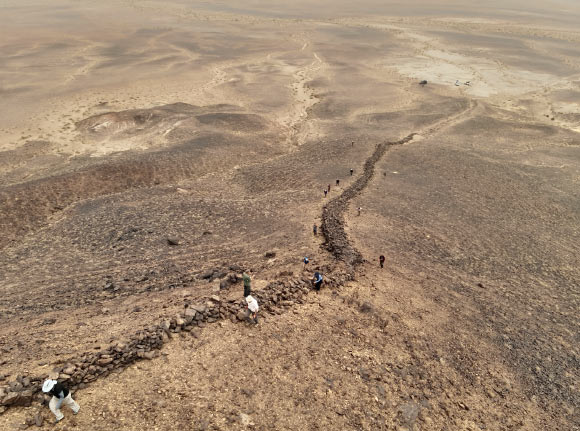
Aerial drone photograph showing the preserved stone section of the Gobi Wall traversing the hillside. Image credit: Golan et al., doi: 10.3390/land14051087.
The Gobi Wall, extending 321 km across Mongolia’s arid highland plateau, is integrated into a vast fortification network that once stretched from China into Mongolia.
Prior to this inquiry, its origins, functional role, and historical context were largely shrouded in mystery.
“The Medieval Wall System encompasses an approximate length of 4,000 km, traversing considerable territories in northern China and Mongolia, in addition to shorter segments within Siberia,” stated Professor Gideon Shelach-Lavi of Hebrew University, alongside his research associates.
“It stands as one of East Asia’s most expansive yet enigmatic architectural formations.”
“In recent times, numerous research initiatives have meticulously examined and published findings on distinct portions of this extensive wall lineage.”
“Such scholarly work has substantiated that this considerable network of earthen ramparts was erected by various empires spanning roughly from the 10th to the 13th centuries CE.”
“Among the diverse segments comprising this system, the particular wall section situated within the southern Gobi Desert of Mongolia remains the least investigated and continues to be poorly understood.”
“Our current investigation concentrates on a 321 km stretch of this extensive wall line, located in the Ömnögovi province of Mongolia, which we have designated as the Gobi Wall.”
Within the scope of this research, Professor Shelach-Lavi and his collaborators successfully unearthed novel evidence pertaining to the wall’s construction methodologies and its functional objectives.
Their findings indicate that the wall and its associated garrison complexes were predominantly erected during the Xi Xia period (1038-1227 CE), a dynasty governed by the Tungut people of Western China and Southern Mongolia.
This era was notably characterized by the expansion of frontier defense mechanisms amidst profound geopolitical transformations.
Contradicting the conventional perception of such structures as exclusively defensive barriers, this research underscores the Gobi Wall’s multifaceted utility in defining boundaries, managing resources, and fortifying imperial dominion.
While the main era of construction and habitation is attributed to the Xi Xia, the archaeological expedition yielded evidence of intermittent occupation in this remote locale from the 2nd century BCE through the 19th century CE. Layers of discovered artifacts strongly suggest the wall’s enduring strategic importance.
The fortifications were constructed using rammed earth techniques, reinforced with stone and timber, showcasing the adept utilization of indigenous materials within this arid, isolated environment.
Furthermore, the study’s ecological and spatial analyses demonstrate that the wall’s alignment was strategically chosen based on the availability of essential resources, particularly water and wood.
The positioning of forts and garrisons capitalized on natural topographical features, such as mountain passes and sand dunes, to augment the wall’s overall efficacy.
“This research prompts a reevaluation of long-held assumptions regarding imperial frontier systems in Inner Asia,” Professor Shelach-Lavi commented.
“The Gobi Wall served not merely as an impediment, but rather as a dynamic instrument for regulating movement, commerce, and territorial sovereignty within a challenging geographical setting.”
The unearthed findings provide crucial insights into the intricate relationship between environmental adaptation and state power in medieval empires, offering broader implications for comprehending ancient infrastructure and its lasting impact on contemporary political and ecological landscapes.
“The research supports a more expansive reconceptualization of medieval frontiers – viewing them not simply as static defensive lines, but as active administrative infrastructures,” the archaeologists stated.
“The Gobi Wall stands as a prime example of a Xi Xia statecraft approach that leveraged architectural investments to manage resources, population flows, and territorial limits.”
“This perspective aligns with theoretical frameworks that characterize frontiers as zones of control and interaction, rather than rigid demarcating lines, and encourages wider comparative analyses across Eurasian contexts.”
A research paper detailing these discoveries has been published in the journal Land.
_____
Dan Golan et al. 2025. Exploring the Gobi Wall: Archaeology of a Large-Scale Medieval Frontier System in the Mongolian Desert. Land 14 (5): 1087; doi: 10.3390/land14051087