Analysis of seismic data gathered by NASA’s InSight mission has revealed that the Martian mantle harbors ancient material fragments, some spanning up to 4 kilometers in width, dating back to the planet’s very formation. These fragments are akin to geological fossils, preserving evidence of the planet’s tumultuous early history.
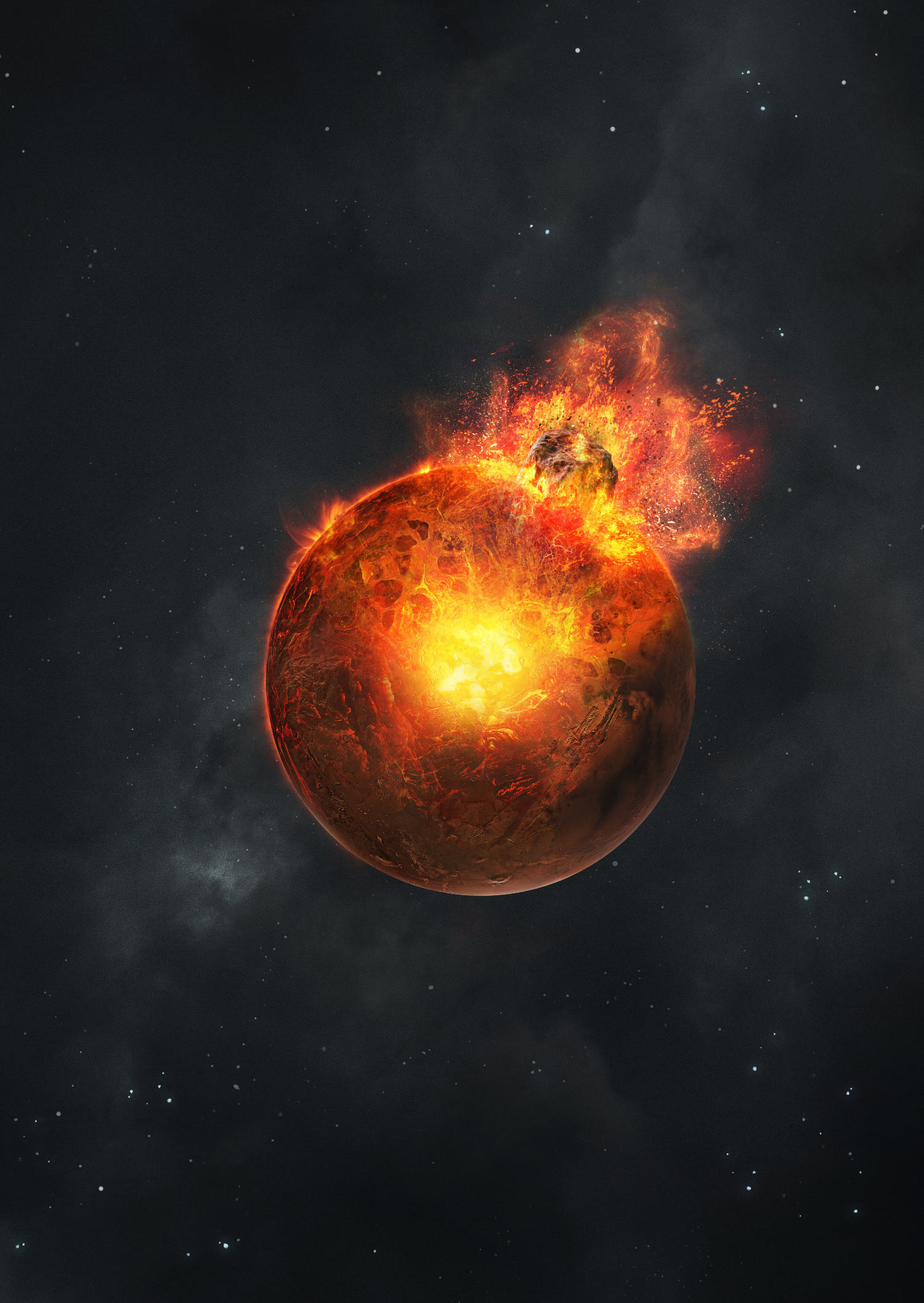
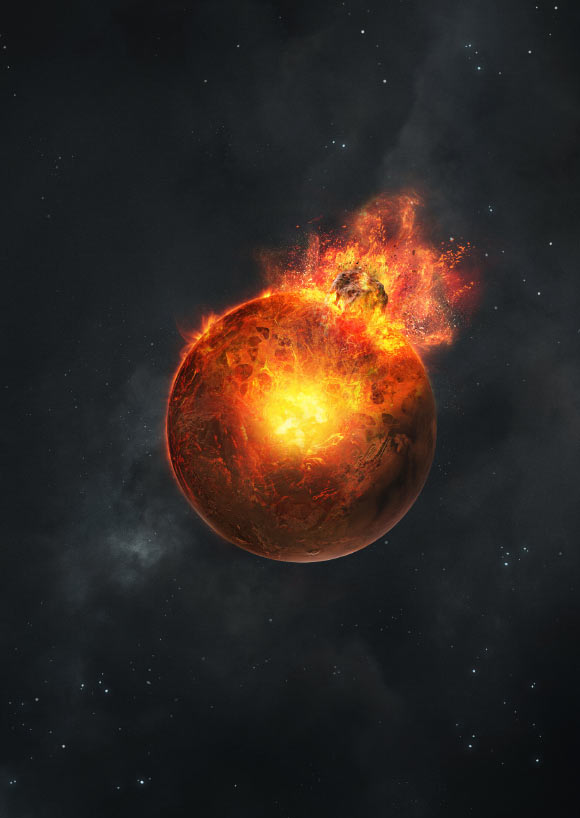
A giant collision in the early history of Mars created a global magma ocean. Image credit: Vadim Sadovski / Imperial College London.
A planet’s mantle, the substantial layer situated between its crust and core, serves as a crucial repository of information concerning planetary genesis and evolutionary pathways.
In contrast to Earth, where vigorous plate tectonics continuously churns the mantle, Mars is distinguished by its smaller size and a singular, unbroken planetary surface.
Consequently, the Martian mantle experiences considerably less internal churning. This reduced mixing suggests it may retain a preserved record of the planet’s nascent internal geological history, potentially offering profound insights into the genesis and development of terrestrial planets.
Leveraging data acquired from NASA’s InSight lander, Dr. Constantinos Charalambous of Imperial College London, in collaboration with his research team, meticulously examined the seismic reverberations from marsquakes. Their objective was to more precisely delineate the characteristics of Mars’ mantle.
Through the examination of eight well-documented marsquakes, including tremors induced by meteoroid impacts, the researchers identified a consistent pattern of delayed arrivals for high-frequency P-waves as they propagated through the deeper mantle strata.
The authors posit that these temporal discrepancies signify subtle, kilometer-scale variations in the mantle’s composition.
Given Mars’ absence of plate tectonics and large-scale material recycling, these minor structural anomalies are inferred to be residual traces from its earliest geological epochs.
The scale of heterogeneity observed within the Martian mantle points towards an origin stemming from exceptionally energetic and disruptive events. These likely included colossal impacts during the planet’s infancy, which not only fractured the planetary interior but also integrated extraterrestrial and crustal materials on a global scale within the mantle.
Furthermore, the subsequent solidification of vast magma oceans, generated in the wake of these cataclysmic events, would have contributed additional compositional heterogeneity.
Rather than being obliterated, these features became effectively ossified as Mars’ crust cooled and mantle convection ceased.
“The seismic signatures exhibited unmistakable indications of impedance as they journeyed through the planet’s profound interior,” stated Dr. Charalambous. “This observation aligns with a mantle replete with structures originating from disparate compositional sources—remnants from Mars’ primordial era.”
“What transpired on Mars was that, following these initial formative events, the planetary surface solidified into a stable, unmoving crust,” he elaborated. “This effectively sealed off the underlying mantle, encasing those ancient, chaotically formed features—akin to a planetary time capsule.”
“What we are observing is a ‘fractal’ distribution pattern, a phenomenon that occurs when the kinetic energy imparted by a cataclysmic impact surpasses the inherent structural integrity of an object,” commented Professor Tom Pike from Imperial College London. “One witnesses a similar effect when a glass object shatters upon impact with a tiled floor, or when a meteorite strikes a planet: the material fractures into a few large fragments and a multitude of smaller particles.”
“It is truly astonishing that we can still detect this distribution pattern today.”
“The data furnished by InSight continue to fundamentally alter our perception of how rocky planets form, with Mars being a particularly illuminating subject,” remarked Dr. Mark Panning, a research scientist at NASA’s Jet Propulsion Laboratory. “It is exhilarating to witness scientists unearthing new discoveries from the seismic events we recorded!”
The research paper authored by the team has been published today in the esteemed journal Science. The publication can be accessed via the following link: here.
_____
Constantinos Charalambous et al. 2025. Seismic evidence for a highly heterogeneous Martian mantle. Science 389 (6763): 899-903; doi: 10.1126/science.adk4292