A remarkable discovery at a construction site, preserved for nearly two millennia since the catastrophic eruption that befell Pompeii in 79 CE, has shed new light on the secret behind the extraordinary longevity of Roman concrete.
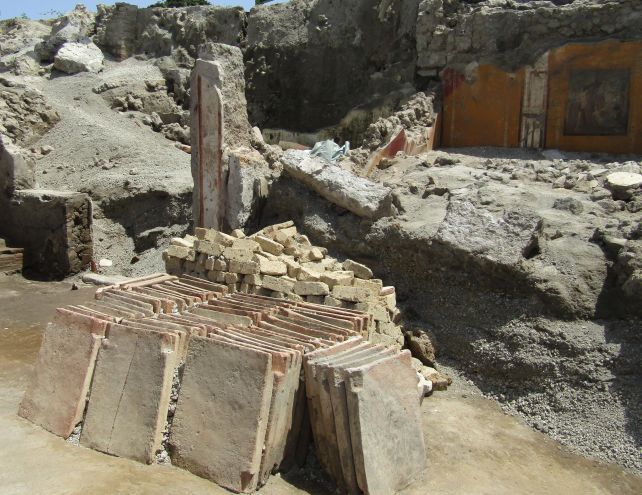
Last year, archaeologists unearthed a remarkably preserved construction site beneath the mantle of volcanic ash that entombed Pompeii, offering a rare, frozen-in-time glimpse into Roman construction practices.
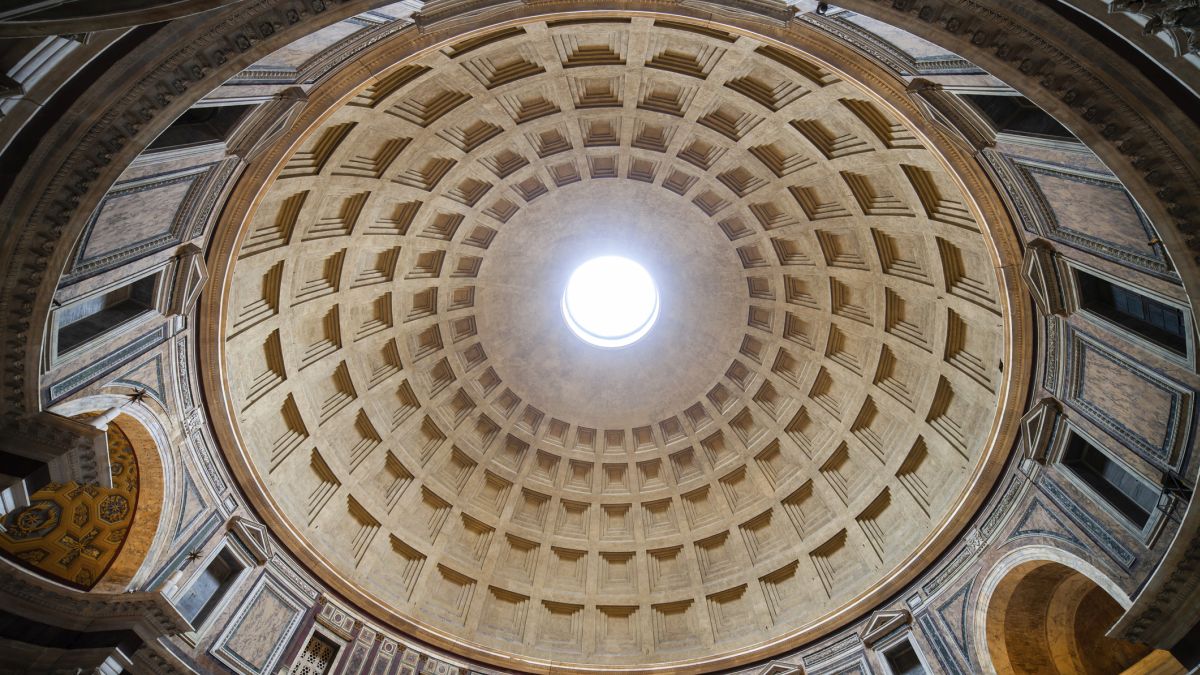
This site featured meticulously arranged stockpiles of construction materials, including the very components utilized to formulate the renowned, enduring concrete found in iconic structures like the Pantheon, whose immense dome, constructed without reinforcement, has defied the ages.
Recent advanced analysis indicates that the key lies in a method referred to by materials scientist Admir Masic of the Massachusetts Institute of Technology (MIT) as “hot-mixing.”
This technique involves the direct amalgamation of the concrete’s constituent parts: a volcanic ash composite known as pozzolan, combined with quicklime. Upon contact with water, this combination initiates a chemical reaction that generates substantial heat within the mixture.
“The advantages conferred by hot mixing are twofold,” Masic explained in 2023, following his experimental revelation of this process.
“Firstly, elevating the concrete’s temperature to elevated levels facilitates chemical interactions that are unachievable when employing solely slaked lime, thereby yielding high-temperature-specific compounds that would otherwise not materialize. Secondly, this augmented thermal state significantly expedites the curing and setting durations, as all reactions are accelerated, permitting considerably swifter construction.”
A third, and arguably most critical, benefit is the inherent self-healing capability imparted to the concrete by the intact fragments, or clasts, of lime dispersed throughout. This characteristic may well be a primary factor enabling the continued existence of ancient Roman edifices while structures from other civilizations have long since succumbed to decay.
When fissures develop in the concrete matrix, they tend to propagate preferentially towards the lime clasts, which possess a greater surface area compared to other aggregate particles. As moisture infiltrates these cracks, it reacts with the lime, precipitating a calcium-rich solution that solidifies into calcium carbonate upon drying, effectively mending the fracture and arresting its further propagation.
“The significance of this material extends from its historical context to its scientific and technological implications for our understanding,” Masic articulates.
“This substance possesses a remarkable capacity for self-repair over millennia; it is reactive and highly dynamic. It has withstood seismic events and volcanic fury. It has endured submersion beneath the sea and resisted degradation from environmental elements.”
While the hot-mixing methodology offered resolutions to the enigmas surrounding Roman concrete, it concurrently presented a new puzzle: the discovered recipe diverged from the instructions for fabricating this building material detailed in the 1st Century BCE treatise De architectura by the renowned architect Vitruvius.
The Vitruvian approach stipulated an initial process of hydrating the lime, known as slaking, before combining the resultant slaked lime with pozzolan. However, this method fails to produce the characteristic lime clasts observed in authentic Roman concrete samples.
This discrepancy has long confounded researchers. Vitruvius’s texts represent the most comprehensive surviving documentation concerning Roman architectural and construction methodologies. He delineates a technique termed opus caementicium for constructing walls, yet physical evidence from ancient structures contradicted his published procedures.
The materials recovered from Pompeii have effectively resolved this long-standing mystery. Masic and his investigative team employed isotopic analysis on five distinct dry material assemblages, identifying pozzolan composed of pumice and lithic ash, quicklime, and, crucially, lime clasts.
Most significantly, these dry components were found to have been pre-mixed – a definitive archaeological indicator.
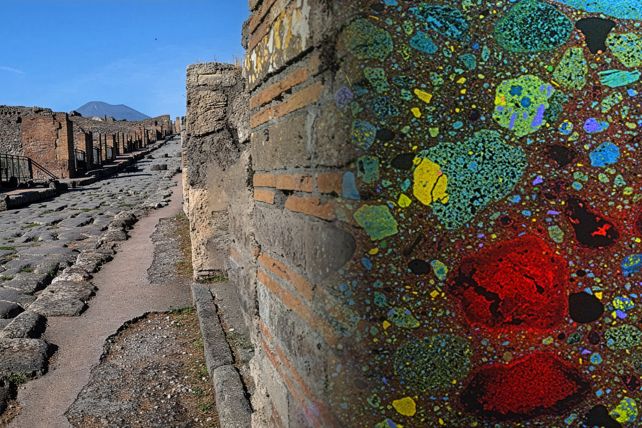
Microscopic examination of mortar samples extracted from the walls revealed unequivocal hallmarks of the hot-mixing process: fractured lime clasts, calcium-rich reaction rinds that integrated with the volcanic ash particles, and minute calcite and aragonite crystals formed within pumice vesicles.
Raman spectroscopy served to corroborate the observed mineral transformations, while isotopic analysis illuminated the chemical progression of carbonation over time.
“Through these stable isotope investigations, we were able to meticulously trace these pivotal carbonation reactions as they unfolded, enabling us to differentiate between hot-mixed lime and the slaked lime initially detailed by Vitruvius,” Masic states.
“These findings demonstrated that the Romans formulated their binder by processing calcined limestone (quicklime), reducing it to a specific particle size, dry-mixing it with volcanic ash, and subsequently introducing water to create a cohesive cementing matrix.”
This revelation does not necessarily invalidate Vitruvius’s account; he may have described an alternative concrete formulation, or his writings might be subject to misinterpretation. Nevertheless, it strongly suggests that the most robust iteration of this material originated from the hot-mixing technique.

The researchers posit that this acquired knowledge holds the potential for integration into contemporary concrete production methodologies, thus honoring the enduring legacy of the Roman Empire, whose monumental structures serve as testaments not only to its grandeur but also to the profound ingenuity of its populace.
Contemporary concrete ranks among the most extensively utilized construction materials globally. Conversely, it exhibits a notable deficiency in durability, frequently succumbing to environmental stresses within mere decades. Furthermore, its production carries a substantial environmental burden, necessitating extensive resource allocation and contributing significantly to greenhouse gas emissions.
An enhancement in concrete’s inherent durability could translate into a considerable improvement in its sustainability profile.
“Our objective is not to replicate Roman concrete verbatim in the present day. Rather, we aim to translate select principles from this repository of knowledge into our modern construction practices,” explains Masic, who has established a venture named DMAT to facilitate this very objective.
“The phenomenon of these pores within volcanic constituents being filled through recrystallization represents an ideal process that we aspire to transpose into our contemporary material science. We envision materials capable of intrinsic regeneration.”