On the terrestrial surface, phosphate minerals, particularly those belonging to the apatite group, typically represent the prevailing forms of phosphorus. Phosphates can originate from phosphides during high-energy occurrences, such as electrical discharges from lightning and meteorite impacts. Groundbreaking research spearheaded by the University of South Florida has revealed that, beyond the formation of metal phosphides, a novel phosphite substance was generated by lightning within a fulgurite collected from New Port Richey, Florida, USA.

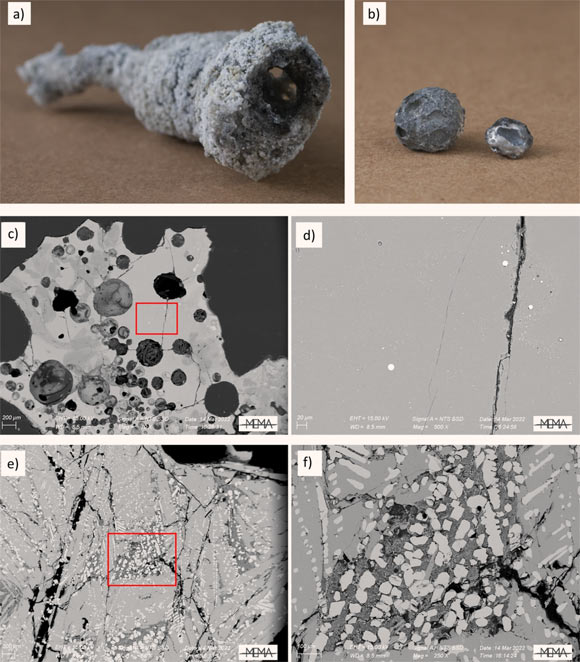
The New Port Richey fulgurite images and microscopy. Image credit: Bindi et al., doi: 10.1038/s43247-023-00736-2.
“When lightning strikes vegetation, the ground in the immediate vicinity typically erupts, and the surrounding flora withers, leaving a scorched area and channeling electrical energy through proximate rock, soil, and sand, thereby generating fulgurites, also recognized as ‘fossilized lightning’,” remarked Professor Matthew Pasek of the University of South Florida, the study’s senior author.
Within the scope of their investigation, Professor Pasek and his collaborators meticulously analyzed a fulgurite discovered in New Port Richey, Florida, United States.
“In environments characterized by high moisture levels, such as those prevalent in Florida, iron frequently accumulates and forms a coating around tree roots,” Professor Pasek explained.
“In this particular instance, the lightning strike not only vaporized the iron present on the tree roots but also combusted the naturally occurring carbon within the tree itself.”
These two elemental components instigated a chemical reaction that culminated in the creation of a fulgurite resembling a metallic ‘globule.’
Encased within the fulgurite, a vibrant, crystalline substance indicated the presence of a material previously undiscovered.
“We have never before encountered this specific material occurring naturally on Earth. While minerals with similar characteristics can be found in meteorites and extraterrestrial contexts, this precise substance has not been observed anywhere on Earth,” Professor Pasek asserted.
Subsequently, the researchers involved in the study endeavored to synthesize the material in a laboratory setting. Their experimental attempts proved unsuccessful, suggesting that the material likely forms rapidly under highly specific conditions, and prolonged exposure to heat causes it to transform into the mineral observed in meteorites.
“Prior research suggests that the reduction of phosphate by lightning was a widespread phenomenon on the primordial Earth,” stated Dr. Tian Feng, a researcher affiliated with the University of South Florida.
“However, Earth currently faces a challenge concerning its phosphite reservoir, making the reconstitution of these solid phosphite materials difficult.”
“Our findings may indicate the plausibility of other forms of reduced minerals and suggest that many of these could have played a significant role in the emergence of life on Earth.”
“Given its scarcity in natural occurrences, it is improbable that this material could be exploited for applications similar to those of other phosphates, such as fertilizers,” Professor Pasek commented.
“Nevertheless, we intend to conduct further investigations into this material to ascertain whether it qualifies for formal mineral designation and to elevate scientific awareness regarding its discovery.”
The study has been formally published in the esteemed journal Communications Earth & Environment.
_____
L. Bindi et al. 2023. Routes to reduction of phosphate by high-energy events. Commun Earth Environ 4, 70; doi: 10.1038/s43247-023-00736-2