In July of 2025, specifically on the 20th and 23rd, NASA’s Psyche spacecraft performed a maneuver to gaze back towards its origin. From a remarkable distance of approximately 290 million kilometers (180 million miles), it successfully acquired imagery of both Earth and its natural satellite, the Moon. The sophisticated twin cameras aboard the spacecraft were instrumental in capturing numerous prolonged exposure photographs of these celestial bodies. As depicted in these images, our planet and the Moon appear as luminous points, shimmering with sunlight that has been reflected, set against a backdrop of stars within the celestial sphere of the constellation Aries.
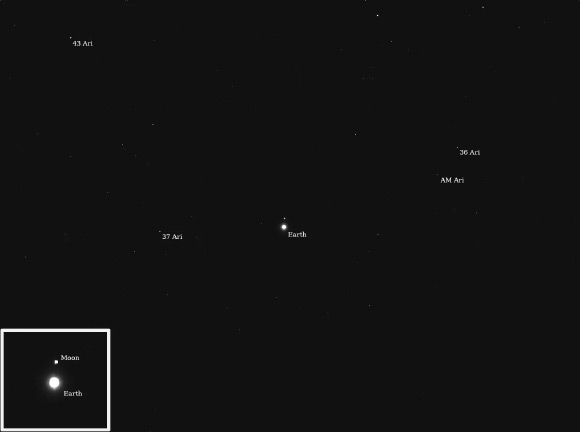
Psyche captured images of Earth and our Moon from about 290 million km (180 million miles) away in July 2025, as it calibrated its imager instrument. Image credit: NASA / JPL-Caltech / ASU.
The primary objective of the Psyche mission, orchestrated by NASA, is to conduct an in-depth investigation of an asteroid characterized by its substantial metallic composition. This asteroid shares the same designation as the mission and is situated within the principal asteroid belt, residing in the orbital plane between Mars and Jupiter.
This pioneering endeavor marks NASA’s inaugural mission dedicated to the study of an asteroid that exhibits a composition richer in metallic elements than in rocky or icy materials.
The Psyche spacecraft embarked on its journey on October 13, 2023, commencing its flight at 10:19 a.m. Eastern Daylight Time. It was propelled into space by a SpaceX Falcon Heavy rocket, launching from the renowned Kennedy Space Center.
By the month of August in the year 2029, the spacecraft is slated to commence its exploration of the asteroid. Scientists hypothesize that due to its exceptionally high metallic content, Psyche may represent a fractured remnant core of a planetesimal—an elemental building block from which early planets coalesced.
“The Psyche multispectral imager instrument is composed of a pair of identical cameras, each outfitted with specialized filters and advanced telescopic lenses. These are designed to capture photographs of the Psyche asteroid’s surface across a spectrum of distinct light wavelengths,” stated members of the mission’s dedicated science team in a formal declaration.
“The distinctive spectral signature, encompassing both coloration and the characteristic fluctuations, of a planetary body can furnish invaluable insights into its fundamental composition.”
“For instance, the Moon and the colossal asteroid Vesta exhibit analogous patterns of undulations and variations within their spectral data, features that researchers might potentially discern when examining Psyche.”
The scientific community harbors a profound interest in the Psyche mission, anticipating that its findings will significantly enhance comprehension of the evolutionary processes involved in the genesis of rocky planets, including Earth, which possess metallic cores at their centers.
When selecting celestial bodies for the meticulous testing and calibration of the imager instrument, researchers prioritize targets that exhibit luminosity through the reflection of solar radiation, mirroring the optical characteristics of the Psyche asteroid itself.
Furthermore, their selection criteria involve identifying celestial objects possessing a spectral profile that is already well-understood. This approach facilitates a robust comparison between pre-existing observational data, gathered via conventional telescopes or prior spacecraft missions, and the new readings obtained by Psyche’s sophisticated instruments.
Earlier in the current year, Psyche was repositioned to direct its optical sensors towards Jupiter and Mars for the purpose of calibration. Both of these planets present a spectral signature that registers as more reddish compared to the predominantly bluer hues characteristic of Earth. This diagnostic phase also proved to be successful.
In order to ascertain any potential shifts in the imager’s performance over time, the research personnel meticulously compare the telemetry data acquired from the various diagnostic operations.
This rigorous comparative analysis ensures that, upon the spacecraft’s eventual successful orbital insertion around the Psyche asteroid, its instrumentation will be confirmed to be functioning precisely as anticipated.
“Following these procedures, we may extend our observations to include Saturn or Vesta, which will further assist in the ongoing validation of our imaging systems,” remarked Dr. Jim Bell, who holds the distinguished position of lead for the Psyche imager instrument at Arizona State University.
“We are essentially compiling a collection of solar system ‘trading cards’ from these diverse celestial bodies, processing them through our calibration workflow to guarantee the accuracy of our collected data.”
The imager was not the sole piece of scientific apparatus to undergo a successful validation process during July of 2025.
The mission’s operational team also subjected the spacecraft’s magnetometer and its gamma-ray and neutron spectrometer to an extensive series of thorough tests, a routine maintenance procedure conducted biannually.
“Our systems are fully operational, and all components are functioning optimally,” stated Dr. Bob Mase, the project manager overseeing the mission at NASA’s Jet Propulsion Laboratory.
“We remain precisely on schedule for our Mars flyby in May of 2026 and are diligently completing all tasks outlined for our interplanetary cruise phase.”
“This upcoming flyby represents a pivotal juncture for the spacecraft, during which it will strategically leverage the gravitational influence of the Red Planet as a slingshot maneuver to facilitate its trajectory towards the Psyche asteroid.”
“This maneuver will signify the initial leg of Psyche’s meticulously planned two-stage orbital trajectory around the Solar System, covering a substantial distance of 1.6 billion kilometers (1 billion miles) since its initial launch from NASA’s Kennedy Space Center in October 2023.”