The spatial geometry of the cosmos is not a common subject of contemplation. However, a recent investigation undertaken by my associates and me indicates that our Universe might possess an asymmetrical or uneven structure, implying a deviation from uniformity in all directions.
Is this a matter of consequence? The prevailing “standard cosmological model,” which delineates the mechanics and configuration of the entire universe, is predicated upon the foundational premise of isotropy—meaning it appears identical from all observational vantage points—and homogeneity when assessed across vast expanses.
Nevertheless, several identified “tensions,” interpreted as discrepancies within observational data, cast doubt upon this concept of a uniform cosmos.
We have recently disseminated a research paper focusing on one of the most significant of these anomalies, designated as the cosmic dipole anomaly. Our findings suggest that this anomaly poses a substantial challenge to the most widely embraced depiction of the Universe, namely the standard cosmological model, also referred to as the Lambda-CDM model.
Let us then explore the nature of the cosmic dipole anomaly and its profound implications for efforts to construct a comprehensive understanding of the universe.
Our exploration commences with the cosmic microwave background (CMB), which represents the residual radiation persisting from the Big Bang event. The CMB exhibits remarkable uniformity across the celestial sphere, deviating by no more than one part in one hundred thousand.
Consequently, cosmologists have developed a high degree of confidence in employing the “maximally symmetric” description of spacetime, as articulated within Einstein’s theory of general relativity, as the framework for their models of the Universe. This vision of a symmetric universe, where conditions are consistent regardless of location or direction, is known as the “FLRW description.”
This symmetrical framework significantly simplifies the resolution of Einstein’s field equations and serves as the bedrock for the Lambda-CDM model.
However, numerous notable anomalies have been identified, including the widely scrutinized Hubble tension. This anomaly is so named in honor of Edwin Hubble, who is credited with the 1929 discovery of the Universe’s expansion.
The divergence in measurements began to surface from disparate data sets in the early 2000s, primarily originating from the Hubble Space Telescope and, more recently, from data acquired by the Gaia satellite. This tension represents a cosmological disagreement, where the calculated rate of the Universe’s expansion based on observations of its early phases does not align with measurements derived from the more proximate (and thus more recent) universe.
While the cosmic dipole anomaly has garnered considerably less attention than the Hubble tension, its implications for our fundamental understanding of the cosmos are arguably even greater.
So, what precisely is this anomaly?
Having established the large-scale symmetry of the cosmic microwave background, subsequent analyses have revealed variations within this remnant Big Bang radiation. Among the most prominent of these is the CMB dipole anisotropy. This phenomenon manifests as the most significant temperature differential in the CMB, with one hemisphere of the sky appearing warmer and the diametrically opposite hemisphere cooler, by approximately one part in a thousand.
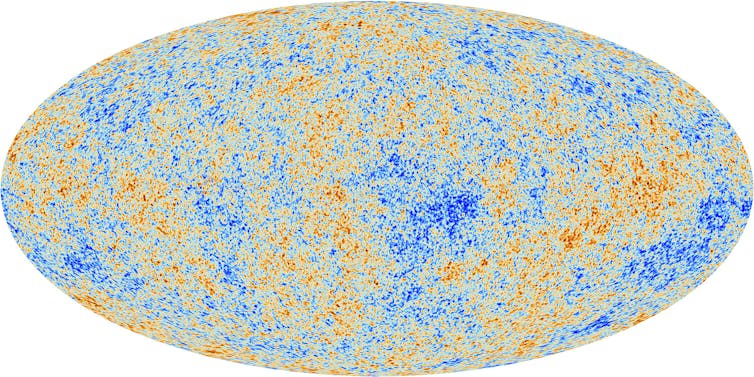
While this particular variation within the CMB does not inherently contradict the Lambda-CDM cosmological model, it necessitates corroborating variations in other astronomical observations.
In 1984, George Ellis and John Baldwin posed the question of whether a similar variation, or “dipole anisotropy,” could be observed in the sky distribution of extremely distant celestial objects, such as radio galaxies and quasars. The requirement for immense distances stems from the potential for nearby objects to generate misleading “clustering dipoles.”
If the “symmetrical universe” premise of the FLRW assumption holds true, then any observed variation in distant astronomical sources should be directly predictable from the measured variation within the CMB. This forms the basis of the Ellis-Baldwin test, named after its originators.
A congruence between the variations observed in the CMB and those found in matter distributions would effectively validate the standard Lambda-CDM model. Conversely, a discordance would directly undermine it, and indeed, the FLRW description itself. Given the high precision required for this specific test, the requisite comprehensive data catalog has only recently become accessible.
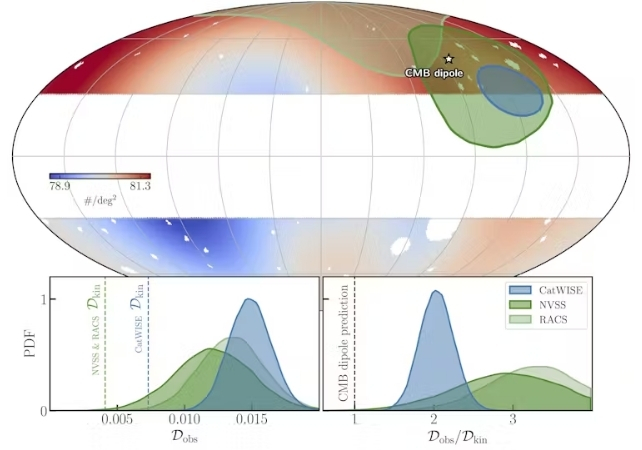
The empirical outcome reveals that the Universe fails the Ellis-Baldwin test. The anisotropy observed in matter distributions is not in agreement with that detected in the CMB.
Given that potential sources of error differ considerably between telescopes and satellites, and across various spectral wavelengths, the consistency of this result, obtained from both terrestrial radio telescopes and satellites operating in the mid-infrared spectrum, is reassuring.
Therefore, the cosmic dipole anomaly has definitively emerged as a significant challenge to the prevailing standard cosmological model, despite a general inclination within the astronomical community to largely disregard it.
This reticence might stem from the absence of a straightforward solution. Addressing this issue necessitates not merely discarding the Lambda-CDM model but abandoning the FLRW description altogether, compelling a return to fundamental principles.
Nevertheless, an anticipated influx of data from upcoming missions, including satellites like Euclid and SPHEREx, and observatories such as the Vera Rubin Observatory and the Square Kilometre Array, is imminent. It is conceivable that we will soon gain profound new insights conducive to the construction of a novel cosmological model, leveraging recent advancements in a specialized branch of artificial intelligence (AI) known as machine learning.
The ramifications of such discoveries would be truly monumental for fundamental physics and our overarching comprehension of the Universe.