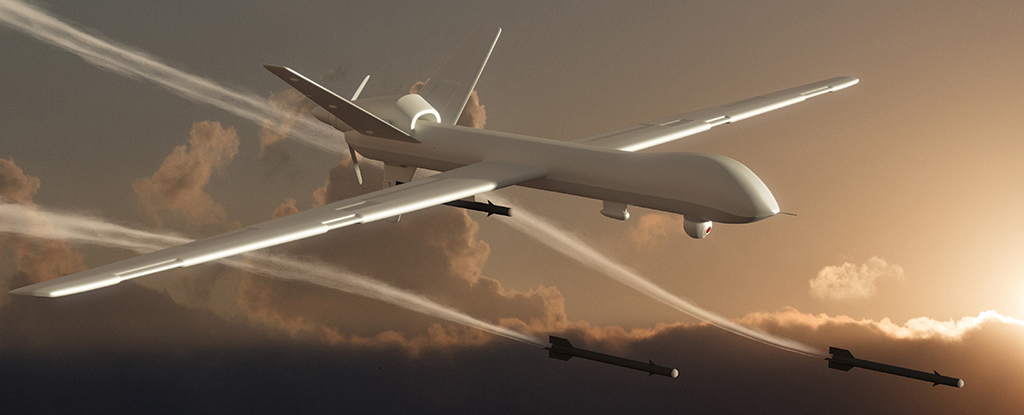
The United States military is poised to integrate thousands of autonomous weapon systems within the upcoming two-year period, a strategic move designed to counteract China’s escalating military influence, as disclosed by US Deputy Secretary of Defense Kathleen Hicks during an address on Monday.
The initiative, designated “Replicator,” intends to foster collaborations with defense contractors and other technology firms to generate substantial quantities of cost-effective systems for all branches of the armed forces.
Military platforms exhibiting varying degrees of independent operational capability have become increasingly prevalent over the past decade.
However, the sheer magnitude and strategic scope of this US declaration unequivocally signify a paradigm shift in the nature of warfare; the era of robotic combatants has officially commenced.
An Evolution Whose Moment Has Arrived
Throughout the preceding decade, considerable advancements have been made in the development of sophisticated robotic systems for military applications. A significant portion of these innovations drew upon the modification of commercially available technologies, which themselves have evolved to become more potent, economical, and widely accessible.
More recently, research and development efforts have pivoted towards optimizing the tactical deployment of these systems in combat scenarios. The ongoing conflict in Ukraine has served as a stark demonstration of the readiness of this technology for real-world engagement.
Expendable aerial munitions, a category of robotic aerial vehicles, have seen extensive deployment in the identification and neutralization of armored vehicles and artillery. Furthermore, Ukrainian naval drones have effectively incapacitated Russia’s Black Sea fleet, compelling their crewed warships to remain confined to port.
The concept of military robots has matured to a point where its implementation is now critically relevant.
Ubiquitous Robotics
In her address, Secretary Hicks articulated a palpable urgency to revolutionize contemporary warfare methodologies. She unequivocally stated, utilizing terminology characteristic of Pentagon discourse, that the newly established Replicator program would endeavor to:
deploy attritable autonomous systems in quantities numbering in the thousands, across multiple operational domains, within the next 18 to 24 months.
To elucidate this statement: “autonomous” signifies a robotic unit capable of executing complex military objectives without requiring direct human control.
“Attritable” denotes that the robot is sufficiently economical to justify being exposed to significant risk, potentially being lost in the course of a high-priority mission. While not strictly designed for single use, such a robot would be reasonably priced, enabling widespread acquisition and the swift replenishment of combat losses.
Finally, “multiple domains” encompasses operations on land, at sea, in the air, and in space. In essence, this signifies the ubiquitous deployment of robots for a diverse array of tactical functions.
The Robotic Imperative
For the United States military, Russia is categorized as an “acute threat,” whereas China is identified as the “pacing challenge” against which its military capabilities are measured.
China’s People’s Liberation Army is perceived to possess a substantial advantage in terms of sheer numbers: it boasts a larger personnel count, a greater number of tanks, vessels, and missiles, among other assets. While the US may possess superior equipment quality, China holds an advantage in quantity.
By rapidly developing thousands of “attritable autonomous systems,” the Replicator initiative is intended to equip the United States with the quantitative superiority deemed essential for prevailing in future large-scale conflicts.
The most prominent hypothetical conflict prompting concern is a potential engagement over Taiwan, which some projections suggest could materialize in the near future. Recent simulation exercises have indicated that vast swarms of robotic assets could prove decisive for the United States in repelling any substantial invasion by China.
However, the Replicator program also adopts a forward-looking perspective, aiming to establish a robust framework for the mass production of robots on a long-term basis. Secretary Hicks has emphasized this point, stating:
We must ensure China’s leadership is confronted daily with the risks of aggression, leading them to conclude that “today is not the day,” and this sentiment should persist not only today but every day, extending through 2027, 2035, 2049, and beyond.
A Transformative Future?
A significant apprehension regarding autonomous systems pertains to their capacity to adhere to the established laws of armed conflict.
Proponents of these systems posit that robots can be meticulously programmed to comply with international regulations and may, in the chaotic environment of combat, exhibit greater adherence to rules than human combatants.
Conversely, skeptics argue that not all potential scenarios can be anticipated, and robots might misinterpret situations, leading to unintended attacks. This perspective holds valid weight.
Among earlier generations of autonomous military systems, the Phalanx close-in weapon system and the Patriot surface-to-air missile have both experienced malfunctions. The Phalanx, employed only once in combat during the 1991 Gulf War, erroneously engaged a chaff decoy cloud instead of intercepting an incoming anti-ship missile. The more recent Patriot system, while effective against ballistic missiles, mistakenly intercepted friendly aircraft on two occasions during the 2003 Gulf War, resulting in the fatalities of their human crews.
While sophisticated design may mitigate such issues in future autonomous systems, Secretary Hicks has pledged a “responsible and ethical approach to AI and autonomous systems,” indicating that any system with lethal capabilities will likely still require formal authorization from a human operator before engaging targets.
A Global Shift in Military Capabilities
Although the United States may be at the vanguard of deploying autonomous systems on a large scale, other nations are expected to follow suit imminently. China, with its considerable expertise in artificial intelligence and extensive capabilities in combat drone manufacturing, is a conspicuous contender.
Furthermore, given that a substantial portion of the technology underpinning autonomous military drones originated from civilian applications, it is readily accessible and comparatively inexpensive. Consequently, autonomous military systems are not exclusively within the purview of major global powers; many middle and smaller states may soon possess them.
Nations such as Libya and Israel have reportedly deployed autonomous weaponry, and Turkish-manufactured drones have played a notable role in the conflict in Ukraine. Australia is another nation actively exploring the potential of autonomous weapon systems. The Australian Defence Force is currently developing the MQ-28 Ghostbat autonomous fast jet, robotic armored personnel carriers, automated logistical vehicles, and unmanned submarines. Additionally, they are already utilizing the Bluebottle robot sailboat for maritime border surveillance in the Timor Sea.
In a move that prefigures the Replicator initiative, the Australian government recently solicited proposals from domestic companies on methods to produce substantial quantities of military aerial drones within the country over the coming years. SYPAQ, an Australian firm, has already commenced operations by dispatching a number of its low-cost, cardboard-constructed drones to reinforce Ukraine’s defensive capabilities.