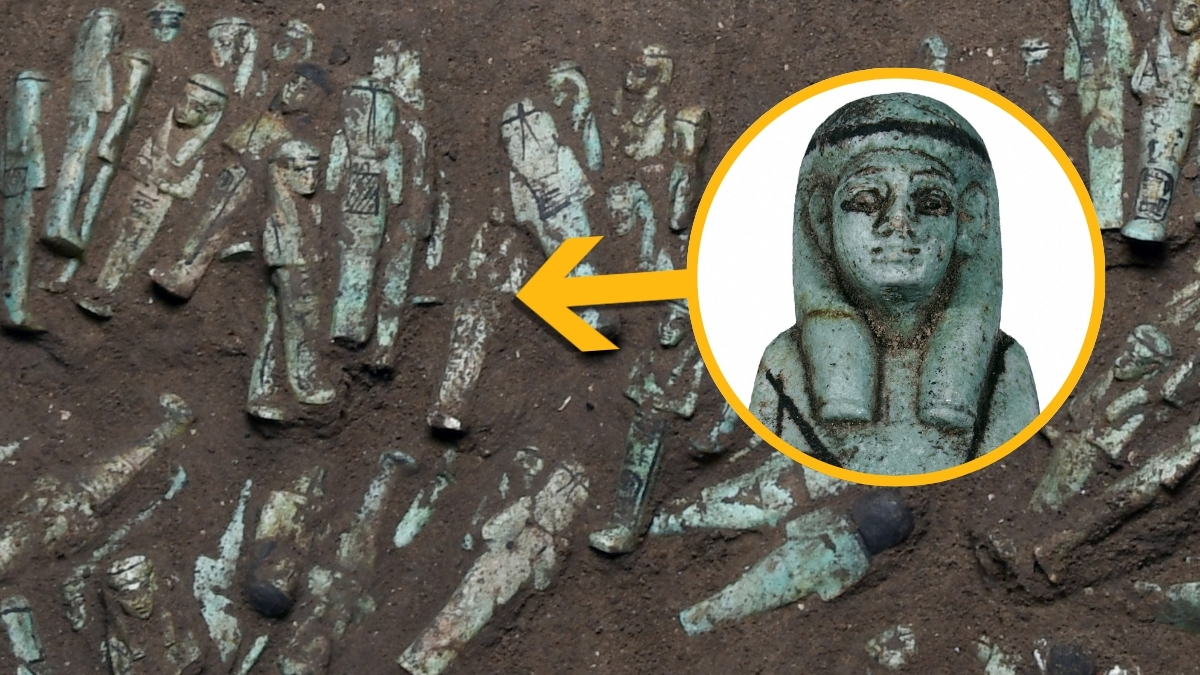
A remarkable compilation of 225 funerary statuettes has been unearthed within an ancient burial chamber located in the historic Egyptian metropolis of Tanis, situated in the Nile Delta region. This significant discovery not only represents a rare find but has also resolved a protracted enigma.
“Instances of figurines being found undisturbed within a royal sepulchre have been absent from the Tanis necropolis since 1946,” stated French egyptologist Frederic Payraudeau to assembled journalists in Paris on Friday.
Such an occurrence has never previously been documented further south in Egypt’s renowned Valley of the Kings, in proximity to present-day Luxor. With the singular exception of the tomb belonging to the celebrated young pharaoh Tutankhamun in 1922, the majority of these archaeological sites have unfortunately suffered extensive plundering throughout history, he elaborated.
Payraudeau, who presides over the French mission conducting excavations at Tanis, indicated that this extraordinary find was made during the early hours of October 9.
The archaeological team had already completed the excavation of the three other corners of a confined tomb that housed an imposing, yet unidentified, sarcophagus.
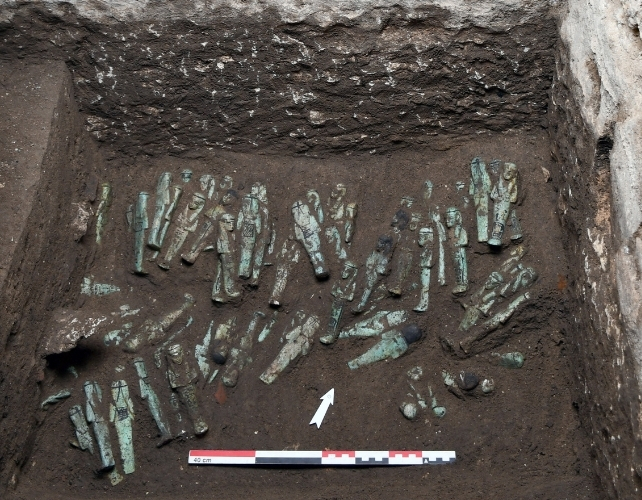
“Upon observing three or four figurines grouped together, we immediately recognized the immense significance of the moment,” Payraudeau remarked.
“I promptly conveyed the news to my colleagues and the accompanying officials. Following this, the situation became rather intense. It was the day preceding the weekend, and our operations typically conclude at 2 PM. Our collective thought was: ‘This cannot be true.'”
Consequently, the team established auxiliary lighting to extend their work into the night.
The meticulous retrieval of all 225 small figurines, fashioned from a green material, required a period of ten days.
According to Payraudeau, they were “precisely positioned in a stellar arrangement around the perimeter of a trapezoidal shaft and in level tiers at its base.”
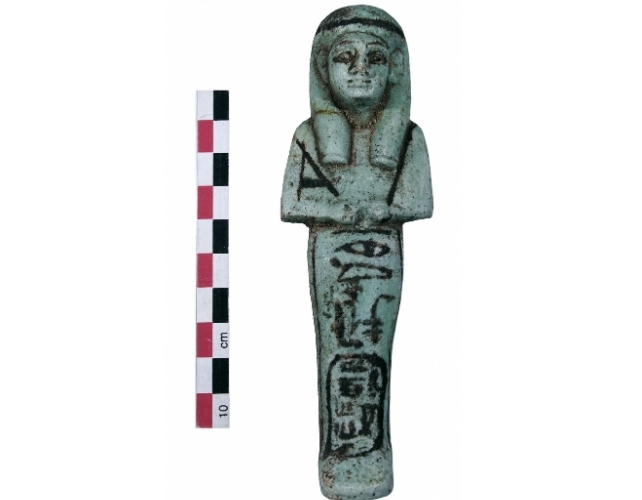
These funerary statuettes, commonly referred to as ushabti, were traditionally conceived as attendants destined to accompany the deceased into the eternal realm.
Payraudeau noted that the preponderance of female figures among the figurines, exceeding half of the total count, is “rather extraordinary.”

Tanis, situated in the Nile Delta, was established circa 1050 BC and served as the administrative center of the Egyptian kingdom during the Twenty-First Dynasty.
During this era, the Valley of the Kings, which had experienced considerable pillaging under rulers such as Ramses, was disused, and the royal burial grounds were relocated to Tanis, as explained by Payraudeau.
A Conundrum Unfolds
The royal insignia present on the recently discovered figurines has effectively resolved a long-standing enigma by definitively identifying the individual interred within the sarcophagus.
The occupant was determined to be Pharaoh Shoshenq III, whose reign extended from 830 to 791 BC.
This revelation is described as “astonishing” given that the walls of a separate tomb at the same location, and its largest sarcophagus, bear his name, Payraudeau commented.
“The pertinent question arises: why is he not interred in this particular sepulchre?” inquired the expert.
“It is an inherent risk for a pharaoh to commission the construction of a tomb, as there is no absolute certainty that their designated successor will ensure their burial there,” he posited.
“It is evident that we now possess further corroboration that these undertakings do not consistently yield the anticipated outcome,” Payraudeau stated with a slight smile.
Pharaoh Shoshenq III’s dominion, which spanned four decades, was characterized by considerable upheaval, exacerbated by a “highly contentious civil conflict between Upper and Lower Egypt, with multiple claimants vying for supremacy,” he remarked.
Therefore, it remains plausible that the royal succession did not proceed as planned, leading to the pharaoh’s interment elsewhere than his intended final resting place.
An alternative hypothesis suggests that his remains may have been relocated at a later juncture, possibly as a consequence of tomb raiding.
However, Payraudeau expressed skepticism, stating, “It is challenging to envision how a granite sarcophagus measuring 3.5 by 1.5 meters could have been repositioned within such a confined space.”
Following a thorough scholarly examination of the figurines, they are slated for public exhibition in an Egyptian museum, Payraudeau concluded.