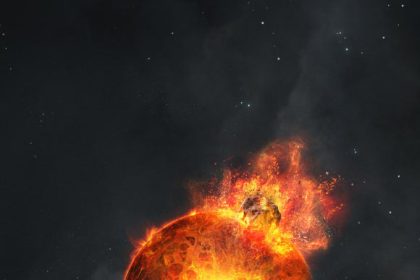
Lonsdaleite, a scarce hexagonal allotrope of diamond unearthed within ureilite meteorites, originated shortly after a celestial event 4.5 billion years ago where an inner solar system dwarf planet experienced a collision with a substantial asteroid.

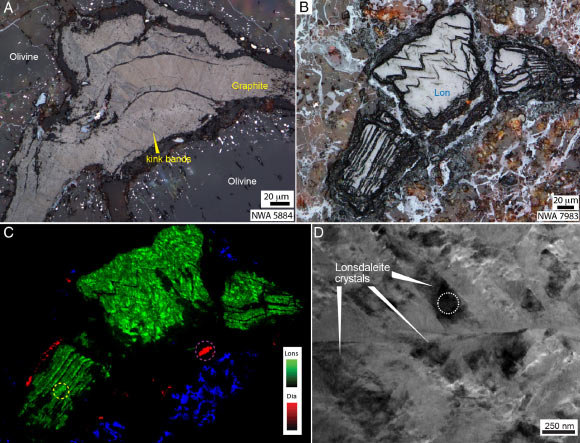
Images of graphite, lonsdaleite, and diamond in ureilite meteorites: (A) reflected light image showing folded crystalline graphite, with fold morphology defined by graphite cleavage; different shading in the graphite is produced by axial planar kink bands; (B) reflected light image (stacked foci) showing an example of the inherited fold morphology preserved in lonsdaleite; (C) cathodoluminescence map of the same area as (B) indicating different phases of carbon, where the green regions are lonsdaleite and the red areas on the periphery (including the purple dashed circle) are cubic diamond (blue is the cathodoluminescence response from olivine); (D) scanning TEM image of a region cut out of the area indicated by yellow circle in (C), highlighting dark lonsdaleite crystals. Image credit: Tomkins et al., doi: 10.1073/pnas.2208814119.
“We had previously theorized that lonsdaleite’s hexagonal atomic arrangement might confer superior hardness compared to conventional diamond, which possesses a cubic structure,” stated RMIT University’s Professor Dougal McCulloch, the study’s senior author.
“Our investigation conclusively validates the natural existence of lonsdaleite.”
“Furthermore, we have identified the largest lonsdaleite crystals documented to date, measuring up to a micron in size—a dimension significantly smaller than a human hair.”
“The distinctive configuration of lonsdaleite could offer insights for developing novel production methodologies for extremely robust materials utilized in mining operations.”
Through the application of sophisticated electron microscopy techniques, Professor McCulloch and his research associates meticulously examined solid, intact fragments derived from ureilite meteorites. This analytical approach enabled them to reconstruct the formation processes of both lonsdaleite and conventional diamond.
“There exists compelling evidence suggesting a novel formation pathway for lonsdaleite and regular diamond, akin to a supercritical chemical vapor deposition process that transpired within these extraterrestrial rocks, likely in the progenitor dwarf planet shortly following a devastating impact,” Professor McCulloch elaborated.
“The process of chemical vapor deposition is presently employed in laboratory settings for synthesizing diamonds, typically involving controlled growth within specialized chambers.”
The researchers posit that the lonsdaleite found within the meteorites coalesced from a supercritical fluid under conditions of elevated temperature and moderate pressure, thereby faithfully preserving the structural integrity and textures of the antecedent graphite.
“Subsequently, the lonsdaleite underwent partial transformation into diamond as the ambient environment cooled and reduced in pressure,” explained Monash University’s Professor Andy Tomkins, the lead author of the research.
“Consequently, nature has presented us with a process that the industrial sector may endeavor to emulate.”
The findings of this investigation have been published in the Proceedings of the National Academy of Sciences and can be accessed via the following link.
_____
Andrew G. Tomkins et al. 2022. Sequential Lonsdaleite to Diamond Formation in Ureilite Meteorites via In Situ Chemical Fluid/Vapor Deposition. PNAS 119 (38): e2208814119; doi: 10.1073/pnas.2208814119