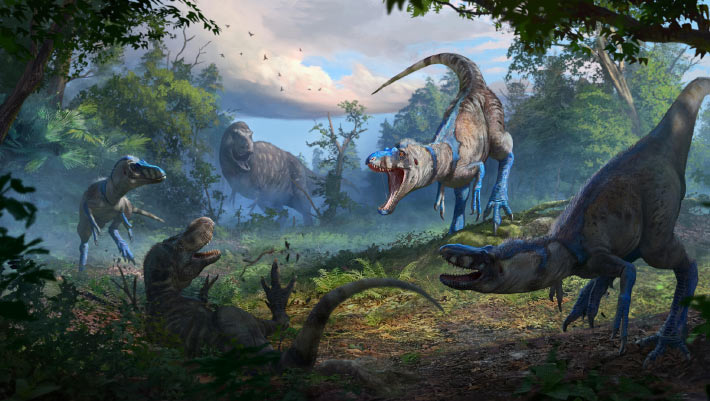
An exceptionally well-preserved, nearly fully-grown tyrannosaur skeleton, unearthed from Montana’s Hell Creek Formation, has undergone rigorous examination by paleontological experts. The scientific findings indicate that this specimen exhibits characteristics consistent with the holotype of Nanotyrannus, thereby substantiating the distinctiveness of this evolutionary lineage from Tyrannosaurus.

A pack of Nanotyrannus brazenly attacks a juvenile Tyrannosaurus rex. Image credit: Anthony Hutchings.
“This remarkable fossil challenges decades of established understanding regarding Tyrannosaurus rex research,” stated Dr. Lindsay Zanno, a distinguished researcher affiliated with North Carolina State University and the North Carolina Museum of Natural Sciences.
Through meticulous analysis of growth rings, vertebral fusion patterns, and developmental anatomy, the research team conclusively determined that the newly studied specimen was approximately 20 years of age and had attained full somatic maturity.
Its distinct skeletal morphology—encompassing disproportionately large forelimbs, a greater number of dentition, a reduced count of caudal vertebrae, and unique cranial nerve pathways—represents traits fixed early in ontogeny and deemed biologically incongruent with those of Tyrannosaurus rex.
“For Nanotyrannus to be classified as a juvenile variant of Tyrannosaurus rex, it would necessitate a fundamental abandonment of all established principles of vertebrate growth. This scenario is not merely improbable; it is scientifically untenable,” asserted Dr. James Napoli, a researcher from Stony Brook University.
For an extended period, paleontologists have relied on fossils attributed to Nanotyrannus as a basis for reconstructing the growth patterns and behavioral ecology of Tyrannosaurus.
The emergent evidence now reveals that these prior investigations were predicated on the assumption of a singular species, when in reality, they were based on two entirely disparate organisms. This discovery further implies the contemporaneous existence of multiple tyrannosaurid lineages within the same ecological niches during the final million years preceding the Cretaceous–Paleogene extinction event.
As an integral part of their comprehensive investigation, Dr. Zanno and Dr. Napoli meticulously scrutinized an extensive collection of over 200 tyrannosaurid fossils.
Their diligent work led to the identification of a particular fossil skeleton, previously interpreted as a subadult Tyrannosaurus rex, exhibiting subtle divergences from the characteristics of the established species, Nanotyrannus lancensis, which is notably associated with the renowned Dueling Dinosaurs specimen.
The authors of the study have put forth the conclusion that this specimen represents a novel species within the Nanotyrannus genus, which they have formally designated as Nanotyrannus lethaeus.
The definitive validation of Nanotyrannus as a distinct taxon carries significant implications, suggesting that the predatory biodiversity present in the terminal epoch of the Cretaceous period was considerably more complex than previously theorized. Moreover, it raises the possibility that other diminutive dinosaur species may also have been misidentified.
“This groundbreaking revelation paints a more nuanced and competitively charged portrait of the twilight years of the dinosaurs,” Dr. Zanno remarked.
“While the imposing stature, formidable bite force, and binocular vision of Tyrannosaurus rex rendered it an apex predator of unparalleled might, its dominance was not absolute.”
“Coexisting alongside it was Nanotyrannus—a more gracile, swift, and agile hunter.”
These pivotal findings are officially published today in the esteemed scientific journal, Nature.
_____
L.E. Zanno & J.G. Napoli. Nanotyrannus and Tyrannosaurus coexisted at the close of the Cretaceous. Nature, published online October 30, 2025; doi: 10.1038/s41586-025-09801-6