New research presented in recent publications within the Monthly Notices of the Royal Astronomical Society and Geophysical Research Letters indicates that Uranus expends approximately 15% more energy than it absorbs from solar radiation.
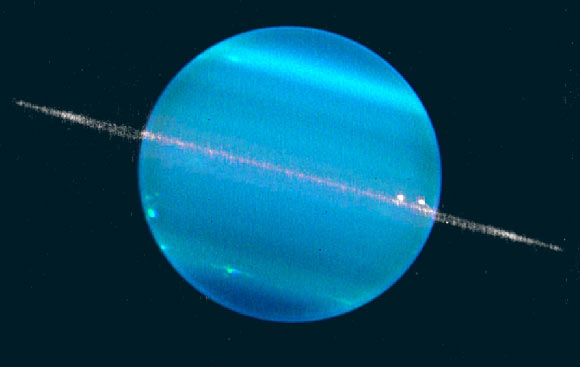
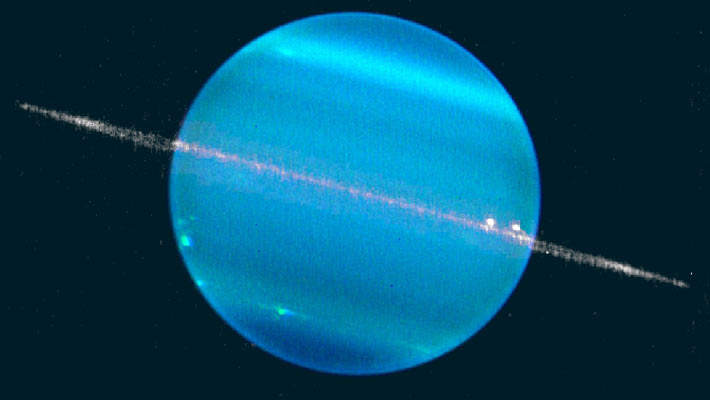
Composite image of Uranus. Image credit: Marcos van Dam / W. M. Keck Observatory.
Uranus presents a unique profile among the celestial bodies in our solar system. Its axial tilt is extreme, positioning its poles to directly face the Sun for consecutive 42-year periods of ‘summer’.
Furthermore, this planet’s rotational movement is retrograde in comparison to all other planets, with the exception of Venus.
Data gathered during the 1986 flyby of Uranus by NASA’s Voyager 2 previously suggested that the planet possessed an unusually low internal temperature, prompting scientists to re-evaluate fundamental models concerning planetary formation and evolutionary processes throughout our solar system.
“Ever since Voyager 2’s passage, the prevailing scientific consensus has been that Uranus lacks internal heat generation,” stated Dr. Amy Simon, a planetary scientist affiliated with NASA’s Goddard Space Flight Center and a co-author of the initial study.
“However, elucidating the reasons behind this apparent deficit, particularly when juxtaposed with other gas giants, has proven exceedingly challenging.”
“These estimations for Uranus’ heat output were derived from a single close-range measurement of the planet’s thermal emissions, as recorded by Voyager 2.”
“The entirety of our understanding rests upon this solitary data point, which contributes to the complexity of the issue.”
Through the application of an advanced computational modeling methodology and a thorough re-examination of historical data, Dr. Simon and her research team have concluded that Uranus does indeed generate internal heat.
A planet’s internal thermal output can be quantified by contrasting the solar energy it absorbs with the energy it radiates back into space as reflected light and thermal emissions.
The other colossal planets within our solar system—Saturn, Jupiter, and Neptune—radiate more energy than they receive, indicating that this surplus heat originates from their interiors, largely a residual effect of the high-energy phenomena that shaped these planets approximately 4.5 billion years ago.
The magnitude of a planet’s radiated heat may serve as an indicator of its age; a lower emission rate relative to absorbed solar heat suggests a more advanced age.
Uranus was an anomaly because it appeared to radiate an amount of heat equivalent to what it absorbed, leading to the inference that it possessed no intrinsic heat source.
This observation presented a scientific quandary. Some theories posited that Uranus might be considerably older than its counterparts and had consequently dissipated all its internal heat.
Alternative hypotheses suggested that a cataclysmic impact—potentially the same event that tilted the planet on its side—expelled all of Uranus’ internal thermal energy.
These speculative explanations, however, failed to satisfy the scientific community, thus motivating a renewed effort to resolve the enigma of Uranus’ thermal state.
“We posed the question, could it truly be that Uranus exhibits no internal heat generation?” remarked Professor Patrick Irwin from the University of Oxford, the principal author of the first research paper.
“Through extensive calculations aimed at quantifying the solar radiation reflected by Uranus, we discerned that its reflectivity is, in fact, higher than previously estimated.”
The investigators embarked on a mission to establish a comprehensive energy balance for Uranus, comparing the solar influx with its albedo and thermal emissivity.
To achieve this, an estimation of the total light scattered from the planet across all directional angles was deemed necessary.
“It is imperative to account for light that is reflected off to the sides, not solely what is returned directly towards the observer,” Dr. Simon elaborated.
To generate the most precise assessment of Uranus’ energy budget to date, the scientists engineered a sophisticated computational model. This model integrated all available knowledge regarding Uranus’ atmosphere, compiled from decades of telescopic observations from both ground-based facilities and orbital platforms, including the NASA/ESA Hubble Space Telescope and NASA’s Infrared Telescope Facility located in Hawai’i.
The model incorporated detailed information pertaining to the planet’s atmospheric hazes, cloud formations, and seasonal variations, all of which influence solar light reflection and thermal energy dissipation.
The research concluded that Uranus discharges approximately 15% more energy than it absorbs from solar radiation, a finding that aligns closely with an estimation presented in the second study.
These collective investigations propose that Uranus does possess an internal heat source, albeit significantly less than its neighboring planet Neptune, which emits more than double the solar energy it receives.
“Our current imperative is to comprehend the implications of this residual internal heat at Uranus, and to obtain more precise measurements of it,” Dr. Simon emphasized.
_____
Patrick G.J. Irwin et al. 2025. The bolometric Bond albedo and energy balance of Uranus. MNRAS 540 (2): 1719-1729; doi: 10.1093/mnras/staf800
Xinyue Wang et al. 2025. Internal Heat Flux and Energy Imbalance of Uranus. Geophysical Research Letters 52 (14): e2025GL115660; doi: 10.1029/2025GL115660