Leveraging the capabilities of the NASA/ESA/CSA James Webb Space Telescope, esteemed astronomers have identified a supernova explosion intrinsically linked to the gamma-ray burst event designated GRB 250314A. This celestial phenomenon occurred at a redshift of 7.3, a period when the cosmos was merely 730 million years old. Previously, the most nascent supernova on record was observed when the Universe had attained an age of 1.8 billion years. The findings, detailing this groundbreaking discovery, have been disseminated through two scholarly articles published in the esteemed journal Astronomy & Astrophysics.
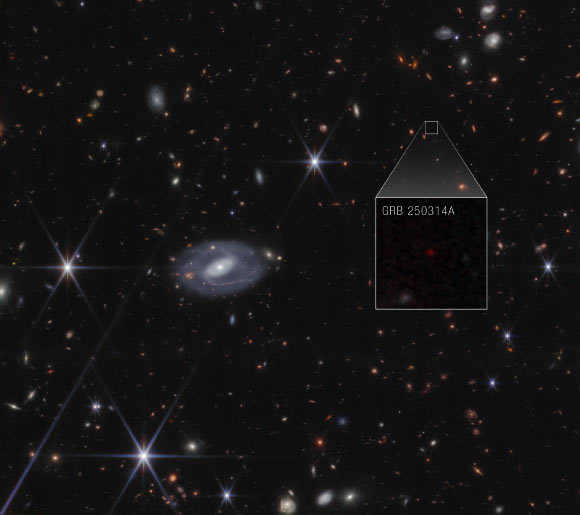
Webb identified the source of a super bright flash of light known as a gamma-ray burst: a supernova that exploded when the Universe was only 730 million years old. Image credit: NASA / ESA / CSA / STScI / A. Levan, IMAPP / A. Pagan, STScI.
“It was only through the advanced instrumentation of Webb that we could definitively ascertain that this emitted light originated from a supernova – the cataclysmic endpoint of a massive star’s life,” remarked Dr. Andrew Levan, a distinguished astronomer affiliated with Radboud University and the University of Warwick, and the principal author of one of the two investigative reports.
“Furthermore, this particular observation convincingly demonstrates our capacity to detect individual stellar events during a time when the Universe was just 5% of its present-day age.”
While gamma-ray bursts typically manifest as transient phenomena, lasting from mere seconds to a few minutes, a supernova undergoes a rapid luminosity increase over several weeks, followed by a gradual decline in brightness.
In stark contrast, the supernova associated with GRB 250314A exhibited a more protracted brightening period, extending over several months.
Due to its occurrence so early in the Universe’s evolutionary timeline, the light emanating from this event has been significantly redshifted as a consequence of cosmic expansion over billions of years.
The stretching of light waves directly correlates with an elongation of the temporal duration over which such cosmic events appear to unfold.
Webb’s observational campaign was strategically timed to commence 3.5 months subsequent to the cessation of the GRB 250314A event, predicated on the anticipation that the underlying supernova would reach its peak luminosity during this interval.
“Webb furnished the swift and highly sensitive follow-up observations that were imperative for our investigation,” stated Dr. Benjamin Schneider, an astronomer at the Laboratoire d’Astrophysique de Marseille.
Gamma-ray bursts are exceedingly rare cosmological occurrences. Those with durations of a few seconds are often attributed to the cataclysmic merger of two neutron stars, or a neutron star and a black hole.
However, extended bursts, such as the one documented here which persisted for approximately 10 seconds, are frequently associated with the explosive demise of exceptionally massive stars.
On March 14, 2025, the SVOM mission, a collaborative astronomical endeavor between France and China launched in 2024 and specifically designed for the detection of ephemeral cosmic events, registered a gamma-ray burst originating from an exceptionally remote source. This detection is detailed in a comprehensive report by B. Cordier et al.
Within a mere ninety minutes, NASA’s Neil Gehrels Swift Observatory successfully triangulated the precise celestial coordinates of the X-ray source. This crucial localization paved the way for subsequent observational efforts that ultimately facilitated the determination of the distance, enabling Webb’s crucial participation.
Eleven hours later, the Nordic Optical Telescope was engaged, and its observations revealed an infrared-light afterglow associated with the gamma-ray burst, providing a salient indicator that the burst might be linked to an extremely distant cosmic entity.
An additional four hours onward, ESO’s Very Large Telescope provided an estimation of the object’s existence, placing it at 730 million years following the Big Bang.
“Across the past half-century, only a scant number of gamma-ray bursts have been detected within the initial billion years of the Universe’s existence,” Dr. Levan articulated.
“This particular event stands out as exceptionally rare and profoundly exciting.”
Given that this represents the earliest and most distant supernova ever detected to date, the research team undertook a comparative analysis with contemporary, nearby supernovae. To their considerable surprise, the two were found to be remarkably similar.
The underlying reasons for this similarity remain largely enigmatic, particularly concerning the formative first billion years of the Universe.
It is theorized that early stellar populations possessed lower abundances of heavy elements, were generally more massive, and consequently experienced shorter lifespans.
Moreover, these stars existed during the Era of Reionization, a period characterized by intergalactic gas that was largely impervious to high-energy electromagnetic radiation.
“Webb’s observations unequivocally demonstrate that this supernova bears a striking resemblance to its modern counterparts,” stated Professor Nial Tanvir from the University of Leicester.
“The data obtained by Webb suggest that this ancient galaxy shares significant characteristics with other galaxies prevalent during the same epoch,” added Dr. Emeric Le Floc’h, an astronomer at the CEA Paris-Saclay.
_____
A.J. Levan et al. 2025. JWST reveals a supernova following a gamma-ray burst at z ≃ 7.3. A&A 704, L8; doi: 10.1051/0004-6361/202556581
B. Cordier et al. 2025. SVOM GRB 250314A at z ≃ 7.3: An exploding star in the era of re-ionization. A&A 704, L7; doi: 10.1051/0004-6361/202556580