Employing sophisticated neutron and X-ray tomography techniques, a collective of planetary scientists from Lund University and affiliated institutions undertook an in-depth examination of a fragment designated Miller Range (MIL) 03346, a nakhlite meteorite originating from the Miller Range in Antarctica.

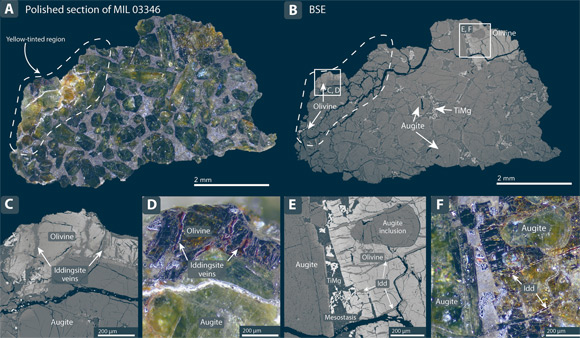
A polished cross-section of the Martian meteorite designated Miller Range (MIL) 03346 is presented: (A) depicts a photographic view of the interior, highlighting a distinct yellowish hue in the leftward portion of the sample, delineated by dashed lines; mineral constituents within this discolored zone exhibit pronounced susceptibility to aqueous alteration. (B) shows a backscattered electron (BSE) image of the identical section; lighter grey olivine crystals, indicated by directional markers, are observed within the affected regions; enclosed rectangular areas denote the positions for magnified depictions in subfigures (C) through (F). (C) is a BSE image focusing on an olivine crystal in the upper left, corresponding to a boxed area in (B); this crystal is traversed by iddingsite-filled fissures, with augite crystals and a fine-grained matrix (dark grey) containing skeletal titanomagnetite (bright) also visible. (D) offers a photographic perspective of the same upper left olivine crystal as in (C), where the iddingsite veins present a deep crimson coloration. (E) provides a BSE image detailing an olivine crystal in the upper right, revealing fracturing and an intricate network of iddingsite veins predominantly oriented from east to west across the frame. (F) is a photographic depiction of the crystal shown in (E), with the dark red iddingsite veins clearly demarcated. Image attribution: Martell et al., doi: 10.1126/sciadv.abn3044.
Nakhlites represent a class of igneous meteorites originating from Mars, characterized by a significant abundance of pyroxene and olivine minerals.
A pivotal observation within these extraterrestrial rocks is the presence of evidence pointing to pre-terrestrial, Martian, aqueous alteration affecting the olivine grains.
Current scientific consensus suggests that all discovered nakhlites originate from a singular volcanic system, a conclusion drawn from their comparable petrological and geochemical characteristics, as well as a unified ejection age of 11 million years.
The emplacement of these nakhlites is believed to have occurred across a minimum of four distinct magmatic episodes, with documented crystallization ages spanning from 1.42 to 1.32 billion years in the past.
Potential originating locales have been posited to include the extensive volcanic expanses of the Northern Plains, the Tharsis region, the Elysium-Amazonis volcanic plains, and Syrtis Major.
“Given that water plays a pivotal role in the inquiry into whether life ever manifested on Mars, our objective was to ascertain the extent to which the MIL 03346 nakhlite meteorite interacted with water while it was still an integral component of the Martian crust,” stated Josefin Martell, a doctoral candidate at Lund University.
In pursuit of an answer regarding the existence of a substantial hydrothermal system—a geological setting typically conducive to the emergence of life—Martell and her collaborators employed advanced neutron and X-ray tomography methodologies.
X-ray tomography stands as a widely adopted method for non-destructive investigation of an object. Neutron tomography was specifically chosen due to the heightened sensitivity of neutrons to hydrogen atoms.
This sensitivity enables the three-dimensional study of any mineral containing hydrogen, facilitating the precise localization of hydrogen within the meteorite’s structure.
The presence of hydrogen is consistently a subject of keen interest for scientists analyzing Martian materials, primarily because water is an indispensable prerequisite for life as currently understood.
The analytical outcomes indicate that only a relatively modest portion of the sample appears to have undergone interaction with water, suggesting that the observed alteration was likely not the product of a large-scale hydrothermal system.
“A more plausible hypothesis posits that the reaction transpired following the melting of localized deposits of subsurface ice, an event possibly triggered by a meteorite impact approximately 630 million years ago,” Martell elaborated.
“Naturally, this finding does not preclude the possibility of life having existed elsewhere on Mars, nor does it rule out the existence of life at different temporal junctures.”
These groundbreaking discoveries have been published in the esteemed journal Science Advances.
_____
Josefin Martell et al. 2022. The scale of a Martian hydrothermal system explored using combined neutron and X-ray tomography. Science Advances 8 (19); doi: 10.1126/sciadv.abn3044