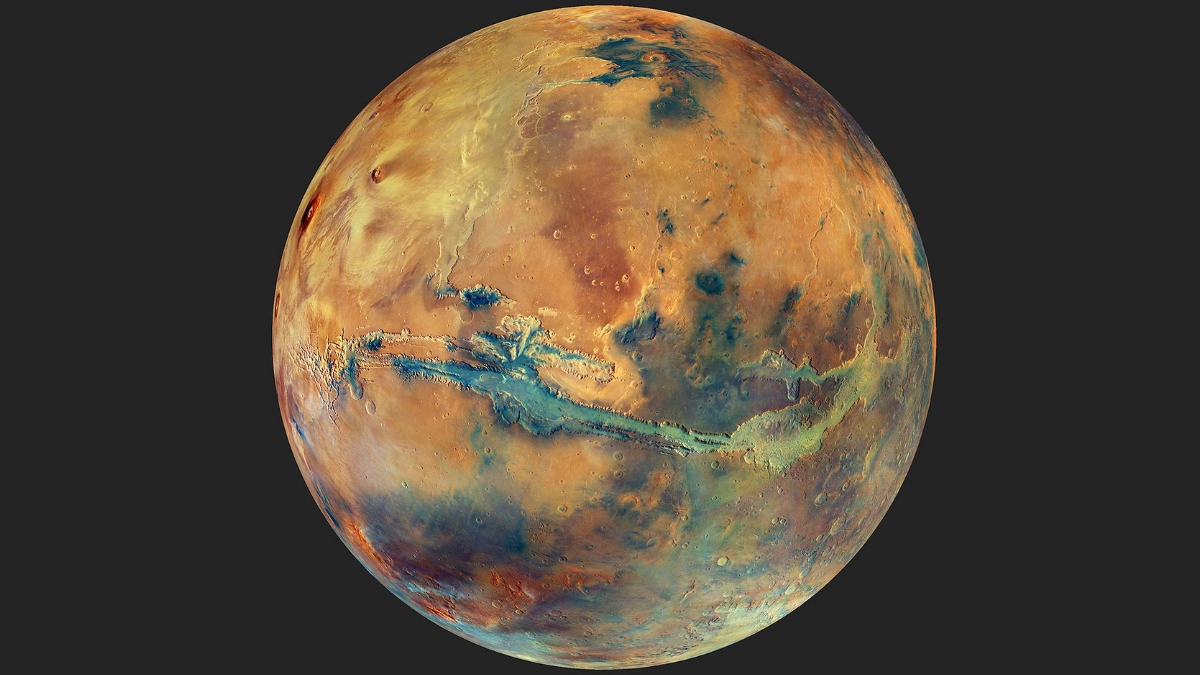
Scientific investigations undertaken by two physicists affiliated with the National Institute of Standards and Technology (NIST) in the United States indicate that atomic clocks situated on the Martian surface operate, on average, at a faster rate by 477 millionths of a second (or 477 microseconds) each day when contrasted with terrestrial timekeepers.
While seemingly insignificant, this temporal discrepancy could assume paramount importance in scenarios demanding the meticulous coordination of time across Earth, its Moon, and Mars, where precision down to the smallest fraction of a second is critical.
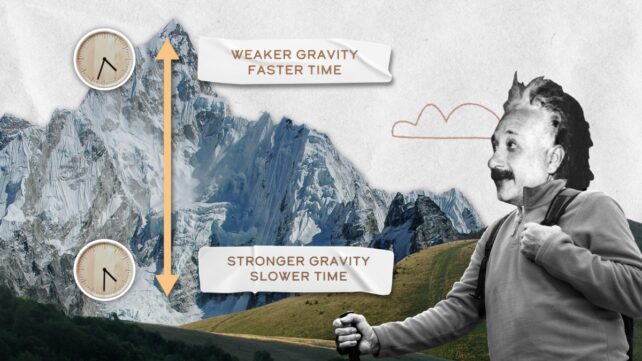
Albert Einstein’s paradigm-shifting theory of general relativity elucidates how mass exerts an influence on the passage of time, a phenomenon known as gravitational time dilation. From the perspective of an external observer, clocks subjected to a predominantly robust gravitational field will exhibit a slower ticking cadence than those operating independently.
Conversely, within a less potent gravitational environment, each ensuing second is compressed and shorter in duration compared to the seconds being meticulously counted by individuals experiencing a more substantial gravitational pull.
As an illustrative instance, atomic clocks deployed on GPS satellites register time at an accelerated pace relative to clocks anchored to Earth’s surface. This is attributable to the subtle variations in gravitational strength experienced in medium-Earth orbit, coupled with the relativistic effects of acceleration impacting time dilation, collectively resulting in a net temporal deviation of 38 microseconds daily.
In the present context, NIST scientists Neil Ashby and Bijunath Patla have successfully formulated a sophisticated and highly accurate temporal tracking methodology tailored for Mars.
These accomplished physicists previously developed and implemented a standard for lunar timekeeping, drawing parallels to Coordinated Universal Time (UTC) on Earth—the globally recognized benchmark for time synchronization. UTC, utilized extensively by astronomical communities and the Deep Space Network (DSN), maintains an impressive accuracy level of approximately 100 picoseconds per day, wherein a picosecond represents one trillionth of a second.
On the lunar surface, time advances 56 microseconds faster than on Earth, a consequence of significant factors such as the Moon’s intrinsic mass and the complex gravitational interactions involving the Sun, Earth, and Moon.
However, the precise measurement of time for Mars presents substantially greater challenges than for its lunar counterpart, as elucidated by Patla: “A problem involving three celestial bodies is inherently extraordinarily complex. Our current endeavor necessitates reckoning with four: the Sun, Earth, the Moon, and indeed, Mars.”
The gravitational acceleration experienced at the Martian surface is considerably weaker than that on Earth, a direct result of Mars possessing approximately one-tenth the mass of our home planet. Leveraging data amassed from various Mars missions, Ashby and Patla have estimated that the surface gravity of Mars is approximately five times less potent than Earth’s.
Furthermore, Mars orbits the Sun at an average distance of roughly 1.5 astronomical units (AU), in contrast to Earth’s 1 AU separation. Given that gravitational attraction diminishes exponentially with distance according to the inverse-square law, Mars is subjected to a less intense gravitational potential originating from the Sun.
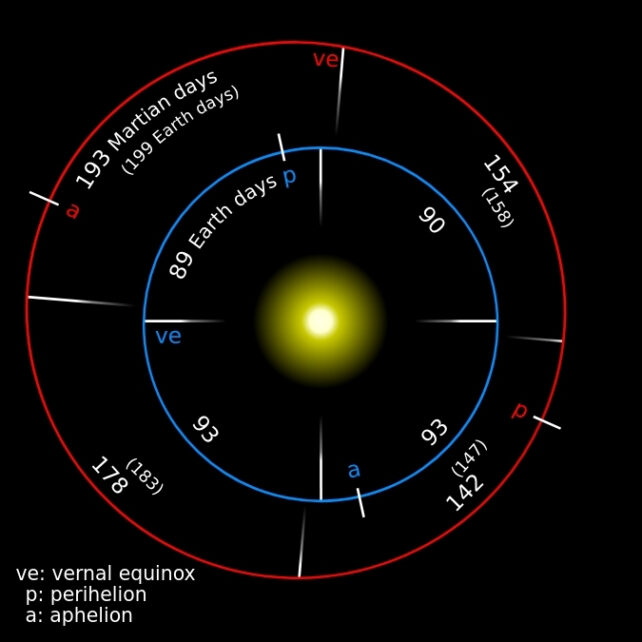
This intricate scenario is further compounded by Mars’s significantly more elliptical orbital path when compared to Earth’s, leading to greater oscillations in its gravitational potential.
Consequently, although Martian clocks tick 477 microseconds faster than Earth’s on average, this differential experiences diurnal fluctuations, escalating or diminishing by as much as 266 microseconds throughout a single Martian year.
The duration of a Martian year also markedly exceeds that of a terrestrial year, as Mars requires 687 Earth days to complete a full revolution around the Sun. The Martian day is similarly elongated, with the red planet necessitating an additional 40 minutes to achieve a complete axial rotation relative to Earth.
The establishment of these highly precise and adaptable temporal frameworks is an absolute prerequisite for the successful execution of forthcoming Martian operations, including the historically significant endeavor of a crewed landing.
“Although it may take decades before the Martian surface is extensively traversed by exploratory rovers, it is beneficial even now to meticulously investigate the complexities associated with formulating navigation systems for extraterrestrial bodies such as other planets and moons,” observes Ashby.
In the interim period, reliable extraterrestrial timekeeping will prove indispensable for supporting vital communication, positioning, and navigation functions for lunar missions currently being planned by both commercial enterprises and governmental space agencies.
Consequently, the development of scalable temporal infrastructure extending beyond the Earth-Moon system, along with the creation of a robust framework for “autonomous interplanetary time synchronization,” emerges as a critical objective. This research, therefore, represents a pivotal advancement in the broader pursuit of space exploration.
Patla underscores the profound implications of these findings: “The timing is opportune for advancing lunar and Martian timekeeping. We are closer than ever to realizing the science fiction aspiration of humanity’s expansion throughout the Solar System.”
This seminal research has been formally published in the esteemed scientific publication, The Astronomical Journal.