
Evidence of a previously unacknowledged human population, genetically divergent from their contemporaries, has been observed for a minimum of 8,000 years within the central Southern Cone of South America, with a particular focus on Argentina.
This region is considered to be among the last geographical areas inhabited by humans during our species’ global migratory expansion. While some of the earliest indications of human occupation in the continent’s most southerly territories date back approximately 14,000 years, this timeline is subject to considerable debate among archaeologists.
Despite this, a remarkably limited number of investigations have examined ancient genetic material from this specific geographical area.
A recent scientific endeavor, spearheaded by Javier Maravall López, a specialist in human evolutionary biology at Harvard University, aims to address this deficiency in our understanding.
“This represents a significant chapter in the continent’s history that has, until now, remained largely unknown,” Maravall López stated.
The research team conducted an analysis of genetic material sourced from 238 ancient individuals residing in the central Southern Cone, whose lifespans collectively spanned a millennium.
This investigation significantly augments the existing repository of ancient DNA samples from this region, multiplying it by more than tenfold. Furthermore, it situates these findings within the broader context of established ancient DNA records extending back 12,000 years, pertaining to Indigenous populations who inhabited the Americas prior to European colonization.
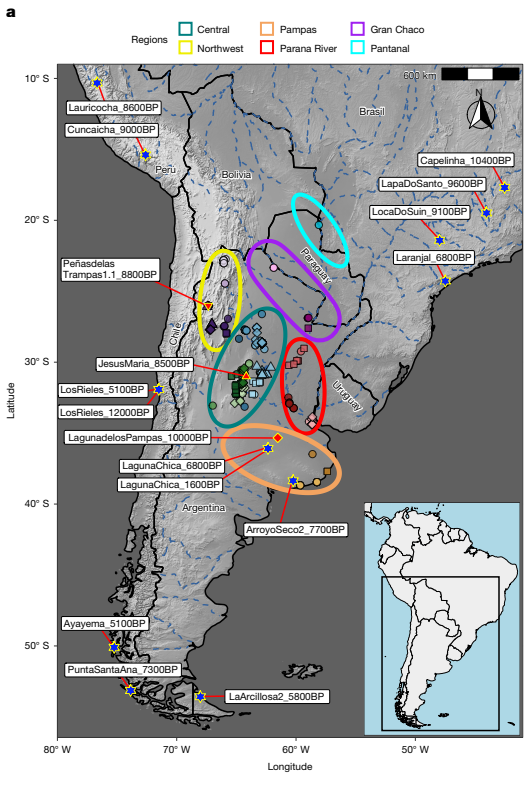
Through this comprehensive analysis, the researchers identified a previously undiscovered human lineage. The earliest known individual belonging to this group lived approximately 8,500 years ago. By roughly 4,600 to 150 years before the present day, the majority of individuals represented in the genetic data belonged to this specific lineage.
Although these individuals from central Argentina coexisted with two other distinct human genetic groups during the Middle Holocene epoch, the genetic evidence reveals a notably limited degree of intermingling between these populations.
Genetic material recovered from an individual unearthed in the Pampas region, who lived around 10,000 years ago, indicated that the inhabitants of this area had already begun to exhibit genetic divergences from other human communities in adjacent parts of South America.
“We have identified a novel lineage, a hitherto unknown group of people, which has persisted as the predominant ancestral component for at least the last 8,000 years, extending to the present era,” Maravall López remarked.
The study’s authors expressed surprise that a region renowned for its extensive linguistic and cultural diversity exhibited such a consistent and homogenous ancestral profile, with minimal evidence of migratory exchange.
“Individuals sharing the same ancestral background, in a manner akin to an archipelago, were concurrently developing distinct cultures and languages while remaining biologically isolated,” explained Maravall López.

The researchers anticipate that this expanded dataset of ancient DNA will, over time, yield further profound insights into the ancient human history of Argentina.
“With substantial sample sizes of ancient DNA, it becomes feasible to investigate questions of paramount interest to many archaeologists – inquiries concerning the precise kinship among individuals at a granular level within archaeological sites, as well as on a regional scale,” stated Harvard geneticist David Reich, the senior author of the publication.
“Leveraging current ancient DNA data technologies, it is now possible to construct sophisticated models of population size fluctuations and migratory patterns, analogous to the detailed representations already available for Europe, and as this study now commences to do for Argentina.
“Such detailed mappings offer a transformative perspective on past human life, unveiling demographic information about antiquity that was previously entirely inaccessible.”