Upon the excavation of minuscule feline skeletal remains in China, exhibiting an antiquity of approximately 5,400 years, initial assessments posited that cats had coexisted with early Chinese agricultural communities since the Neolithic era.
However, a comprehensive new genetic investigation has substantiated prior conjectures: those ancient felines were not typical domestic cats, but rather represented a distinct species.
A collective of evolutionary scientists from Peking University meticulously examined the mitochondrial DNA derived from 22 feline bone fragments sourced from 14 distinct Chinese locales, spanning a historical panorama of 5,400 years. Curiously, the domestication of the *Felis catus* did not become prevalent in China until the seventh century.
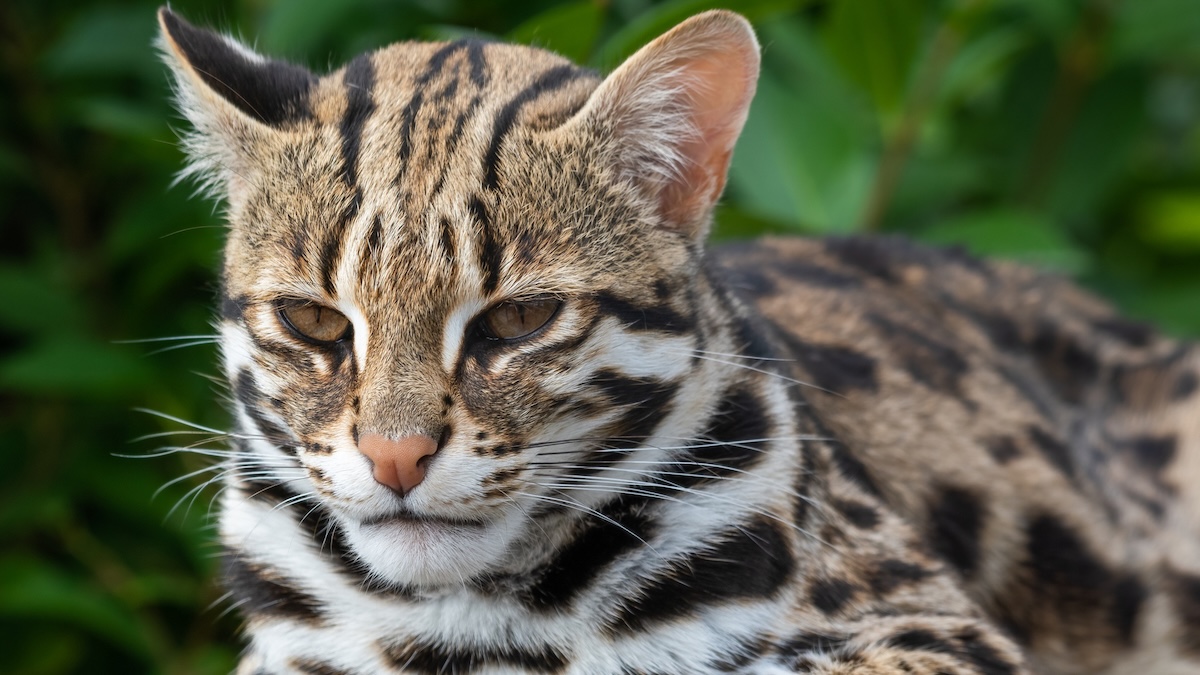
Consequently, the question arises: what cat-like creature shared its existence with Chinese agriculturalists for nearly 4,000 years preceding this period? The research team identified that the older specimens were attributable to the leopard cat (Prionailurus bengalensis), a wild species indigenous to vast regions of South, Southeast, and East Asia, which is not considered a direct progenitor of modern domestic cats.
The genetic data elucidates a fascinating narrative regarding the role of felines in ancient China, aligning concurrently with historical artistic representations and textual records.
It appears that leopard cats may have enjoyed a state of partial domestication in China for extended periods, potentially capitalizing on the abundant sustenance and rudimentary shelter provided by farming settlements, while retaining their freedom to roam. The remnants of these leopard cats, discovered across human habitation sites from that epoch, have been dated between 3400 BCE and 200 CE.
Significantly, no interbreeding was observed between leopard cats and their domestic counterparts. Not only was there an absence of leopard cat genetic markers within the genomes of later domestic cats, but a notable temporal hiatus of several centuries also separated the presence of the two species. The earliest documented remains of domestic cats have been dated to approximately 730 CE.
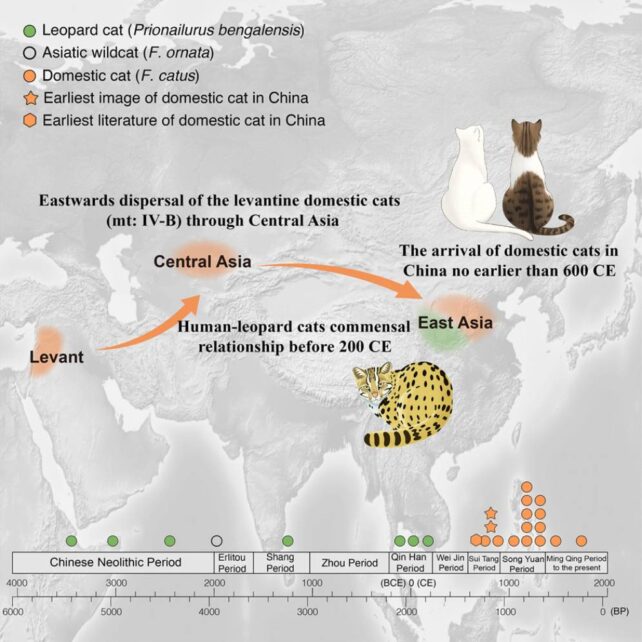
Furthermore, the researchers have posited insights into the likely physical characteristics of this earliest known domestic cat. Through genomic reconstruction, they inferred that it probably possessed short fur and exhibited either a uniform white coloration or was partially white with distinct spots. Its maternal lineage also incorporated genes from the African wildcat, widely regarded as the most probable ancestor of domestic cats.
Artistic and literary depictions from antiquity corroborate the chronological framework established by the genetic evidence. Earlier portrayals of felines in art and written works seem to depict leopard cats, prior to a discernible transition coinciding with the advent of domestic cats.
“The most ancient written testimonies featuring a clear depiction of domestic cats also align with this timeframe, including a narrative from the Tang Dynasty where the Empress bestows a pet cat upon her retinue,” the researchers state in their published findings.
“These historical accounts suggest that domestic cats were esteemed as exotic companions and were likely favored by the ancient Chinese aristocracy, underscoring their relatively recent introduction to the region.”
The temporal alignment suggests that domestic cats were introduced to China through the historical Silk Road trade network, according to the research team. Upon their arrival, they assumed the ecological role previously occupied by leopard cats within these human communities, a role that had diminished centuries earlier, potentially due to a period of significant upheaval between ruling dynasties.
“The introduction of domestic cats might have impeded the re-establishment of leopard cats in human settlements, given that both species inhabit analogous ecological niches,” the scientists propose.
“Moreover, the expansion of poultry farming in ancient China subsequent to the Han Dynasty could have exacerbated human-leopard cat conflict, owing to their predatory inclination towards fowl, thereby further deterring the leopard cat’s return to anthropogenically influenced environments.”
This represents a compelling episode in the historical trajectory of the languid feline companion often found resting near one’s bedside.
The findings of this research have been published in the esteemed journal Cell Genomics.