Göbekli Tepe, an archaeological locale situated in southern Turkey, is distinguished by numerous Neolithic temple-like constructions, embellished with a profusion of elaborately etched symbolic imagery.

Pillar 43 in Enclosure D, Göbekli Tepe. Image credit: Alistair Coombs.
Göbekli Tepe, translating from Turkish to ‘Potbelly Hill,’ stands as one of the earliest recognized examples of human-engineered megalithic edifices, erected with the express purpose of fulfilling the ritualistic exigencies of its prehistoric creators.
This remarkable monumental architecture was brought into being by nomadic hunter-gatherer societies during the Pre-Pottery Neolithic era, specifically between 9,600 and 8,200 BCE.
The discovery of Göbekli Tepe occurred near the close of the preceding century, nestled within the elevated terrain overlooking the Harran Plain.
Its geographic placement is between the upper tributaries of the Euphrates and Tigris rivers, approximately 12 kilometers northeast of the contemporary urban center of Şanliurfa, formerly known as Urfa, a locale often cited as the birthplace of the Biblical figure Abraham.
The ongoing excavations at Göbekli Tepe, which commenced in 1994, have brought to light four substantial sub-circular formations and a multitude of other rectangular structures, generally of a more modest scale.
Each circular enclosure is characterized by a foundational wall constructed from rough stone, interspersed with megalithic T-shaped pillars. These surround a central pairing of more imposing T-shaped pillars, typically anchored within stone sockets.
While initial archaeological assessments posited Göbekli Tepe solely as a sacred site, subsequent investigations have indicated its potential function as a settlement, with the rectangular edifices now believed to have served as dwellings.
Although the grand enclosures continue to be regarded as ‘special’ structures, scholarly discourse remains divided regarding whether they served a distinct cultic function or were the principal residences of prominent families.
Within this ongoing debate, a point of contention is whether these colossal pillars might symbolize deities or, perhaps, venerated ancestral figures.
Regardless of their precise purpose, it is generally inferred that these expansive enclosures were roofed, though definitive corroborating evidence remains elusive.

Monumental round-oval buildings with their characteristic T-shaped monolithic pillars at Göbekli Tepe, Turkey. Image credit: Nico Becker, Göbekli Tepe Archive, German Archaeological Institute.
“Enclosure D, the most extensive complete enclosure unearthed to date, measuring 30 meters (98 feet) in diameter, yielded the earliest radiocarbon dating for the locale at 9530 BCE,” stated Martin Sweatman, an archaeologist from the University of Edinburgh and author of a research paper published in the journal Time and Mind.
“This temporal marker closely aligns with the conclusion of the Younger Dryas period, situated at the Epipaleolithic-Neolithic transition, a time when the climate of the Northern Hemisphere experienced a dramatic upward shift following over 1,200 years of near ice-age conditions characteristic of the Younger Dryas.”
“Nonetheless, the exact commencement of human habitation at Göbekli Tepe remains undetermined,” he elaborated.
“Indications from ground-penetrating radar surveys suggest the presence of additional substantial structures located towards the core of the main mound, awaiting excavation.”
“Considering that only a modest portion of the site’s surface has been excavated, with an even smaller area reaching down to bedrock, it is conceivable that the origins of Göbekli Tepe may eventually be traced back closer to the inception of the Younger Dryas, around 10,800 BCE.”
“Indeed, scientific hypotheses have proposed a Paleolithic genesis for the site.”
In a recent analysis of the V-shaped glyphs etched onto the pillars at Göbekli Tepe, Dr. Sweatman posited that each V marking could denote a single day.
This interpretive framework enabled the researcher to ascertain a solar calendar comprising 365 days on one of the pillars, segmented into 12 lunar months supplemented by 11 additional days.
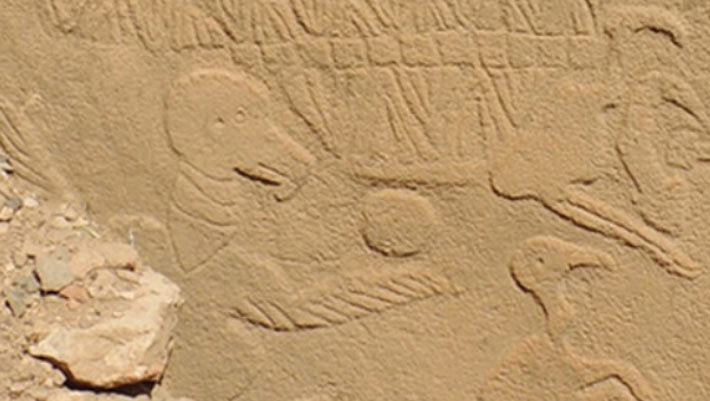
The summer solstice is depicted as a distinct, significant day, represented by a V symbol adorning the neck of a zoomorphic figure, presumed to represent the constellation associated with the summer solstice at that epoch.
Other nearby effigies, potentially representing deities, have also been discovered bearing analogous V-shaped markings around their necks.
Given the representation of both lunar and solar cycles, these carvings could constitute the world’s most ancient known lunisolar calendar, predicated on lunar phases and solar positioning—predating other recognized calendars of this nature by many millennia.

Detail of the center of Pillar 43 at Göbekli Tepe. Image credit: Martin B. Sweatman, doi: 10.1080/1751696X.2024.2373876.
“It is conceivable that ancient peoples fashioned these carvings at Göbekli Tepe as a record of the date when a swarm of comet fragments impacted Earth approximately 13,000 years ago, or 10,850 BCE,” the scientist suggested.
“This conjectured comet impact is believed to have precipitated a period of intense cold, a mini ice age, that persisted for over 1,200 years and led to the extinction of numerous large animal species.”
“Furthermore, it may have instigated profound shifts in human lifestyles and agricultural practices, phenomena often linked to the emergence of civilization in the Fertile Crescent of Western Asia shortly thereafter.”
An additional pillar at the site appears to depict the Taurid meteor stream—regarded as the origin of the comet fragments—spanning 27 days and originating from the celestial directions of Aquarius and Pisces.
This discovery also lends credence to the theory that ancient peoples possessed the capacity to record temporal events using the principle of precession—the subtle wobble in Earth’s axial tilt that influences the apparent movement of constellations across the night sky—at least 10,000 years prior to its documented observation by Hipparchus of ancient Greece in 150 BCE.
The etched imagery seems to have maintained profound significance for the inhabitants of Göbekli Tepe across the millennia, suggesting that the impact event may have catalyzed the development of a new religious doctrine or spiritual practice that shaped the trajectory of civilization.
This finding further substantiates a hypothesis proposing that Earth is subject to recurrent comet impacts as its orbit intersects the path of circling comet debris, phenomena typically perceived by us as meteor showers.
“It appears the inhabitants of Göbekli Tepe were assiduous observers of the celestial sphere, a disposition one might expect given that their world had been catastrophically affected by a comet strike,” Dr. Sweatman commented.
“This cataclysmic event may have served as a catalyst for civilization by initiating a novel religious framework and by fostering advancements in agriculture to adapt to the prevailing cold climate.”
“It is possible that their endeavors to document their celestial observations represent the nascent stages of development that eventually led to the creation of written language millennia later.”
_____
Martin B. Sweatman. Representations of calendars and time at Göbekli Tepe and Karahan Tepe support an astronomical interpretation of their symbolism. Time and Mind, published online July 24, 2024; doi: 10.1080/1751696X.2024.2373876