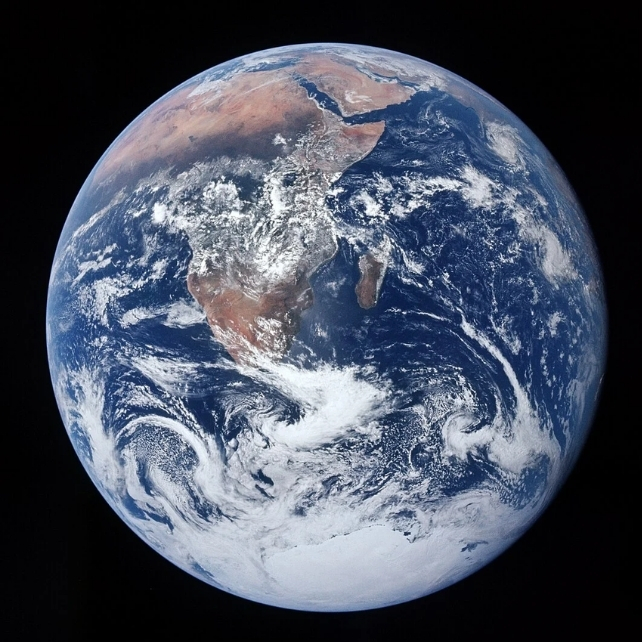
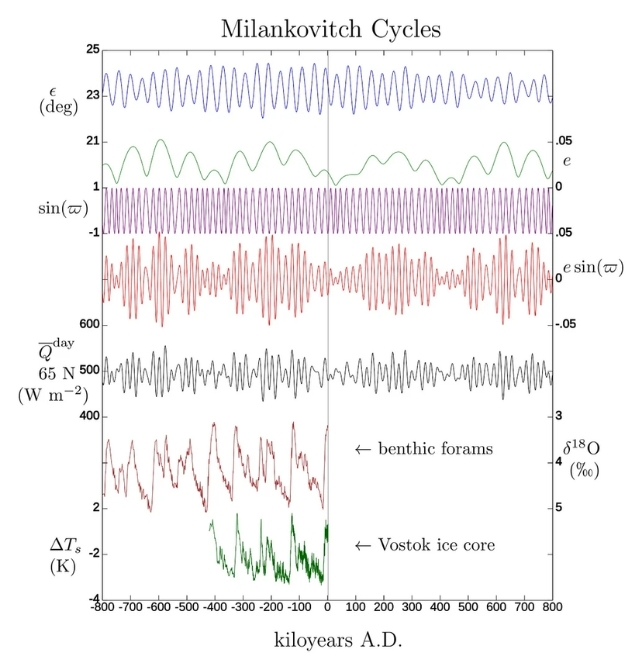
For millennia, Earth’s climate has undergone cyclical transformations between glacial periods and warmer epochs, a phenomenon attributed to subtle shifts in our planet’s orbital trajectory and the inclination of its rotational axis. These orbital fluctuations, termed Milankovitch cycles, arise from Earth’s dynamic interaction within the solar system, rather than existing in isolation.
The gravitational forces exerted by neighboring celestial bodies continuously influence Earth, leading to gradual modifications in its orbital path, axial tilt, and the orientation of its poles.
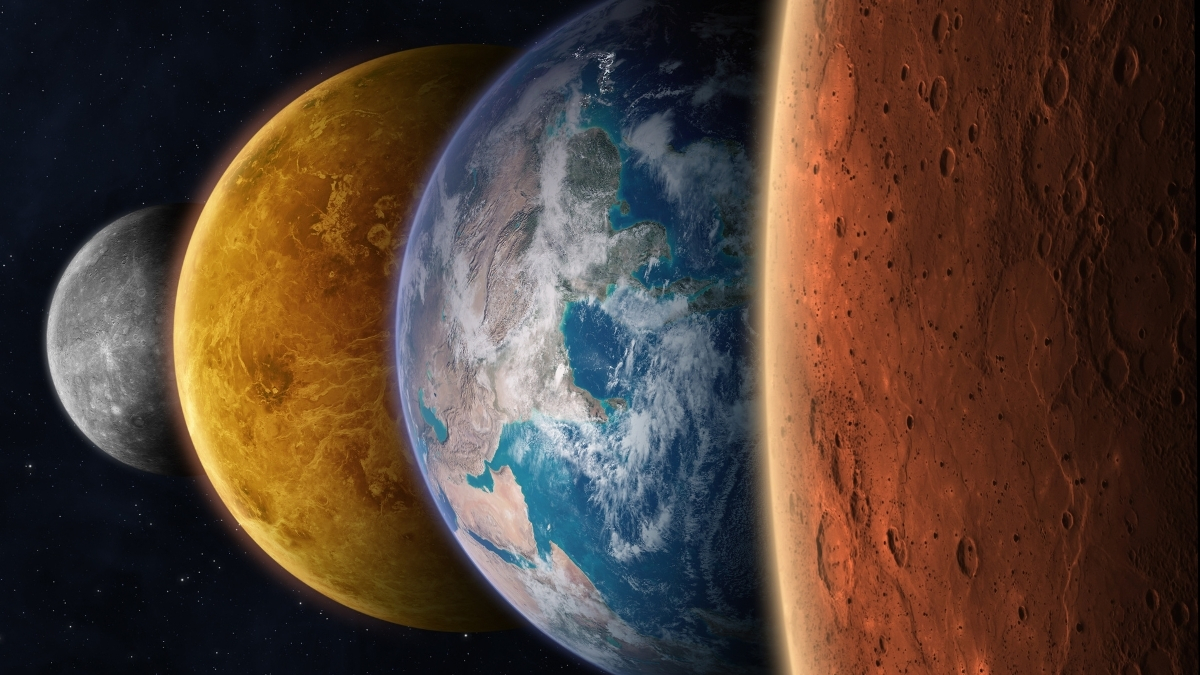
While the significant gravitational influence of Jupiter and Venus on these cycles has been recognized by astronomers for a considerable time, a recent, in-depth investigation highlights that Mars, despite its considerably smaller mass compared to the gas giants, exerts a remarkably potent effect on Earth’s climatic rhythms.
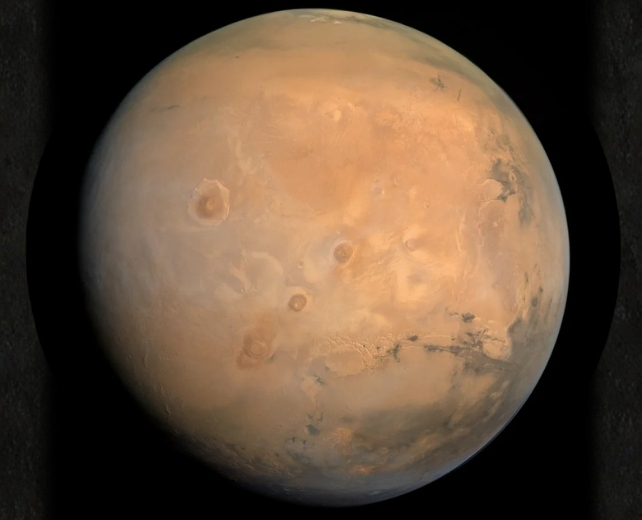
Led by Stephen Kane, a team of researchers conducted sophisticated computer simulations. These simulations involved manipulating the mass of Mars, scaling it from negligible to ten times its current magnitude, to observe the subsequent impact on Earth’s orbital variations over vast timescales. The outcomes of this research firmly establish Mars as a pivotal factor in dictating Earth’s seasonal patterns.
The most enduring characteristic observed across all simulated scenarios was the 405,000-year eccentricity cycle. This cycle, primarily governed by the gravitational interplay between Venus and Jupiter, acts as a consistent “metronome,” maintaining its rhythm irrespective of Mars’s mass and providing a stable underpinning for Earth’s climatic oscillations.

Conversely, the shorter cyclical patterns, approximately 100,000 years in duration, which are instrumental in triggering ice age transitions, are critically dependent on the presence and mass of Mars. As the simulated mass of Mars increases, these cycles become extended and gain greater amplitude, aligning with the enhanced gravitational interplay among the inner planets’ orbital mechanics.
Perhaps most astonishingly, the models reveal that when Mars’s mass is reduced to near zero, a vital climatic mechanism vanishes entirely.
The “grand cycle” of 2.4 million years, responsible for long-term climate fluctuations, owes its existence to Mars possessing sufficient mass to generate the requisite gravitational resonance. This cycle, linked to the gradual rotation of Earth’s and Mars’s orbital paths, influences the quantum of solar radiation that Earth receives over extensive periods.
Furthermore, Earth’s axial tilt, or obliquity, also responds to the gravitational influence originating from Mars. The well-documented 41,000-year obliquity cycle, observable in geological records, undergoes an extension as Mars’s mass is augmented.
Under conditions where Mars is ten times more massive than its current state, this cyclical period shifts to a predominant range of 45,000 to 55,000 years, leading to a profound alteration in the patterns of ice sheet expansion and recession.
This novel scientific revelation also provides valuable insights for evaluating the potential habitability of exoplanets that resemble Earth, by enhancing our understanding of the gravitational contributions from other planets within a stellar system.
A terrestrial planet situated in proximity to a substantial celestial body, arranged in a particular orbital configuration, might encounter climatic variations that either prevent extreme freezing or foster conditions more conducive to life through its seasonal characteristics.
The findings from this research underscore that Earth’s Milankovitch cycles are not solely a consequence of the Earth-Sun relationship. Instead, they are a product of the entire planetary ensemble, with Mars assuming an unexpectedly significant auxiliary role in the sculpting of our climate.
This investigation has been made available on ArXiv.
This content was originally published by Universe Today. For the original publication, please refer to this link.