In the year 2025, scientific findings revealed the identification of elongated hydrocarbon compounds, specifically alkanes, embedded within the primordial mudstones of Mars.
A recent investigation, spearheaded by Alexander Pavlov from NASA’s Goddard Space Flight Center, posits that the estimated initial quantity of these organic molecules, predating their degradation by eons of radiation exposure, is challenging to account for solely through abiotic mechanisms.
This assertion does not unequivocally signify the discovered alkanes as definitive proof of Martian life; the conclusion is predicated on computational models simulating the temporal breakdown of organic matter under radiant bombardment. Nevertheless, this particular revelation underscores the imperative for a more rigorous examination into the genesis of these compounds.
A noteworthy characteristic of the alkanes identified within the Martian regolith is their potential derivation from long-chain fatty acids, molecules that, on Earth, are predominantly, though not exclusively, synthesized by living organisms.
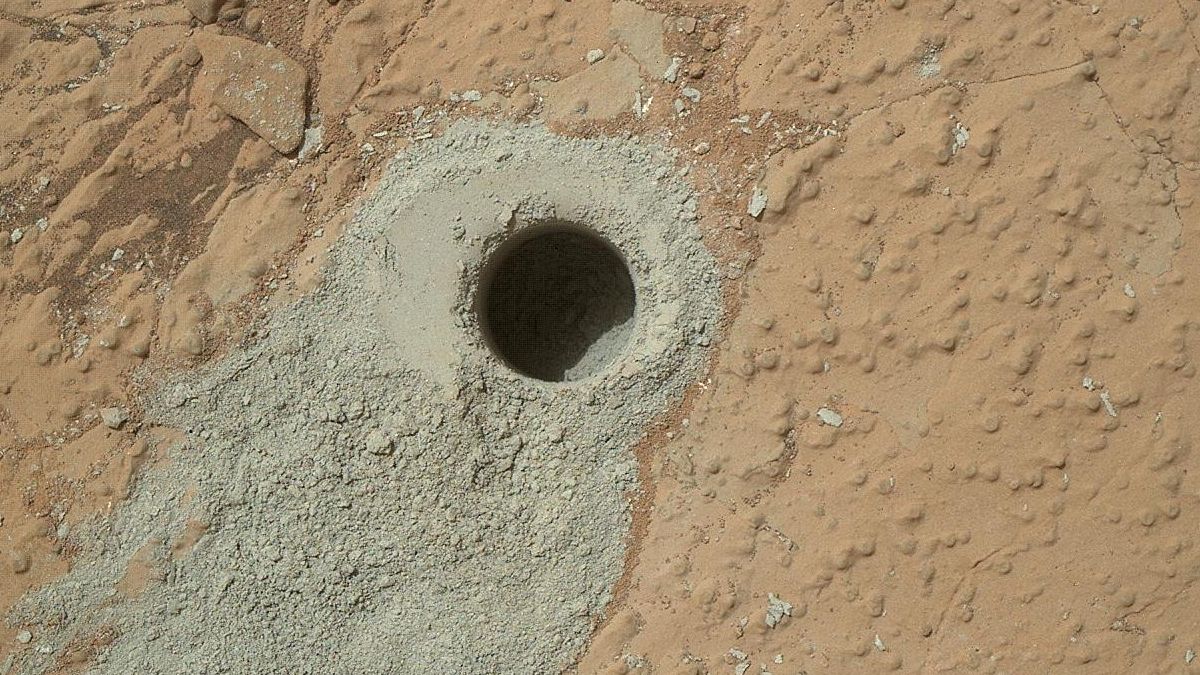
The initial analysis of the Curiosity probe’s sample indicated alkane concentrations in the vicinity of 30 to 50 parts per billion, a level considered relatively modest.
Pavlov and his research consortium formulated two pivotal inquiries: Was the initial concentration of these molecules within the rock stratum substantially higher? If so, what were their potential origins?
The Cumberland mudstone formation has been subjected to the Martian surface environment, enduring approximately 80 million years of unmitigated radiation, a process that would have progressively eroded any organic constituents present in the rock beds.
Leveraging insights from laboratory-based radiolysis experiments, the researchers endeavored to quantify the rate at which radiation deconstructs alkane precursors. This analysis led them to infer a significantly elevated initial concentration, ranging from 120 to 7,700 parts per million (ppm).
Subsequently, the team evaluated the terrestrial and extraterrestrial deposition and synthesis pathways that could have introduced these molecules, encompassing mechanisms such as interplanetary dust transport, meteoritic infall, atmospheric particulate deposition, hydrothermal chemical reactions, and geological processes like serpentinization.
Even when considered collectively, these non-biological processes proved insufficient to account for the hypothesized original abundance of the organic compounds.
“Our methodological approach has enabled us to estimate that, prior to its exposure to ionizing radiation, the Cumberland mudstone conservatively held between 120 and 7,700 ppm of long-chain alkanes and/or fatty acids,” stated the researchers in their peer-reviewed publication.
“We contend that such substantial quantities of long-chain alkanes are incongruent with several established abiotic sources of organic molecules on ancient Mars.”
The scholarly work meticulously emphasizes that its findings do not constitute a conclusive declaration of extraterrestrial life. The possibility remains of hitherto undiscovered abiotic alkane formation pathways on Mars, or of unknown mechanisms governing the interaction of radiation with Martian organic matter. Further scientific inquiry is requisite to resolve these uncertainties.
It is a well-established scientific consensus that Mars harbors a diverse array of organic molecules. The prevailing question now centers on what these findings signify regarding the planet’s past or present habitability.