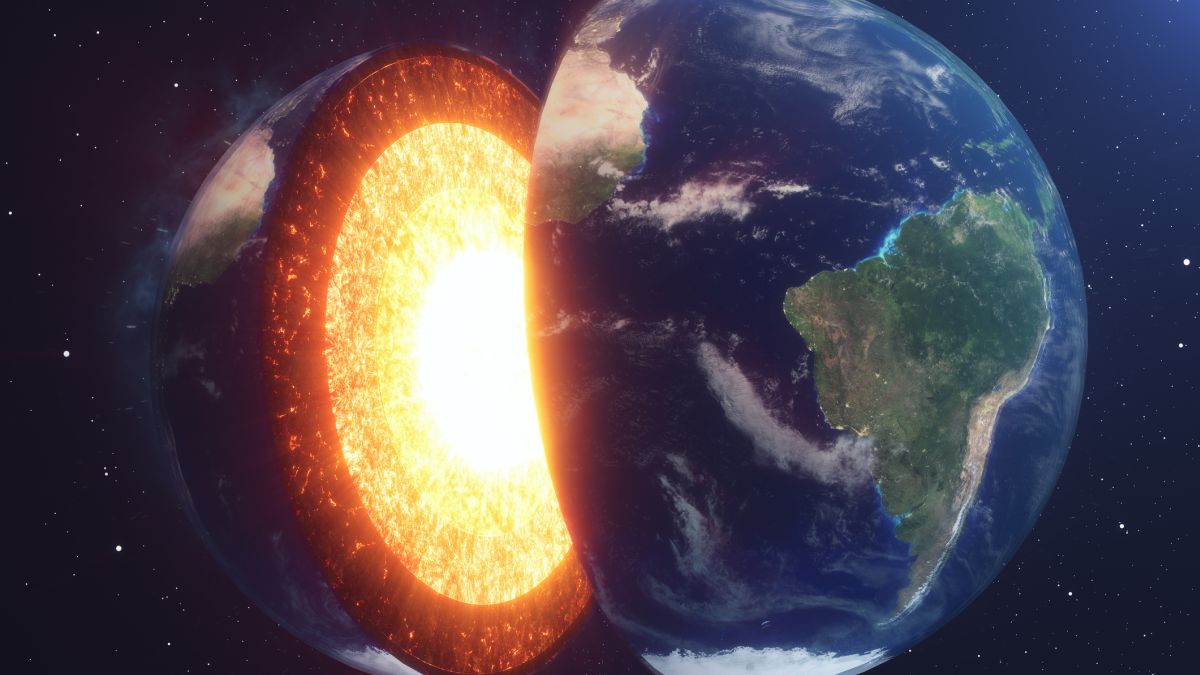
While Earth might not appear to possess a substantial quantity of hydrogen when viewed externally, its presence is undeniable. This most prevalent element in the cosmos is readily observable, chemically bound with oxygen, manifesting as ubiquitous water.
However, recent scientific findings propose that considerable volumes of hydrogen could also be integrated within our planet’s core, associated with the densely compacted iron alloy found at its center.
The magnitude of this potential reservoir? It could potentially hold as much as 45 times the approximately 150 quintillion kilograms of hydrogen currently residing in Earth’s oceans. Such a revelation would position the planet’s core as the most significant repository of hydrogen on Earth.
Naturally, direct access to this subterranean hydrogen is unattainable. Nevertheless, quantifying the hydrogen content within the core provides invaluable insights into Earth’s formative history, the mechanisms driving its geomagnetic field, and the ultimate origin of its water.
In fact, a research group spearheaded by geoscientist Dongyang Huang from Peking University in China has indicated that “Such an amount would necessitate Earth acquiring the majority of its water from the primary stages of terrestrial accretion, rather than through cometary impacts during later addition,” as detailed in their published work.
Given the inherent limitations preventing access to our planet’s core, let alone the extraction of samples, our comprehension of its composition relies on meticulously designed laboratory experiments, computational simulations, and theoretical calculations.
The research undertaken by Huang and his associates represents a particularly rigorous endeavor. Employing a diamond anvil cell, the scientists subjected a minuscule iron sphere, enveloped in a hydrated silicate glass, to pressures reaching 111 gigapascals while simultaneously elevating its temperature to approximately 5,100 kelvins. For context, the lower pressure threshold within Earth’s core is approximately 136 gigapascals, with temperatures ranging between 5,000 and 6,000 kelvins.
Although the experimental pressure falls slightly below that of the actual core environment, its proximity allows for a reasonably accurate replication of elemental behavior under such extreme conditions.
At these elevated temperatures, the sample undergoes complete liquefaction, resulting in a homogeneous solution devoid of any solid constituents. Within this dynamic mixture, the iron, silicon, oxygen, and hydrogen elements exhibit unimpeded mobility, mirroring the anticipated state of Earth’s primordial molten core.
This experimental setup offers the closest possible laboratory approximation to characterizing a core sample, despite the ephemeral nature of the resulting state.
The experimental outcomes demonstrated exceptional miscibility between hydrogen and iron. Subsequently, the hydrogen readily formed bonds with the oxygen and silicon present in the mixture. This process suggests a plausible mechanism for hydrogen sequestration within the core during its formation billions of years ago.
It is established that the core is not composed solely of iron. The manner in which it transmits seismic waves indicates a density that is not entirely uniform, suggesting the presence of other elements. Prior analytical studies have posited that silicon might constitute between 2 and 10 percent of the core’s mass.
Extrapolating from these estimations and the observed hydrogen-silicon bonding dynamics in the anvil experiment, the research team has calculated that hydrogen comprises between 0.07 and 0.36 percent of the core’s total mass.
This translates to an extraordinary quantity, ranging from 9 to 45 times the total amount of hydrogen found in all of Earth’s ocean water, equating to 1.35 to 6.75 sextillion kilograms of this element.
The possibility of Earth’s core harboring significant quantities of hydrogen has been a long-standing hypothesis among scientists, though precise quantification has remained elusive. The current research strongly indicates that while our planet may appear deficient in visible hydrogen, this surface-level abundance could represent merely a fraction of Earth’s comprehensive hydrogen inventory.
A more precise understanding of the hydrogen content within the core is instrumental in reconstructing the origins of Earth’s water and charting its long-term storage and recycling processes over eons. If hydrogen and oxygen can migrate into and out of the core dynamically, then the planet’s water may be far more intrinsically integrated than our surface oceans alone imply.
Furthermore, if this phenomenon proves to be widespread, it could suggest that other terrestrial planets, even those appearing arid from a distance, might also possess substantial concealed water reserves deep beneath their crusts.