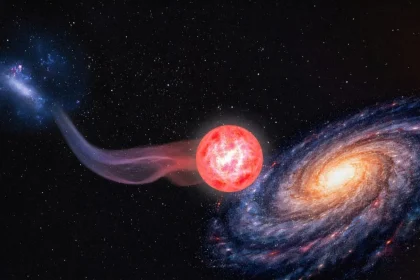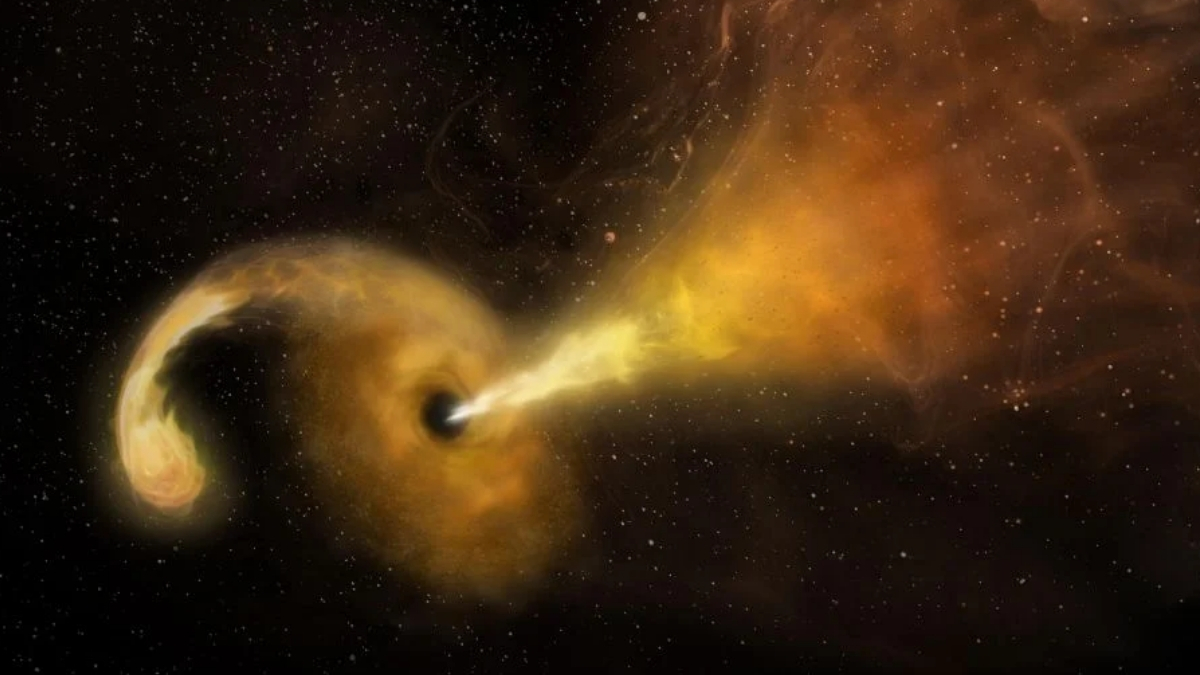
Four years prior, celestial observers documented a colossal supermassive black hole consuming an entire star. The stellar body had strayed too near the SMBH, and its immense gravitational pull precluded any possibility of escape.
This phenomenon, identified as a tidal disruption event (TDE), is now, after a four-year interval, still exhibiting escalating energy output.
The TDE in question is designated AT2018hyz. The “AT” prefix signifies Astronomical Transient, the numerals “2018” denote its initial discovery year, and “hyz” represents a chronological identifier series for that year. While the All Sky Automated Survey for SuperNovae (ASASS-SN) first detected it in 2018, its radio emissions did not manifest and become detectable until 2022.
“We are presenting continuous radio observations of the tidal disruption event (TDE) AT2018hyz, which was first registered in radio frequencies 972 days post-disruption, following numerous unsuccessful attempts during earlier observational campaigns,” the researchers state.
The new observational data gathered by the research team covers the period from approximately 1370 to 2160 days following the disruptive event. The report indicates, “We observe that the light curves persist in their ascent across all measured frequencies throughout this timeframe…”
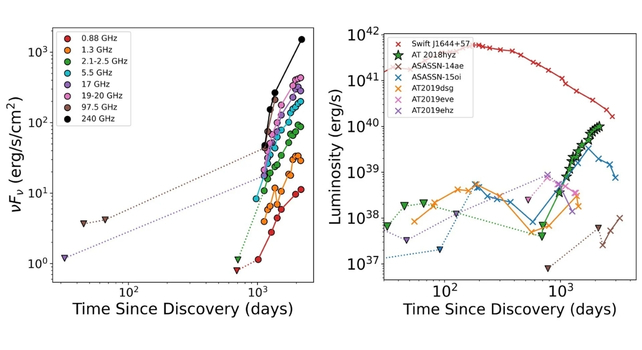
The event was initially observed through optical light modalities in 2018, at which point it registered as just another TDE. Several years thereafter, Cendes re-examined AT2018hyz, discovering a substantial emission of energy in radio wavelengths.
A scientific paper detailing this peculiar TDE was published in 2022. This publication highlighted the burgeoning emissions, positing that “Such a rapid escalation is unexplainable within any plausible framework of an outflow initiated at the moment of disruption, and instead suggests a delayed initiation.”
In their most recent publication, Cendes and her collaborators report a significant surge in the energy radiated by the SMBH during the interim years. Notably, its current brightness is 50 times greater than when it was first identified.
Two principal theoretical models are proposed to account for this escalating radio luminosity. The first is termed a “delayed spherical outflow.”
Under this hypothesis, the outflow commenced approximately 620 days after the disruption. The researchers articulate, “The physical progression of the radius for a spherical outflow supports an outflow that was initiated with a considerable delay of about 1.7 years relative to the detection of optical radiation.”
The alternative hypothesis posits an astrophysical jet, characterized by an highly oblique angle of incidence and traveling at near-light velocities.
“The radio emissions originating from an off-axis jet are diminished in the early stages due to relativistic beaming but subsequently escalate rapidly as the jet decelerates and expands,” the authors elucidate.
Current research indicates that the stream of radio waves emanating from the SMBH is projected to continue its ascent, reaching its zenith around 2027.
“This is genuinely extraordinary,” stated lead author Cendes in a press release. “I would struggle to identify any phenomenon exhibiting such sustained escalation over an extended duration.”
Upon calculating the black hole’s energy output, the researchers encountered a further astonishing revelation. The released energy is approximately equivalent to that generated by a gamma-ray burst (GRB). Given that GRBs represent the most luminous and energy-intensive explosions in the cosmos, this elevates the SMBH to the status of one of the most powerful events ever observed.
For illustrative purposes, the authors drew a parallel to the Death Star from the Star Wars saga. Employing fan-calculated energy output figures for the Death Star, the researchers’ calculations suggest the SMBH is radiating at least one trillion times more energy than a fully operational Death Star, with the potential upper estimate reaching 100 trillion times that of the fictional weapon.
However, these calculations are based on observations from a considerable distance. Only ongoing monitoring efforts can definitively validate their precision.
This discovery prompts a significant inquiry: are other black holes and TDEs within the cosmic expanse also exhibiting comparable rising radiation patterns? The current understanding is that this remains unknown, as such phenomena have not been extensively investigated.
“If an explosion occurs, why would one anticipate observable phenomena years after its occurrence if nothing was detected prior?” Cendes questioned. She further noted the intense competition for observational time on premier astronomical instruments. Now that an SMBH with anomalous luminosity has been identified, their proposals to search for additional instances are likely to carry greater scientific credibility.
It is noteworthy that this is not the sole TDE exhibiting delayed radio emissions; however, its luminosity is exceptionally pronounced in comparison to other known instances.
“We find that AT2018hyz stands out as a unique TDE even within the cohort of TDEs with delayed radio emission, and future observations should enable us to differentiate between these proposed scenarios,” the authors concluded.
Cendes and her research colleagues intend to sustain their observational campaign of AT2018hyz across multiple spectral bands. This sustained observation will facilitate their monitoring of “the ongoing evolution of the outflow and of the circumnuclear medium,” as stated by the authors.
This content was initially disseminated by Universe Today. The original publication is available for review.