Material retrieved from the C-type asteroid (162173) Ryugu by JAXA’s Hayabusa-2 spacecraft has yielded all five fundamental nucleobases that form the building blocks of genetic material — the purines adenine and guanine, alongside the pyrimidines cytosine, thymine, and uracil. This discovery strongly suggests that the foundational chemistry of life may have extraterrestrial origins.
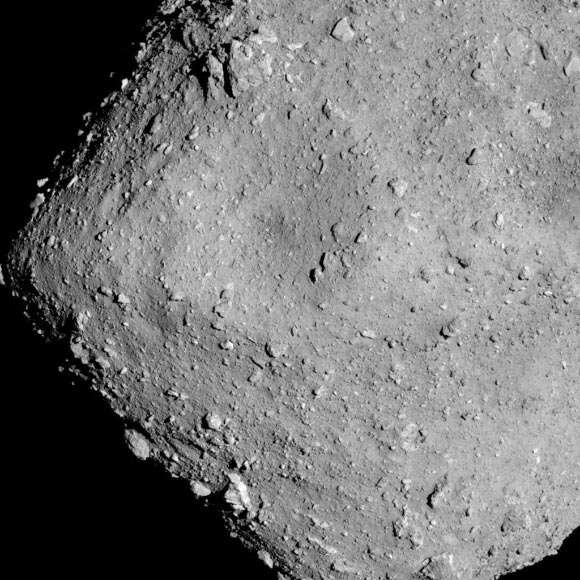
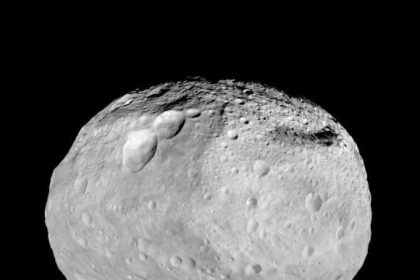
Hayabusa-2 image of the asteroid Ryugu as seen from a distance of 3.7 miles. A particularly large crater is visible near the center of the image. Image credit: JAXA / University of Tokyo / Kochi University / Rikkyo University / Nagoya University / Chiba Institute of Technology / Meiji University / University of Aizu / AIST.
These nucleobases are the essential constituents of deoxyribonucleic acid (DNA) and ribonucleic acid (RNA), the molecular frameworks that support all known life on our planet.
The presence of these compounds in pristine extraterrestrial matter provides a unique opportunity for researchers to investigate their formation mechanisms independent of biological processes and to understand their potential dissemination throughout the solar system.
Previous investigations of samples originating from Ryugu had identified the nucleobase uracil. In contrast, analyses of meteorites and material sourced from the near-Earth asteroid Bennu had revealed a more diverse array of nucleobases.
“For a precise evaluation of nucleobases within extraterrestrial materials, it is imperative to examine samples that have undergone minimal alteration by terrestrial environmental factors,” stated Dr. Toshiki Koga of the Japan Agency for Marine-Earth Science and Technology, along with his collaborators.
“In this regard, samples directly from asteroids, untouched by Earth’s biosphere, possess immense scientific significance.”
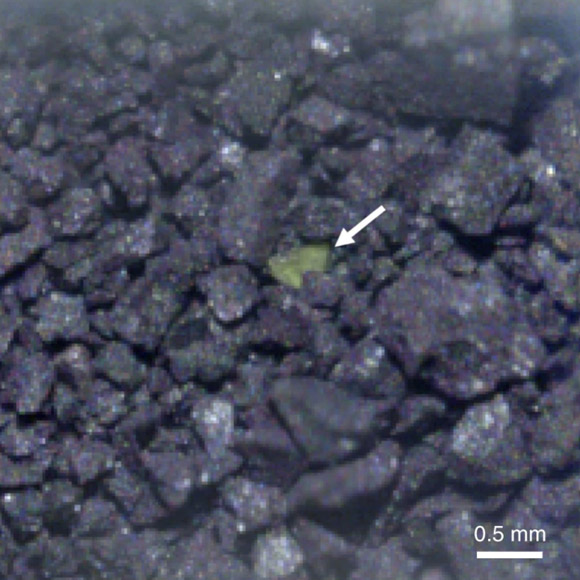
A carbonate-rich grain in the sample of material from the near-Earth asteroid Ryugu. Image credit: Pilorget et al., doi: 10.1038/s41550-021-01549-z.
In the current research, the investigative team meticulously analyzed two distinct samples gathered by the Hayabusa-2 mission from the Ryugu asteroid.
Both samples contained detectable quantities of all five canonical nucleobases: adenine, guanine, cytosine, thymine, and uracil.
These findings were then systematically compared with data derived from the Murchison and Orgueil meteorites, as well as the materials returned from the asteroid Bennu.
A notable divergence was observed in the relative proportions of the detected nucleobases among these extraterrestrial sources.
Specifically, the Ryugu samples displayed roughly equivalent concentrations of purine and pyrimidine nucleobases. Conversely, the Murchison meteorite samples exhibited a higher prevalence of purines, whereas the Bennu and Orgueil samples were found to be enriched in pyrimidines.
These discrepancies are understood to reflect the distinct chemical environments, geological histories, and evolutionary trajectories of their parent celestial bodies.
The consistent identification of these nucleobases within asteroid and meteorite specimens, despite their inherent chemical variations, strongly implies their widespread presence throughout our solar system.
Furthermore, these discoveries lend support to the hypothesis that carbonaceous asteroids may have played a role in augmenting the elemental composition of early Earth with essential organic molecules.
“An in-depth examination of the distribution and isotopic signatures of nucleobases in other carbonaceous meteorites would furnish crucial insights into the origins of these molecular components and the astrochemical processes involving nitrogen-containing compounds,” the researchers elaborated.
“The ubiquitous confirmation of all five canonical nucleobases in samples from the carbonaceous asteroids Ryugu and Bennu underscores the potential contribution of these exogenous molecules to the organic pool that facilitated prebiotic molecular evolution, ultimately paving the way for the emergence of RNA and DNA on primordial Earth.”
This groundbreaking study has been published this week in the esteemed journal Nature Astronomy.
_____
T. Koga et al. A complete set of canonical nucleobases in the carbonaceous asteroid (162173) Ryugu. Nat Astron, published online March 16, 2026; doi: 10.1038/s41550-026-02791-z