Researchers affiliated with the LHCb experiment at CERN’s renowned Large Hadron Collider (LHC) have announced the identification of a novel type of baryon, exhibiting characteristics similar to a proton but considerably more massive. Designated as Ξcc⁺, this subatomic entity incorporates two charm quarks and a single down quark. This composition provides physicists with an uncommon avenue for investigating the fundamental strong nuclear force responsible for the cohesion of matter’s constituent particles.
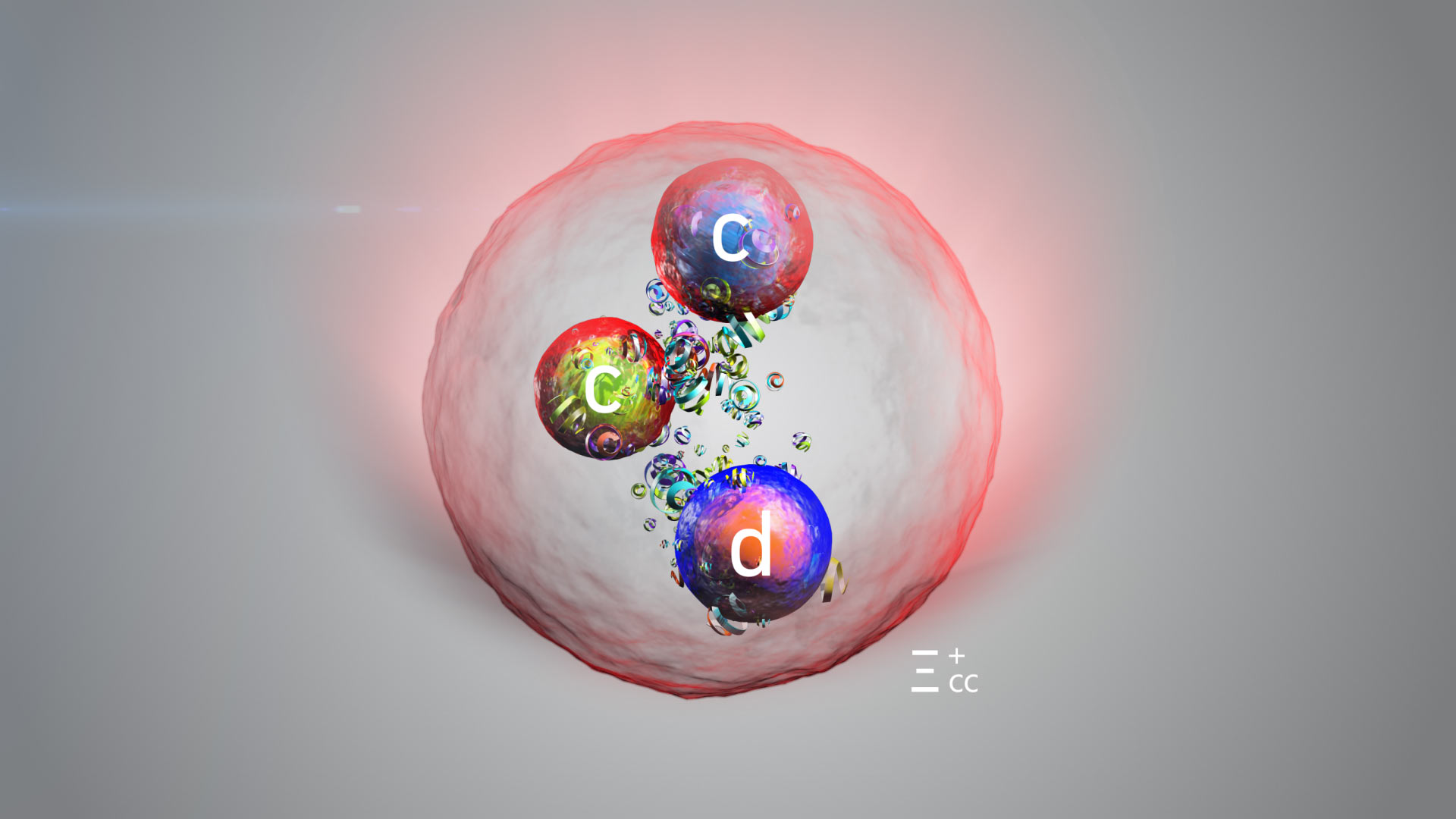
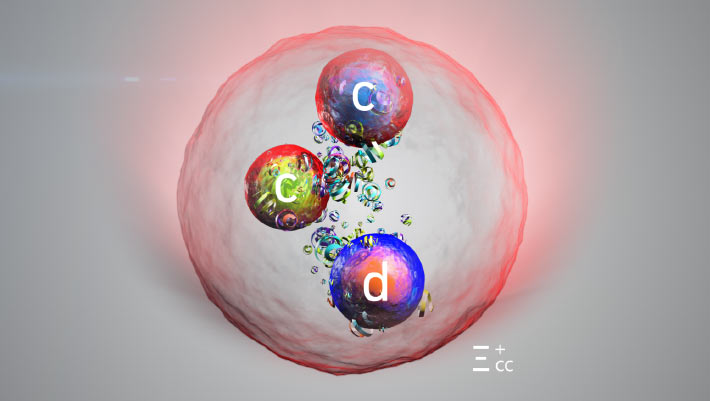
An artist’s impression of the doubly charmed baryon Ξcc⁺, which contains two charm quarks and one down quark. Image credit: CERN.
Quarks represent the elementary constituents of matter, existing in six distinct varieties: up, down, charm, strange, top, and bottom.
These elementary particles commonly aggregate in pairs or triplets to form composite particles known as mesons and baryons. However, in contrast to the perpetually stable proton, the vast majority of hadrons—the encompassing designation for both mesons and baryons—are inherently transient, disintegrating almost instantaneously upon their creation, which poses significant detection challenges.
Their production necessitates the high-energy collision of subatomic particles within sophisticated apparatuses like the LHC.
While these ephemeral hadrons undergo rapid decay, the more enduring particles that emerge from this process can be observed, thereby enabling the inference of the progenitor particle’s characteristics.
The recent discovery of this new particle increases the cumulative count of hadrons identified by LHC experiments to eighty.
“This marks the inaugural detection of a new particle following the comprehensive enhancements to the LHCb detector, which were finalized in 2023. Furthermore, it represents only the second instance where a baryon possessing two heavy quarks has been documented, with the initial observation by LHCb occurring nearly a decade prior,” stated Dr. Vincenzo Vagnoni, spokesperson for LHCb.
“The findings are poised to assist theoretical physicists in validating models of quantum chromodynamics, the established theory governing the strong force that unifies quarks not only into conventional baryons and mesons but also into more unconventional hadron configurations such as tetraquarks and pentaquarks.”
In the year 2017, the LHCb collaboration reported the groundbreaking discovery of a remarkably similar particle, characterized by the presence of two charm quarks and one up quark.
The sole distinction between this previously identified particle and the newly found entity lies in the substitution of the up quark with a down quark.
Notwithstanding their structural similarities, the new particle is theoretically predicted to possess a decay lifetime that is as much as six times shorter than its antecedent, a consequence of intricate quantum mechanical phenomena. This accelerated decay rate renders its observation considerably more arduous.
Through meticulous analysis of data derived from proton-proton collisions captured by the LHCb detector during the third operational phase of the LHC, the research team successfully observed the novel baryon with a statistical confidence level of 7 sigma, a figure substantially exceeding the 5 sigma threshold requisite for confirming a discovery.
“This significant accomplishment serves as a compelling illustration of the indispensable role played by LHCb’s distinctive capabilities in achieving the overarching success of the LHC,” commented Mark Thomson, CERN’s Director-General.
“It underscores precisely how experimental advancements at CERN directly pave the way for novel discoveries, thereby establishing the foundation for the paradigm-shifting scientific endeavors anticipated from the High-Luminosity LHC initiative.”
“These remarkable achievements are attributable solely to the exceptional operational efficiency of CERN’s accelerator infrastructure and the dedicated teams responsible for its seamless functioning, as well as the unwavering commitment of the scientists comprising the LHCb experiment.”