Within the tempestuous waters encircling the southern reaches of Chile, researchers have brought to light what they posit is an uncatalogued member of the Tachyeres genus of steamer ducks, a lineage of exceptionally pugnacious and frequently terrestrial aquatic birds exclusively inhabiting South America.
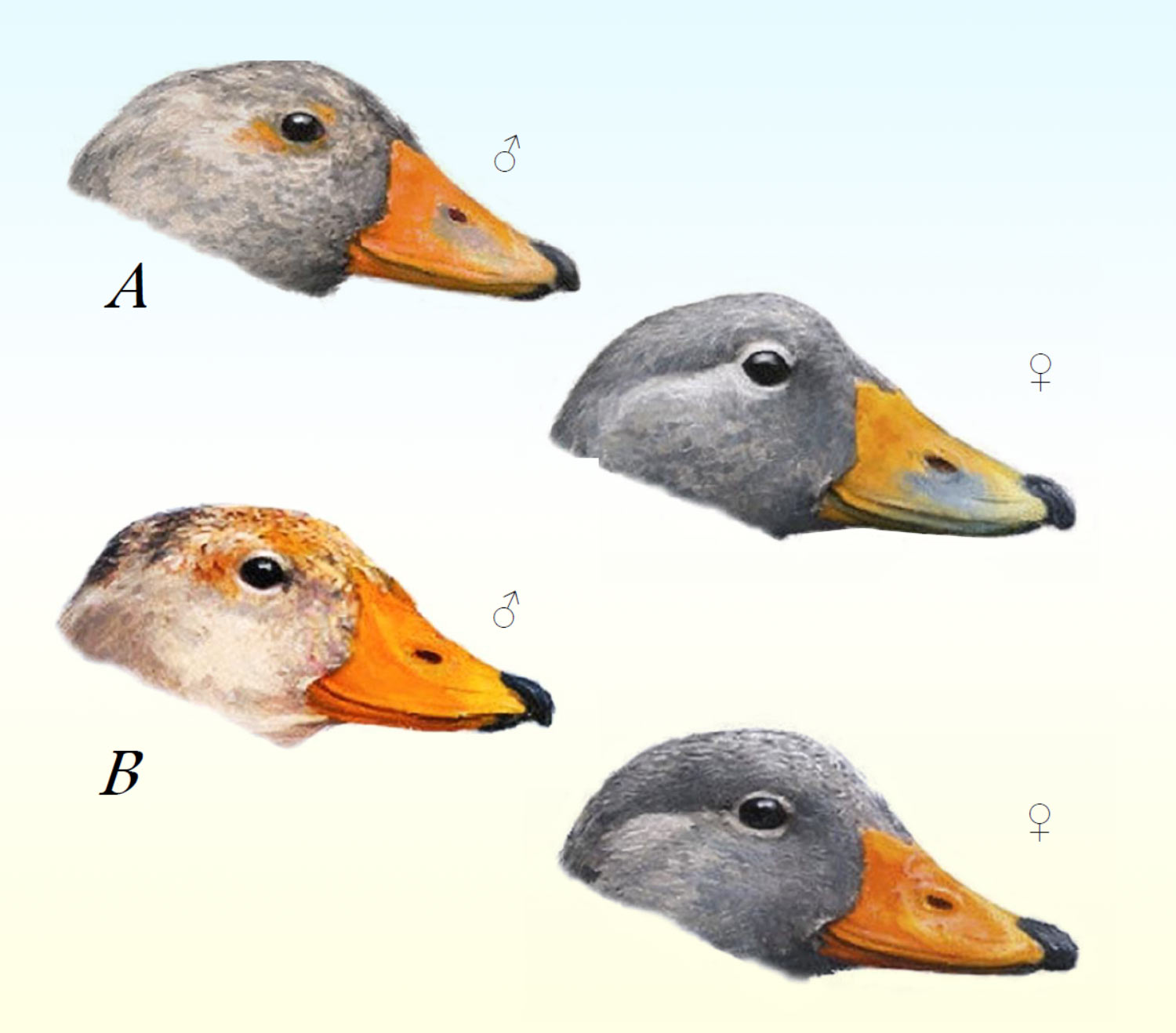
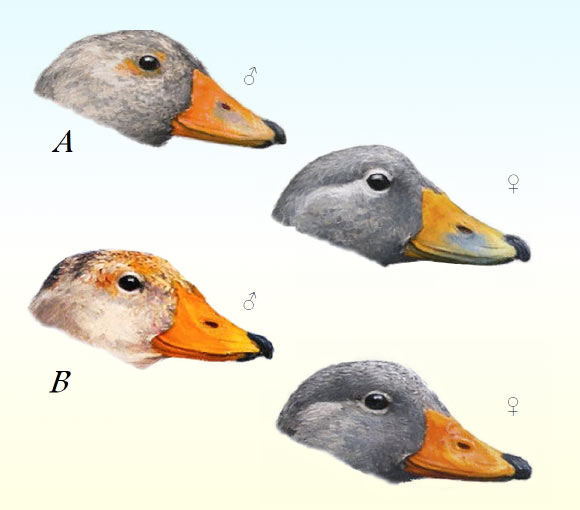
Detailed examination of the bill coloration in adult individuals of the Chiloe steamerduck (A) and the Magellanic steamerduck (B). Photography courtesy of Bernabé López-Lanús & Mariano Costa.
The genus Tachyeres comprises a modest collection of ducks belonging to the Anatidae family of water birds.
These avian creatures are distinguished by their peculiar biological characteristics. A majority of these species lack the capacity for flight and navigate aquatic surfaces by employing their wings in a paddle-like fashion, a behavior that confers upon them their distinctive nomenclature.
Furthermore, they are renowned for their fiercely territorial disposition, exhibiting a propensity for aggressively defending their domains against conspecifics and other avian fauna.
“The natural history of the Tachyeres genus has been accompanied by a protracted chronicle of both established facts and historical inaccuracies,” noted Argentine ornithologists Bernabé López-Lanús and Mariano Costa in their published research.
Certain populations within the Tachyeres genus can encompass individuals possessing the ability to fly alongside those that do not, thereby obscuring distinctions that were once considered definitive markers for separate species. This inherent ambiguity has diminished the utility of such observed traits in taxonomic classification.
Consequently, the investigators opted to explore the realm of bioacoustics. They undertook an exhaustive analysis of vocalizations spanning all recognized steamer duck species, integrating data from field recordings, existing audio archives, and sophisticated spectrogram analysis.
Their findings indicated that while certain vocalizations, particularly the rapid ‘ticking’ sounds employed during territorial displays, exhibited considerable uniformity across different species, another distinct category of call proved to be a decisive differentiator.
This particular vocalization, identified as a ‘rasping grunt,’ demonstrated consistent, species-specific acoustic signatures.
“This particular call is typically produced singularly, or immediately preceding the vocalization that signifies territorial proclamation,” the researchers elaborated.
“Its descriptive character extends beyond the purely behavioral implication of the call—much like the territorial proclamation vocalization—yet it represents another modality of vocal communication within the Tachyeres genus, exhibiting analogous patterns across each taxon.”
The male individuals of the newly identified species produced vocalizations characterized by a unique ‘dome-shaped’ frequency contour, which contrasts with the ‘scalene triangle’ pattern characteristic of a closely related species, the Magellanic steamer duck (Tachyeres pteneres).
Designated as the Chiloe steamerduck (Tachyeres ketru), this recently identified avian species is indigenous to the Chiloé and Aysén regions of Chile. Its geographical distribution spans from approximately the 40th parallel south latitude—encompassing areas from Valdivia and the northern extent of the Chiloé region—down to the Taitao Peninsula in the south.
This species predominantly inhabits sheltered coastal environments, such as bays and inland channels abundant in macroalgae, whereas the Magellanic steamer duck is typically found along more exposed, wave-beaten coastlines situated further south.
“Breeding adults actively vie for locations offering optimal foraging conditions: specifically, the dense canopy of submerged forests composed of brown macroalgae, such as Macrocystis pyrifera (commonly known as ‘kelp’),” the scientists detailed in their publication.
“This particular habitat is characterized by the presence of abundant shelters offering a rich diversity of small invertebrates (including amphipods, gastropods, polychaetes, and immature fish). Individuals of this taxon access these resources by diving, a behavior consistent with other members of the Tachyeres genus.”
This discovery serves to underscore the increasing significance of auditory analysis in contemporary taxonomy and highlights the potential for unrecognized diversity even within extensively studied species, particularly in remote or ecologically intricate locales.
“Instances such as the identification of Tachyeres ketru lead us to the conclusion that bioacoustics represents an indispensable methodology for comprehending the taxonomy of cryptic species, even when working with a limited dataset,” the authors concluded.
Their research paper has been made available online in the esteemed journal, Audiornis.
_____
Bernabé López-Lanús & Mariano Costa. 2026. A new species of Steamerduck (Anatidae: Tachyeres) from the Chiloé region, Chile, finally confirmed as a taxon distinct from Tachyeres pteneres. Audiornis 5: 2-65