Revisiting the fossilized remains of Cistecynodon parvus, a creature known solely from a single skull unearthed in South Africa in 1952, has led to significant shifts in its perceived place within the evolutionary lineage. This taxon has experienced numerous reclassifications, having been posited at different junctures as closely related to advanced cynodonts, a juvenile specimen of another species, or even an entity outside this particular group. A recent comprehensive study, employing computed tomography (CT) scans for a detailed digital reconstruction of the fossil, establishes that this creature from the Triassic period represents a distinct and valid species. Furthermore, the findings indicate that it was a far more primitive cynodont than some paleontological experts had previously theorized.
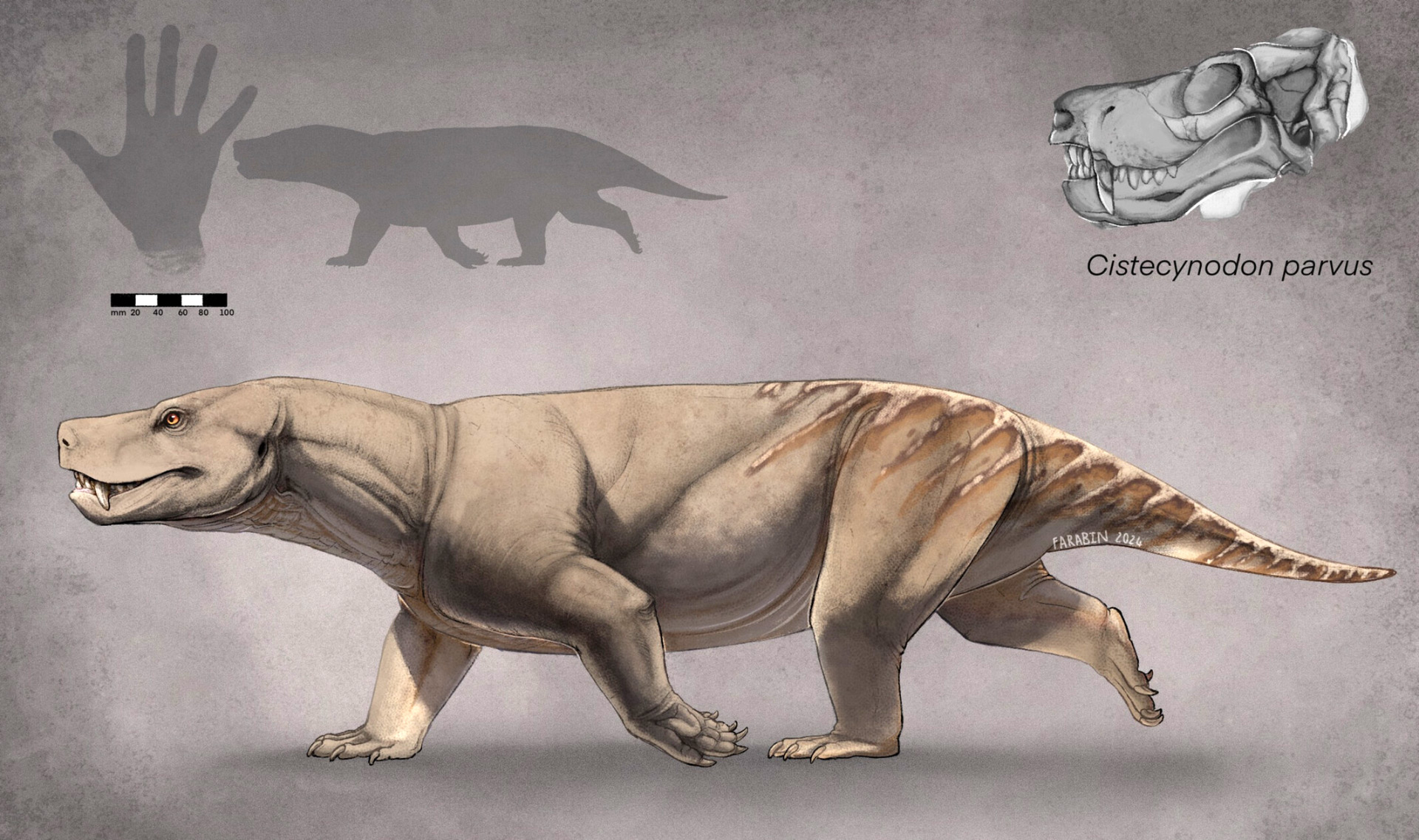
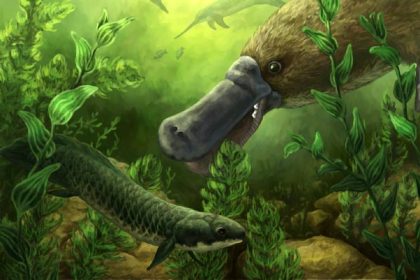
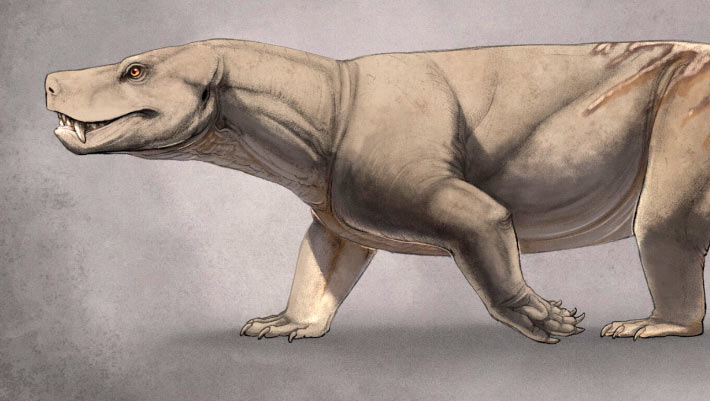
Life reconstruction of Cistecynodon parvus. Image credit: Morgan Hopf.
“Cynodontia represents one of the six principal subclades of Therapsida, which emerged during the Late Permian epoch and constituted a considerable and varied component of the tetrapod fauna throughout the Triassic,” stated Dr. Erin Lund of the University of the Witwatersrand, along with her esteemed colleagues.
“This taxonomic assemblage encompasses both non-mammaliaform cynodonts and Mammaliaformes, including extant and extinct crown mammals, rendering it fundamentally important for elucidating the origins of mammalian life.”
“The significant diversification of cynodonts witnessed during the Triassic is primarily attributed to the Eucynodontia, a group composed of two monophyletic subclades: the Cynognathia and the Probainognathia.”
In a novel investigation, paleontologists meticulously re-examined the cranial structure of Cistecynodon parvus, a cynodont species that flourished during the Middle Triassic period, spanning an interval between 247 and 237 million years ago.
The specimen, measuring 5.72 cm in length, was initially discovered in 1952 at a site known as Luiperdkop (or Luiperdskop). This location is situated to the west of the town Maletswai in the Eastern Cape province of South Africa.
Utilizing advanced CT scanning technology, the research team was able to probe the internal architecture of the fossil, thereby reconstructing intricate details of the skull, mandible, and internal anatomical features.
The results of their detailed analyses stratify Cistecynodon parvus within the basal, or non-eucynodont, cynodonts, rather than placing it amongst the more evolutionarily advanced eucynodont group.
Concurrently, the fossil exhibits a distinctive and rather unusual amalgamation of anatomical characteristics. These include a significantly enlarged vestibule within the inner ear structure, a parietal foramen that is notably small and constricted, a relatively uncomplicated maxillary canal, and the complete absence of carotid foramina.
Collectively, these unique features serve to differentiate Cistecynodon parvus from other known cynodonts and strongly corroborate its standing as a distinct genus and species.
The researchers posit that certain observable features within the fossil suggest a subterranean mode of existence.
Specifically, they interpret the pronounced inflation of the inner ear vestibule as indicative of heightened sensitivity to low-frequency auditory stimuli. This sensory adaptation is a characteristic commonly observed in extant fauna that exhibit fossorial, or burrowing, habits.
Consequently, their conclusions strongly suggest that Cistecynodon parvus was likely an obligate fossorial organism.
“Throughout the preceding century, Cistecynodon parvus has been assigned to various clades of non-mammalian cynodonts without the emergence of any definitive consensus,” the scientists articulated.
“The empirical data derived from this research unequivocally supports the designation of Cistecynodon parvus as a valid taxon belonging to the basal non-eucynodont Cynodontia (specifically, a non-eucynodont epicynodont).”
“Its phylogenetic placement is further substantiated by the presence of a secondary palate that remains open along the midline, even though the specimen represents a sub-adult to adult individual.”
“Finally, the distinctive anatomy of its inner ear and endocast strongly supports the characterization of Cistecynodon parvus as a fossorial animal.”
“Our reconstruction portrays Cistecynodon parvus as an ancestral lineage of cynodonts inhabiting Southern Africa, which successfully navigated the mass extinction event at the conclusion of the Permian period. It persisted as a relict fauna well into the early Middle Triassic,” they concluded.
Their published findings appeared this month in the esteemed journal, The Anatomical Record.
_____
Erin S. Lund et al. Redescription of the Triassic cynodont Cistecynodon parvus and reassessment of its phylogeny. The Anatomical Record, published online March 19, 2026; doi: 10.1002/ar.70179