A recent scholarly investigation may have unearthed the most ancient known implements resembling dice, with an estimated age exceeding 12,000 years.
These exceptionally old gaming components were apparently employed by indigenous hunter-gatherer societies in North America towards the conclusion of the last glacial period, positioning them millennia prior to any previously recognized artifacts that could be categorized as dice.
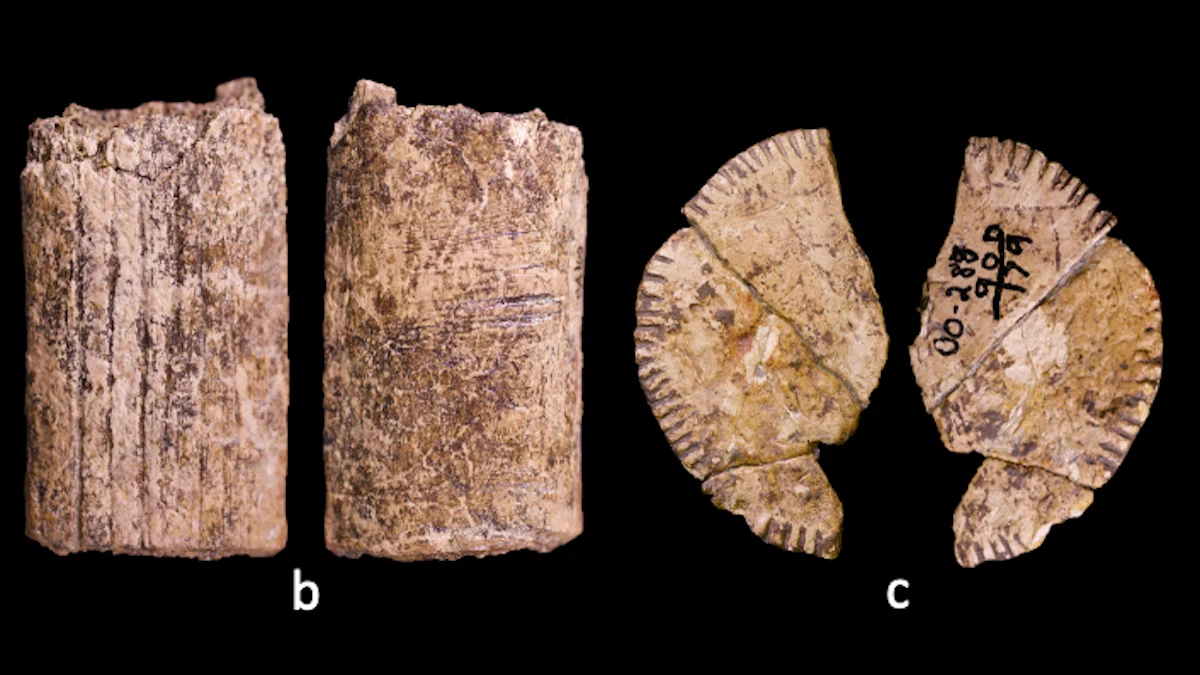
These ancient objects did not bear the familiar cubic form adorned with pips that players of modern board games would recognize. Instead, they were bi-faced items, each surface bearing distinct etchings or markings. Nevertheless, the underlying principle remained consistent: their capacity for being cast to yield a random binary outcome in games of chance, akin to the function of a coin toss.
“Traditionally, scholars have attributed the origins of dice and the study of probability to developments in the Old World,” observes anthropologist Robert Madden, a doctoral candidate at Colorado State University and lead author of the contemporary study.
“The archaeological evidence now indicates that ancient indigenous peoples in North America were intentionally crafting objects designed to produce unpredictable results and incorporating these outcomes into structured gaming activities, several thousand years before this practice was previously understood to exist.”
While these ancient artifacts were not previously unknown to archaeologists, their specific function as potential dice is a recent revelation. Madden devised a systematic methodology: by scrutinizing Native American artifacts already accepted as dice, he pinpointed four common characteristics.
Subsequently, he evaluated other artifacts presumed to be game pieces, assessing them for the presence of these identified features. Artifacts exhibiting all four characteristics were classified as “diagnostic” prehistoric Native American dice, while those meeting only some criteria were designated as “probable” dice.
To qualify as dice, the objects needed to be two-sided, manufactured from either wood or bone. Each side was required to exhibit clear differentiation, typically achieved through the application of paints, pigments, or carved markings. They possessed either flat or subtly concave surfaces, and their dimensions and form were suitable for manipulation and casting onto a surface by players holding several in their hands.
“In numerous instances, these objects had already been exhumed and documented in academic literature,” Madden states. “What was lacking was not the physical evidence itself, but rather a clear, pan-continental standard for definitively identifying their purpose.”
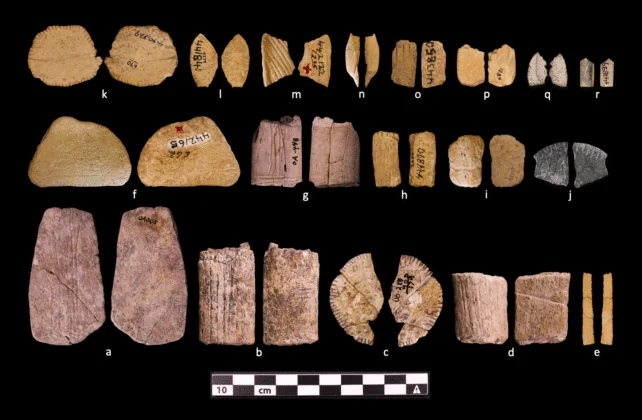
Among the collection of artifacts examined by Madden, 565 items were identified as fulfilling all four criteria indicative of dice. An additional 94 objects were categorized as probable dice, displaying a subset of these distinguishing features. These artifacts originated from 57 diverse archaeological locations across North America, representing a broad historical spectrum.
The oldest specimens can be traced back to the era of the Folsom culture, existing approximately 12,200 to 12,800 years ago, from which over a dozen diagnostic dice were recovered. Furthermore, a single probable die has been tentatively linked to the Clovis people, potentially dating back as far as 13,000 years.
Beyond the Americas, the next oldest instances of objects serving a dice-like function are considerably younger, dating to approximately 5,500 years ago and discovered in Asia and the Middle East. Therefore, if the North American assemblage indeed represents an early iteration of dice as currently understood, it significantly extends the timeline not only for this category of games but also for a specific form of mathematical reasoning.
“This discovery holds considerable importance as historians of mathematics often cite the invention of dice and games of chance as a foundational early development in humanity’s progressive exploration and comprehension of randomness and the inherently probabilistic nature of the cosmos,” Madden articulates in the published research paper.
Naturally, a degree of uncertainty persists, and there remains the possibility that these artifacts served purposes other than gaming – Madden acknowledges that their use for divination, for example, cannot be entirely ruled out. However, the supporting evidence for such alternative functions is not as robust as that for their application in games, as indicated by the study.
“The findings from this research suggest that dice, games of chance, and the practice of gambling have been an enduring element within Native American cultural traditions – serving as a vital mechanism for social cohesion – for a minimum of the last 12,000 years and continuing into the present day,” Madden elaborates in his written findings.
The results of this extensive research have been formally presented and published in the academic journal American Antiquity.