A recent scientific publication, available online as of March 18 in the journal Acta Palaeontologica Polonica, details the identification of a novel harvestman species by a team of paleontologists. This extinct arachnid was discovered preserved within two separate samples of Eocene-era amber, one originating from Ukraine and the other from the Baltic region.
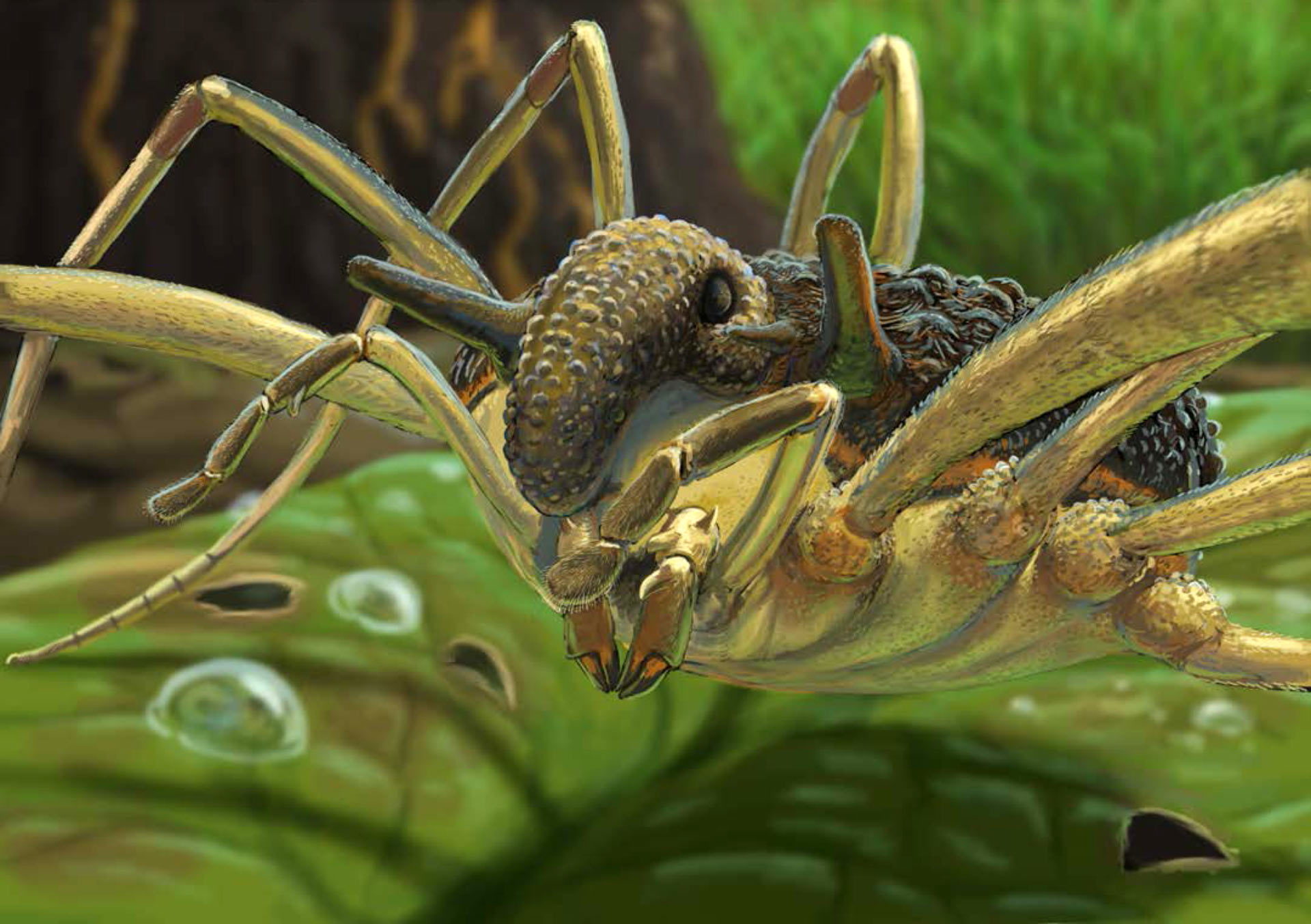
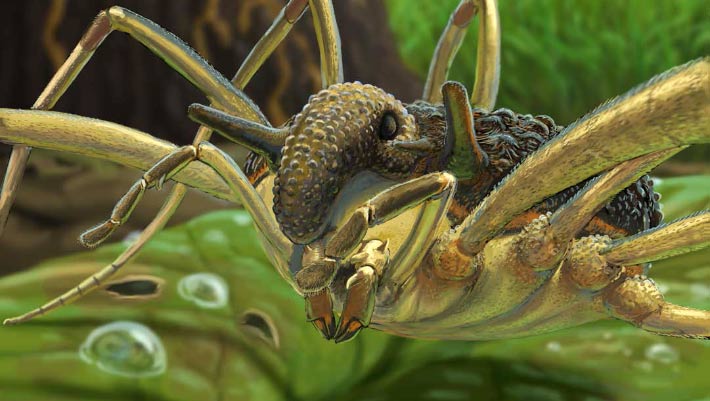
An artist’s rendition of a male Balticolasma wunderlichi. Image courtesy of Joshua Knüppe.
This newly cataloged harvestman represents the inaugural known fossilized specimen belonging to the subfamily Ortholasmatinae.
Designated Balticolasma wunderlichi, this species inhabited Europe approximately 35 million years ago, during the Eocene epoch.
Currently, these distinctive arachnids, often characterized by elaborate sculptural features, are found exclusively in portions of East Asia and the Americas.
“Members of the subfamily Ortholasmatinae encompass some of the most visually striking extant harvestmen, frequently exhibiting a highly intricate and branched ocular tubercle alongside a unique dorsal micro-sculpture composed of what are termed keel cells,” stated Christian Bartel, a paleontologist at the Bavarian State Collections of Natural History, and his research collaborators.
“Presently, seven extant genera comprising 27 described species are acknowledged, displaying a disjunct geographical distribution.”
The classification of Balticolasma wunderlichi is based on two recovered specimens: a presumed female discovered in Rovno amber sourced from northwestern Ukraine, and a male specimen encased in Baltic amber.
These fossil specimens were originally part of private collections in Germany (the Baltic specimen) and Lithuania (the Rovno specimen), and have since been transferred to the Museum für Naturkunde Berlin.
“The unexpected discovery of an ortholasmatine harvestman within European Eocene amber deposits was a significant surprise. Harvestmen from this group are no longer extant in Europe,” commented Dr. Bartel.
“Their closest living relatives are presently encountered solely in East Asia, as well as in North and Central America.”
“It is evident that, during the Eocene epoch, approximately 35 million years ago, these harvestmen possessed a considerably more extensive geographical range across the northern hemisphere than they do today.”
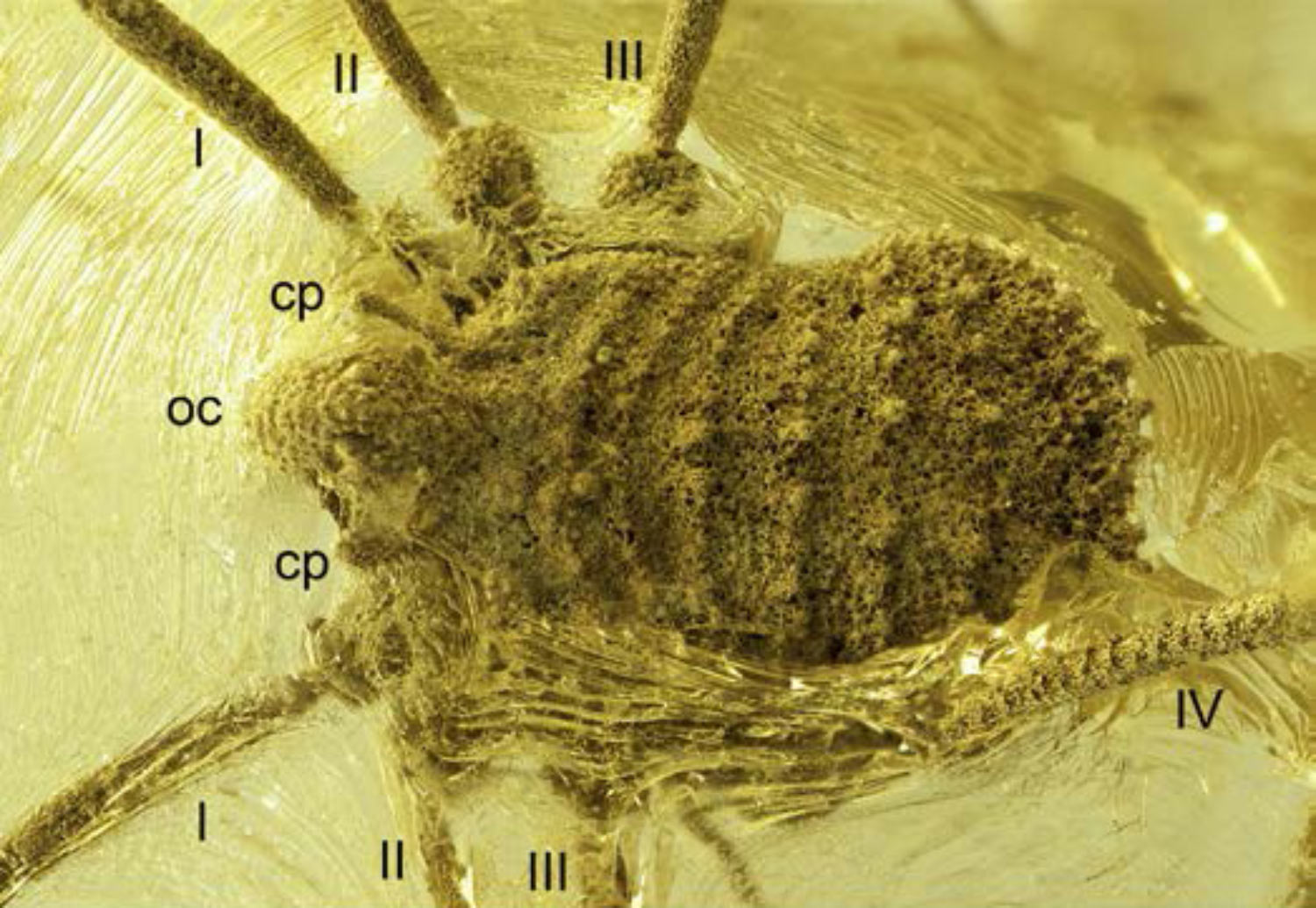
A female specimen of Balticolasma wunderlichi originating from Rovno amber. Image credit: Bartel et al., doi: 10.4202/app.01283.2025.
Through the application of high-resolution synchrotron microtomography, the research team successfully reconstructed the detailed anatomical structure of Balticolasma wunderlichi.
The radiographic analyses revealed a diminutive, flattened exoskeleton measuring less than 3 millimeters in length, adorned with discernible rows of tubercles and a distinctive hood-like projection extending anteriorly.
“Certain morphological characteristics of this fossil appear to bear closer resemblance to extant Asian genera,” the scientists observed.
Furthermore, this investigation underscores the considerable scientific importance of amber deposits located in the Baltic and Rovno regions.
This recent finding expands the roster of known harvestman species preserved within these amber formations and provides a fresh reference point for reconstructing the evolutionary lineage of this arthropod group.
“Baltic amber is renowned for its rich fossil diversity. It consistently yields species that are no longer present in Europe today,” stated Dr. Jason Dunlop, a paleontologist affiliated with the Museum für Naturkunde in Berlin.
“The co-occurrence of the new harvestman species in Ukraine further substantiates the hypothesis that the harvestman faunas of both regions were likely similar.”
“With the inclusion of this new species, the total number of identified harvestman species from Baltic amber increases to 19, while those from the ancient Ukrainian Rovno amber are now seven. Six species have been documented in both geographical areas.”
_____
C. Bartel et al. 2026. 3D analyses of the first ortholasmatine harvestmen from European Eocene ambers. Acta Palaeontologica Polonica 71 (1): 95-107; doi: 10.4202/app.01283.2025