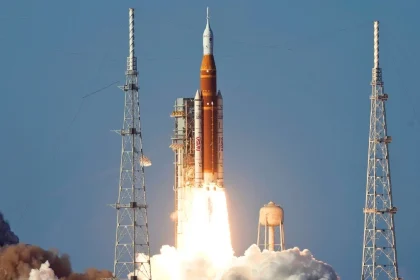
The Artemis II mission has achieved a groundbreaking milestone, propelling humanity to a distance from Earth unprecedented in recorded history.
At precisely 17:56 UTC on Monday, April 6, 2026, the Orion spacecraft, designated Integrity, with its complement of four astronauts aboard, officially surpassed the 1970 Apollo 13 record of 400,171 kilometers (248,655 miles) from our home planet.
NASA confirmed that the mission reached its apogee, its farthest point from Earth, at 23:02 UTC, a remarkable 406,771 kilometers. This record-setting distance was achieved as the spacecraft traversed the far side of the Moon, extending humanity’s reach by an additional 6,616 kilometers beyond the previous benchmark established by Apollo 13.
To provide a frame of reference, the average orbital distance to the Moon is approximately 384,400 kilometers, underscoring that Orion ventured tens of thousands of kilometers beyond this celestial neighbor.
“As we endeavor to exceed the furthest reach of human exploration from planet Earth, we do so with profound respect for the exceptional endeavors and achievements of those who paved the way in our collective journey through space,” stated mission specialist Jeremy Hansen of the Canadian Space Agency, as recorded in a recent communiqué.
“Our sojourn continues further into the cosmos before our home world’s gravitational embrace draws us back to all that we hold dear. Yet, it is at this pivotal juncture that we issue a challenge to this generation and those to come: ensure this record is not one that stands for an extended duration.”
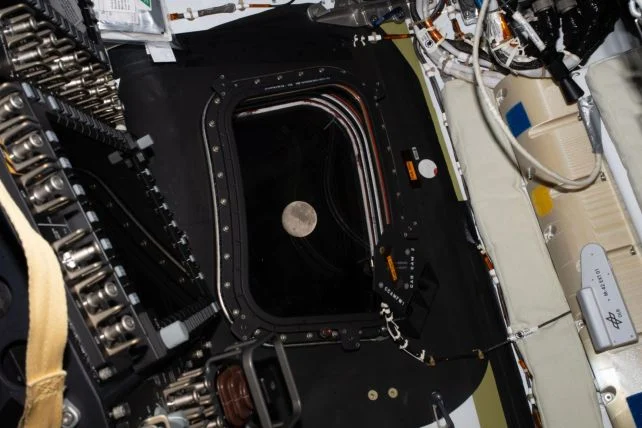
During the spacecraft’s passage behind the lunar disc, communication with Earth experienced an interruption of approximately 40 minutes, as the Moon itself obstructed the signal transmission.
At 23:24 UTC, Integrity re-emerged, affording its occupants a spectacle few humans have ever witnessed firsthand: the phenomenon of an Earthrise blooming over the Moon’s horizon.
Communications with the spacecraft and its four-member crew – comprising mission commander Reid Wiseman, pilot Victor Glover, and mission specialists Christina Koch and Jeremy Hansen – have been successfully re-established.
According to NASA’s latest reports, all onboard systems are operating within nominal parameters, an industry term signifying adherence to expected performance benchmarks.

While the record-breaking distance is both awe-inspiring and motivating, the Integrity mission carries significant weight beyond this singular achievement. It represents a crucial stride toward the ambitious goal of returning humans to the lunar surface. As the inaugural crewed flight of the Artemis program, Artemis II serves as a vital validation of the complex systems engineered to transport and sustain astronauts throughout their deep-space voyages.
Furthermore, as the first crewed mission into deep space since the conclusion of the Apollo era in 1972, this endeavor will provide invaluable insights into the physiological and psychological impacts of prolonged space travel on a crew confined to close quarters, far from Earth.
Thus far, the crew has demonstrated remarkable adaptability in navigating a series of unexpectedly mundane yet critical challenges, including technical issues with Outlook and the necessity of addressing onboard waste management systems.
However, amidst the routine, moments of profound sublimity have also arisen. The Integrity spacecraft brought the astronauts within a mere 6,545 kilometers of the lunar surface during their passage behind the far side.
As they navigated their trajectory past the Moon, the crew also had the opportunity to observe its surface features and proposed new designations for two of its craters. Their suggestions include naming one crater in honor of Integrity, the very Orion spacecraft enabling their journey, and another in tribute to Wiseman’s late wife, Carroll. These proposed names will be formally submitted to the International Astronomical Union for their review and consideration.
🌞🌕🧑🚀
Right now, the Orion capsule is passing behind the Moon, so the Sun is entirely eclipsed from their perspective. During this time, they will view a mostly darkened Moon and will use the opportunity to analyze the solar corona. pic.twitter.com/PWDPfZKxGh— NASA (@NASA) April 7, 2026
Furthermore, an iconic new image of Earth, titled “Hello, World,” has emerged. This photograph was captured by mission commander Reid Wiseman on April 3, as the spacecraft initiated its departure from Earth following a translunar injection maneuver.
This image marks the first documented photograph of our planet as a complete sphere taken by a human occupant since the Apollo missions concluded.

The subsequent phase of the Artemis initiative, Artemis III, is currently slated for activation in 2027. This mission will operate closer to Earth, deploying a crew via the Orion spacecraft propelled by the SLS rocket into low Earth orbit. Its primary objectives will involve rigorous testing of rendezvous and docking procedures with commercial spacecraft intended for future lunar landing operations.
Artemis IV, the fourth installment of the program, is presently targeted for early 2028. NASA has indicated that this mission’s objective will be a crewed landing in proximity to the Moon’s south polar region, where astronauts will conduct vital scientific observations and gather geological samples.
However, before these future endeavors, the immediate priority remains the safe return of the Integrity crew. This phase, arguably the most perilous of the mission, involves a high-velocity atmospheric re-entry followed by a parachute-assisted splashdown in the Pacific Ocean, off the coast of San Diego. This critical event is anticipated to transpire on April 10.
“At NASA, we embrace a culture of audacious ambition, pushing the boundaries of exploration and achieving the seemingly impossible. This spirit is personified by our Artemis II astronauts – Reid, Victor, Christina, and Jeremy. They are forging new pathways for the advancement of all humankind,” stated Lori Glaze, acting associate administrator for NASA’s Exploration Systems Development Mission Directorate, in a recent official statement.
“Their unwavering commitment transcends the mere setting of new records; it serves as a profound catalyst, igniting hope and inspiring a vision for a bold and expansive future.”