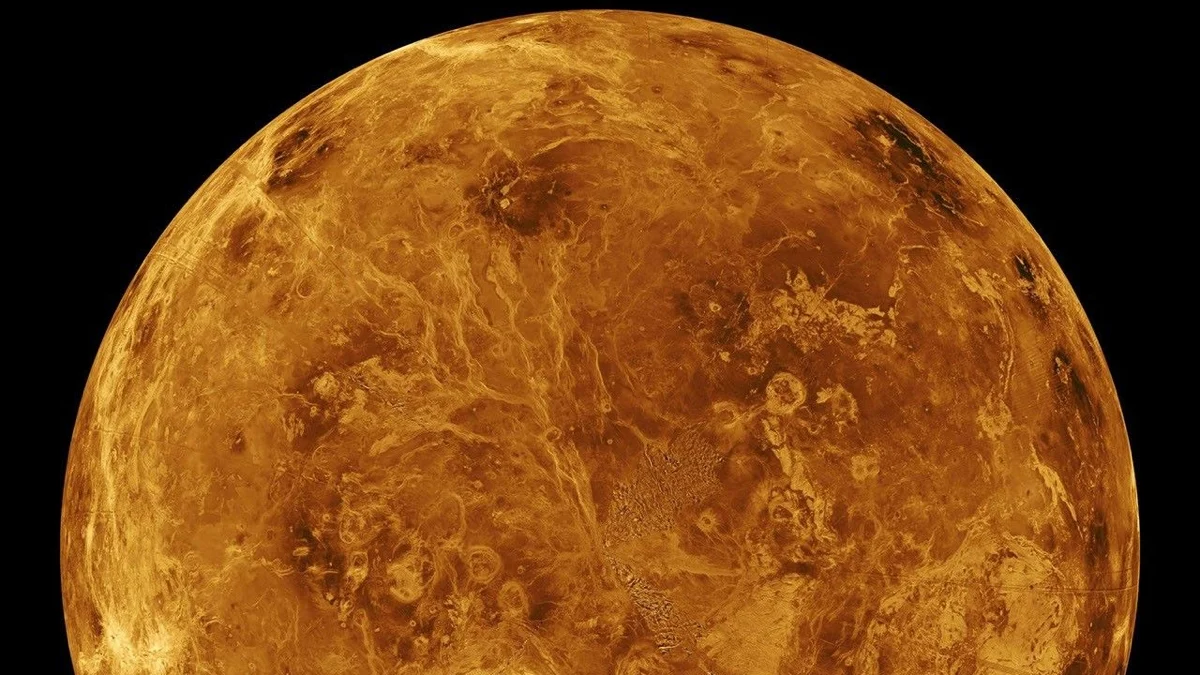
The concept of panspermia posits that biological entities can traverse the cosmos, disseminated by celestial bodies such as asteroids, comets, and other interplanetary debris.
When the fundamental constituents of life arise on a planetary body, catastrophic impact events can propel surface material into the vacuum of space. This ejected matter then serves as a vector, transporting these nascent life forms to distant worlds.
For a considerable duration, researchers have engaged in deliberations concerning the feasibility of such interplanetary exchanges between Earth and Mars, allowing for bidirectional transfer.
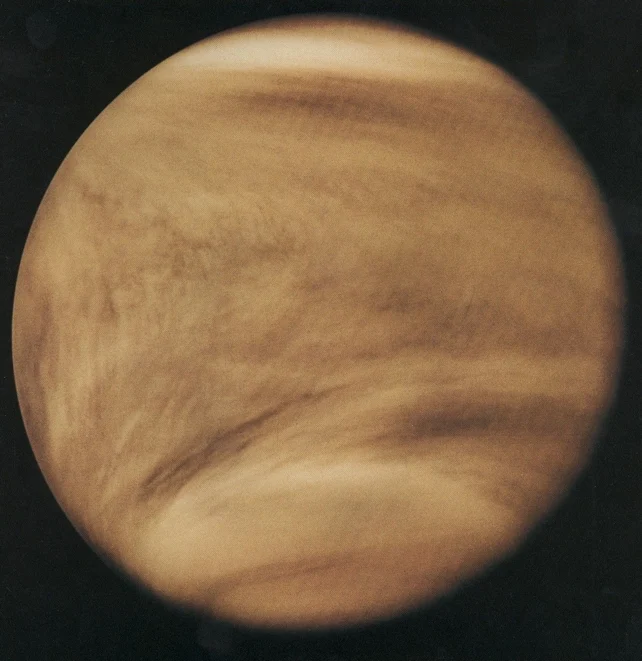
Nevertheless, recent discourse surrounding the potential presence of microbial organisms within the dense atmospheric layers of Venus has instigated renewed discussions regarding interplanetary transport dynamics between Venus, Earth, and Mars.
Leveraging the framework of the “Venus Life Equation” (VLE), a model conceptualized by Noam Izenberg and colleagues in 2021, the research team’s simulations indicate that life could subsist within Venus’ cloud systems for periods extending to several days each century, facilitated by material ejected from Earth.
Analogous to the principles of the Drake Equation, the VLE deconstructs the probabilistic assessment of life into a sequence of interconnected factors. When these factors are multiplied, they yield an estimation of life’s likelihood. Mathematically, the VLE is articulated as follows: L = O x R x C
In this formulation, L represents the Likelihood of Extant Life (quantified on a scale from 0 to 1, where 0 signifies no possibility and 1 denotes absolute certainty). O denotes Origination (the probability that life initiated and became established on Venus). R signifies Robustness (the potential for a biosphere to endure and withstand environmental fluctuations). C denotes Continuity (the probability that habitable conditions persisted up to the present era).
Within this analytical structure, the research group initially examined the critical condition that any organic material, irrespective of its origin, must surmount the challenges of interstellar transit.
Beyond the severe physical stressors imposed by impact events, the process involves significant thermal generation, followed by exposure to extreme temperatures, pervasive radiation, and the vacuum of space.
However, through sophisticated computational modeling and empirical analysis of meteoritic samples recovered on Earth, it has been substantiated that organic compounds can indeed survive the processes of ejection and interplanetary displacement. Upon reaching Venus, for life to persist, any introduced organic matter would necessitate dispersal within or above the planet’s cloud layers.
With this imperative in mind, the team’s computational efforts were directed towards understanding the trajectory and survival of fireball meteorites (bolides) as they traverse Venus’ atmosphere, accounting for atmospheric ablation, explosive fragmentation, and the subsequent dispersal of resulting particles capable of floating within the clouds.
Their analysis employed the “pancake model,” a widely utilized semi-analytical methodology that elucidates the fragmentation behavior of bolides during atmospheric entry.
Following the bolide’s disintegration within the atmosphere (an event termed an “airburst”), the forces of aerodynamic drag facilitate the horizontal dispersion of these fragments, creating a flattened “pancake” of distributed matter, which the researchers refer to as “cells.”
By applying the pancake model in conjunction with previous research to derive values for the initial two parameters, the team quantified the total influx of bolides from either Earth or Mars into the Venusian cloud environment.
Their findings indicate that potentially hundreds of billions of cells may have been transported from Earth to Venus’ clouds, with a substantial proportion remaining viable.
Nonetheless, the most refined estimate derived from their model suggests an average transfer rate of approximately 100 dispersed cells within Venus’ clouds per Earth year. Over the span of the preceding billion years, it is estimated that up to 20 billion cells could have been transferred from our planet.
While acknowledging that their computational model does not encompass every nuance of bolide-atmosphere interaction and that each parameter within the VLE is subject to extensive degrees of uncertainty—much like the Drake Equation—the study nonetheless provides compelling evidence for the plausibility of panspermia between Earth and Venus.
Consequently, should a future astrobiological endeavor detect evidence of life within the clouds of Venus, there exists a non-negligible probability that its genesis may be terrestrial in origin.
This content was originally published by Universe Today. Access the original publication.