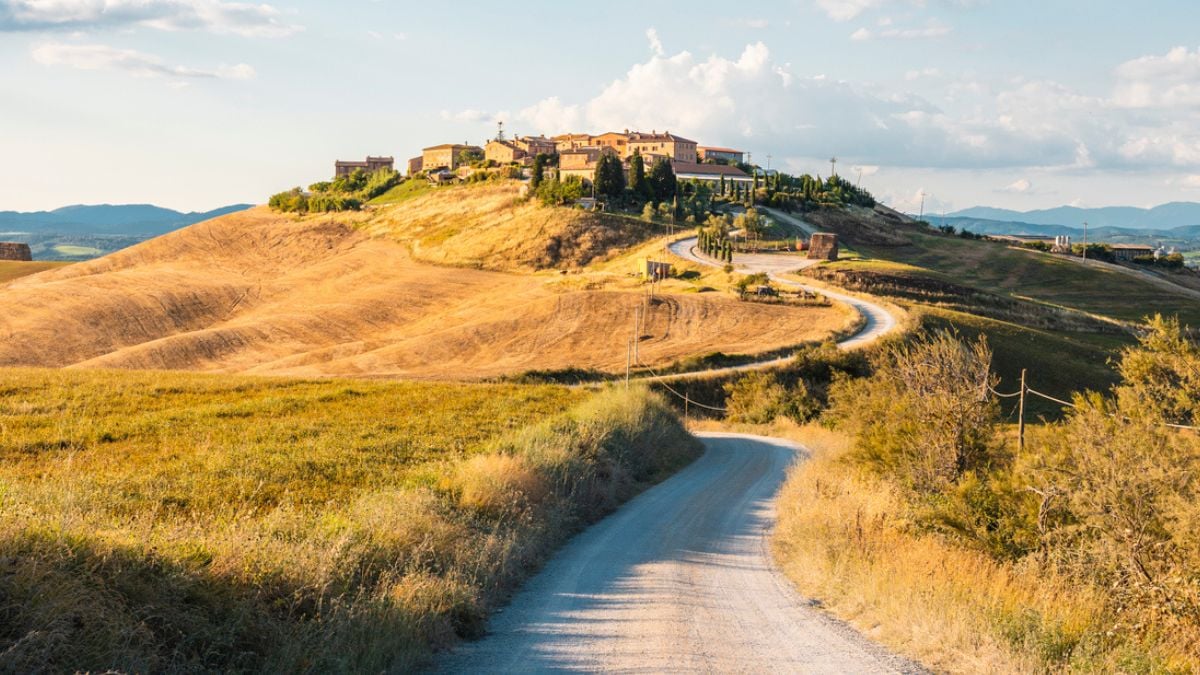
A substantial reserve of subterranean magma, potentially unreleased through volcanic activity, has been pinpointed beneath the Tuscan landscape.
The immense scale and extreme thermal energy of this geological formation remained undetected until recent investigations, owing to the absence of any discernible volcanic edifice.
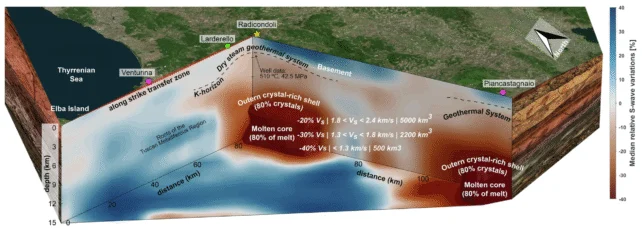
While the Tuscany region is characterized by infrequent volcanic occurrences, subsurface research indicates an astonishing accumulation of over 5,000 km3 of magma and partially molten rock churning between 8 to 15 kilometers (5-9 miles) below the surface.
This volumetric equivalent approaches that of the upper magma chambers feeding the renowned Yellowstone supervolcano. However, unlike its North American counterpart, this colossal subterranean entity in western Italy shows no external indicators such as sulfurous emissions or vibrant thermal springs to betray its presence.
This significant finding emerged from the collaborative efforts of an international consortium of geoscientists and volcanologists, spearheaded by teams from the University of Geneva (UNIGE) in Switzerland, alongside Italy’s Institute of Geosciences and Earth Resources and the Italian National Institute of Geophysics and Volcanology.
“The geothermal activity of this expansive region, stretching across Tuscany from north to south, was previously acknowledged. Nevertheless, the sheer magnitude of its magma reserves, rivaling those found in supervolcanic systems like Yellowstone, was an unforeseen revelation,” stated lead author and geoscientist Matteo Lupi of UNIGE.
The dimensions of the Tuscan magma accumulation were ascertained through the deployment of a seismic network, which functions akin to terrestrial radiography, enabling the examination of subsurface structures. Utilizing the resultant seismic data, Lupi and his research associates constructed a model of the upper 15 kilometers of Tuscany’s continental crust.
“These findings hold considerable importance, not only for advancing fundamental geological understanding but also for practical utility, such as identifying geothermal energy sources or economically viable deposits of lithium and rare earth elements crucial for manufacturing components like electric vehicle batteries,” Lupi elaborated.
“Beyond their intrinsic scientific value, these investigations highlight the efficacy of tomographic techniques as a rapid and cost-effective means of subsurface exploration, thereby supporting the ongoing energy transition.”
The research team posits that the Tuscan region’s middle crust hosts an extensive magmatic reservoir.
The authors further reported that the scale of this subterranean network is comparable to “those associated with some of the planet’s most prodigious eruptive systems, including Taupō, Long Valley, and Yellowstone, all of which have experienced super-eruptions.”
Conversely, no historical eruptions have been directly linked to this geothermal system within Tuscany.
Given the lack of an apparent vent, scientists project that supercritical fluids in the shallow subsurface could attain temperatures exceeding 500 °C (932 °F).
“The underlying causes for this vast quantity of magma remaining quiescent, without manifesting as eruptions, remain an intriguing subject of ongoing discussion and investigation,” the researchers concluded.
“Such partially molten rock formations may offer profound insights into the long-term developmental trajectories of volcanic systems that have historically produced super-eruptions, as well as regional high-enthalpy systems that have yet to exhibit eruptive behavior.”
The comprehensive study has been published in the peer-reviewed journal Communications Earth & Environment.