Discoveries of echidna fossils within Australia are infrequent and exhibit a scattered pattern across both geological epochs and geographical locations. In a recent academic publication featured in The Alcheringa, an Australasian Journal of Palaeontology, a team of paleontologists has detailed a partial cranial specimen belonging to the Owen’s giant echidna (Megalibgwilia owenii), unearthed in southeastern Australia. This particular specimen, recovered approximately 120 years ago from Foul Air Cave within the Buchan Caves Reserve in East Gippsland, constitutes the inaugural verified instance of this extinct species being documented in the state of Victoria, a region from which it had previously been conspicuously absent in the fossil record.
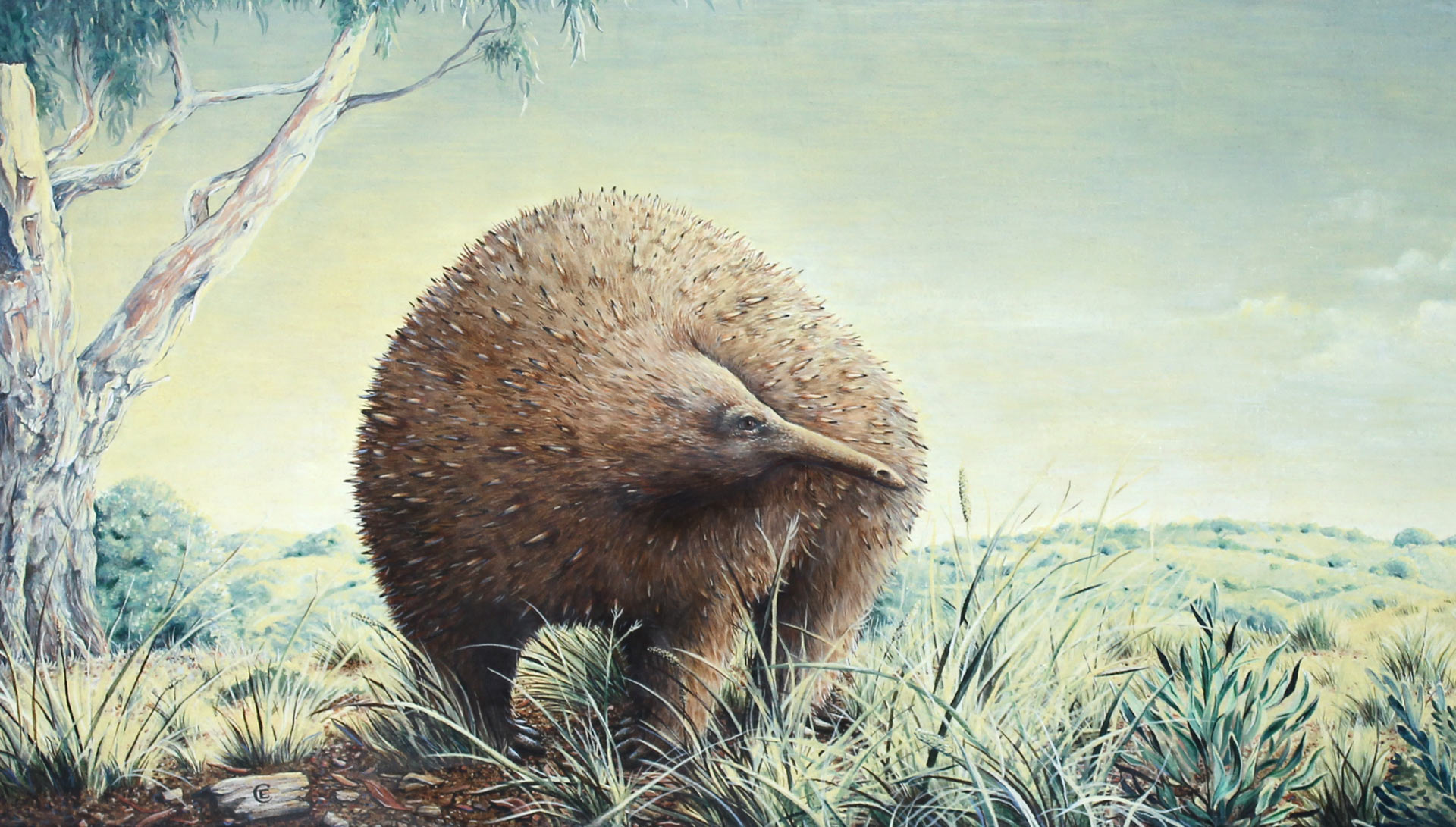
Life reconstruction of the Owen’s giant echidna (Megalibgwilia owenii). Image credit: Chris Edser.
First formally identified and described in the 1990s, Megalibgwilia owenii was known to reach lengths of up to 1 meter and weigh approximately 15 kilograms.
The prior lack of evidence for this species in Victoria stood in stark contrast to its established presence across the broader continent, spanning from Western Australia to Tasmania and extending into southern New South Wales.
This newly documented fossil find serves to rectify that geographical anomaly, suggesting that the species’ distribution was likely more contiguous than previously understood.
The fossil itself is a fragmented skull, a discovery that did not originate from contemporary field excavation but rather from within the Palaeontology Collection housed at Museums Victoria.
Dr. Tim Ziegler, who holds the position of collection manager for vertebrate paleontology at the Museums Victoria Research Institute, first observed the specimen in 2021. Through an examination of historical records, he was able to ascertain that it had been retrieved during a 1907 expedition to Foul Air Cave undertaken by museum officer and naturalist Frank Spry.
“Museum collections are instrumental in preserving the connection between scientific endeavor, cultural heritage, and the public,” Dr. Ziegler stated.
“More than a century ago, Spry, in collaboration with fellow scientists and local inhabitants, explored the caves of Buchan utilizing rudimentary equipment such as ropes and oil lamps, thereby inspiring us to continue their investigative legacy.”
According to Dr. Ziegler and Jeremy Lockett, a student from Deakin University, this discovery highlights the significant value of re-examining historical collections, which can yield novel scientific insights even many decades after the initial acquisition of specimens.
To comprehensively understand the diversity and geographical spread of ancient echidnas during the Quaternary period, additional systematic surveys of museum archives and fossil sites will be necessary.
“Prior research conducted by Museums Victoria has demonstrated that the Buchan Caves offer an extraordinary repository of Australia’s distinctive megafauna, including the short-faced kangaroo Simosthenurus occidentalis and the colossal marsupial Palorchestes azael,” Dr. Ziegler remarked.
“The next groundbreaking revelation could emerge from within the confines of a museum, through ongoing fieldwork, or by the perceptive observation of a citizen scientist. I eagerly anticipate what that discovery might be.”
_____
Tim Ziegler & Jeremy Lockett. The first Victorian record of Owen’s Giant Echidna Megalibgwilia owenii from Buchan Caves in East Gippsland, Australia. The Alcheringa, published online April 13, 2026; doi: 10.1080/03115518.2026.2643598