Recent imagery obtained by the James Webb Space Telescope, a collaborative effort between NASA, the ESA, and the CSA, depicts the barred spiral galaxy Messier 77 as a dynamic vortex of radiant cosmic dust, nascent stars, and an exceptionally luminous central nucleus.
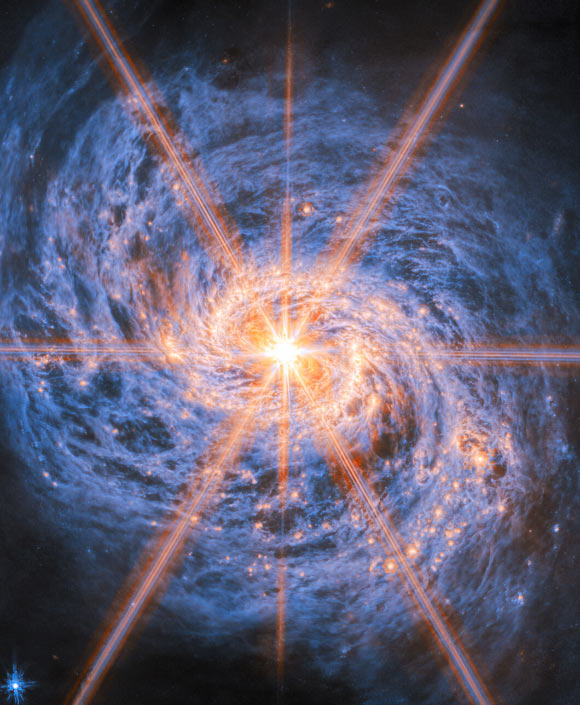
This visualization of Messier 77, courtesy of Webb’s Mid-Infrared Instrument (MIRI), accentuates its spiraling arms, the dusty expanse of its disk, and its remarkably brilliant core with unprecedented clarity. The vivid orange streaks emanating from the galaxy’s center are not an intrinsic galactic feature; rather, they are an optical artifact resulting from the telescope’s design. Known as diffraction spikes, these phenomena are generated as intense light from the unobscured active galactic nucleus (AGN) undergoes slight bending (diffraction) at the peripheries of Webb’s hexagonal mirror segments and around one of the support struts for its secondary mirror. Attributed to NASA / ESA / CSA / Webb / A. Leroy.
Situated approximately 62 million light-years from Earth, within the celestial borders of the constellation Cetus, Messier 77 stands as one of the night sky’s most prominent and extensively studied galaxies.
This celestial object, also recognized by designations such as the Squid Galaxy, NGC 1068, LEDA 10266, and Cetus A, exhibits an apparent magnitude of 9.6.
The initial detection of Messier 77 is credited to French astronomer Pierre Méchain in 1780, who initially cataloged it as a nebula. Méchain subsequently shared his findings with his colleague, fellow French astronomer Charles Messier.
While Messier initially posited that the intensely luminous object was a stellar cluster, advancements in astronomical technology eventually confirmed its true identity as a galaxy.
With a diameter spanning 100,000 light-years, Messier 77 ranks among the most substantial galaxies cataloged by Messier—its immense gravitational influence distorts and warps the morphology of adjacent galaxies. Furthermore, it is recognized as one of the nearest galaxies harboring an active galactic nucleus (AGN).
Messier 77 is classified as a Type II Seyfert galaxy, a category distinguished by its pronounced luminosity in the infrared spectrum.
“At the core of Messier 77 lies a concentrated area teeming with superheated gas, which by itself eclipses the luminosity of the remainder of the galaxy, even surpassing the light-gathering capabilities of Webb’s instruments,” stated the Webb astronomers in an official release.
“This central region is an active galactic nucleus (AGN), driven by M77’s central supermassive black hole, an entity possessing a mass eight million times that of our Sun.”
“The gravitational pull of the black hole compels galactic matter in the central zones into an accelerated, tightly bound orbital path, resulting in energetic collisions and intense heating, which in turn generates prodigious amounts of radiation.”
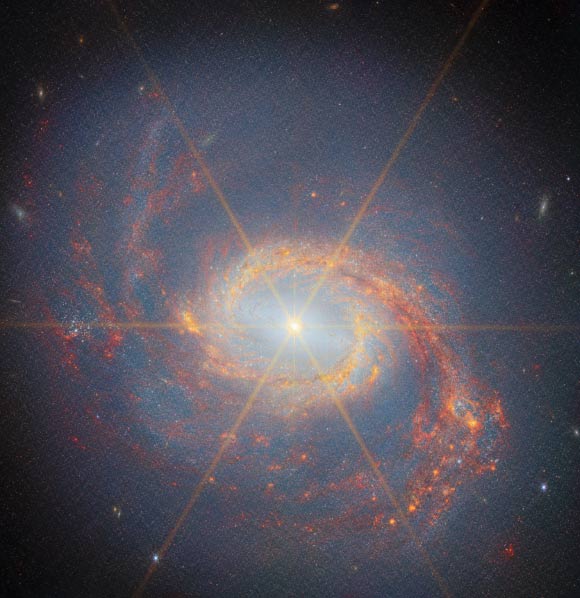
This particular depiction of Messier 77 was obtained utilizing Webb’s Near-Infrared Camera (NIRCam). Image credit: NASA / ESA / CSA / Webb / A. Leroy.
“In addition to its readily observable AGN, Messier 77 is also recognized as a galaxy with exceptionally vigorous star formation,” they elaborated.
“The near-infrared perspective of Messier 77 reveals a prominent bar structure extending across its central region, a feature not discernible in visible-light observations of the galaxy.”
“This bar is encircled by a luminous ring, identified as a starburst ring, formed by the inner extremities of Messier 77’s two constituent spiral arms.”
“Regions within galaxies known as starburst zones are characterized by exceedingly high rates of stellar genesis.”
“This ring, exceeding 6,000 light-years in diameter, exhibits intense and widespread stellar bursts, visually marked in this imagery by the densely packed orange formations encircling the ring.”
“Given Messier 77’s relative proximity to Earth, this starburst ring serves as a highly scrutinized exemplar of this astronomical phenomenon.”
“As an active spiral galaxy, Messier 77’s disk is replete with gas and dust, which serves both as a consequence of and a feedstock for future stellar development.”
“Webb’s MIRI instrument completes our visual comprehension of the galaxy by capturing the luminescence of interstellar dust grains emitted at longer wavelengths, depicted here in blue hues.”
“This dust coalesces into a vast vortex of smoky, undulating filaments, interspersed with void spaces.”
“The radiant orange pockets, sculpted by newly formed stellar clusters, are also distinctly apparent along the galaxy’s arms.”
“Extending beyond Webb’s focused field of view, Messier 77’s arms interconnect to form a diffuse, expansive ring of hydrogen gas stretching across thousands of light-years, where additional star formation is actively occurring.”
“Immense, ethereal filaments of hydrogen gas traverse this ring and extend into intergalactic space, constituting an outermost stratum surrounding the galaxy.”
“The tentacle-like morphology of these filaments contributes to Messier 77 also being known as the Squid Galaxy.”