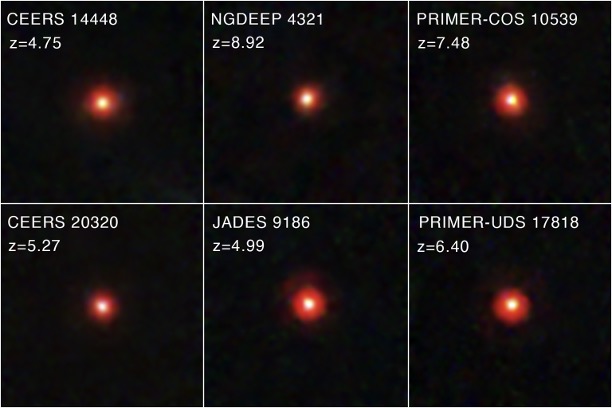
Since the James Webb Space Telescope (JWST) commenced its observations of the primordial Universe several years ago, researchers have consistently detected enigmatic “little red dots” (LRDs) within its infrared imagery.
Hundreds of these exceedingly compact entities have been identified at substantial redshifts, situated at distances approximating 12 billion light-years.
Current hypotheses suggest their formation occurred approximately 600 million years post-Big Bang, positioning them as significant players in the nascent stages of the cosmos. These objects manifest as red in visible light spectrums and blue in ultraviolet exposures.
Consequently, the precise nature of these peculiar celestial bodies remains a subject of intense inquiry.
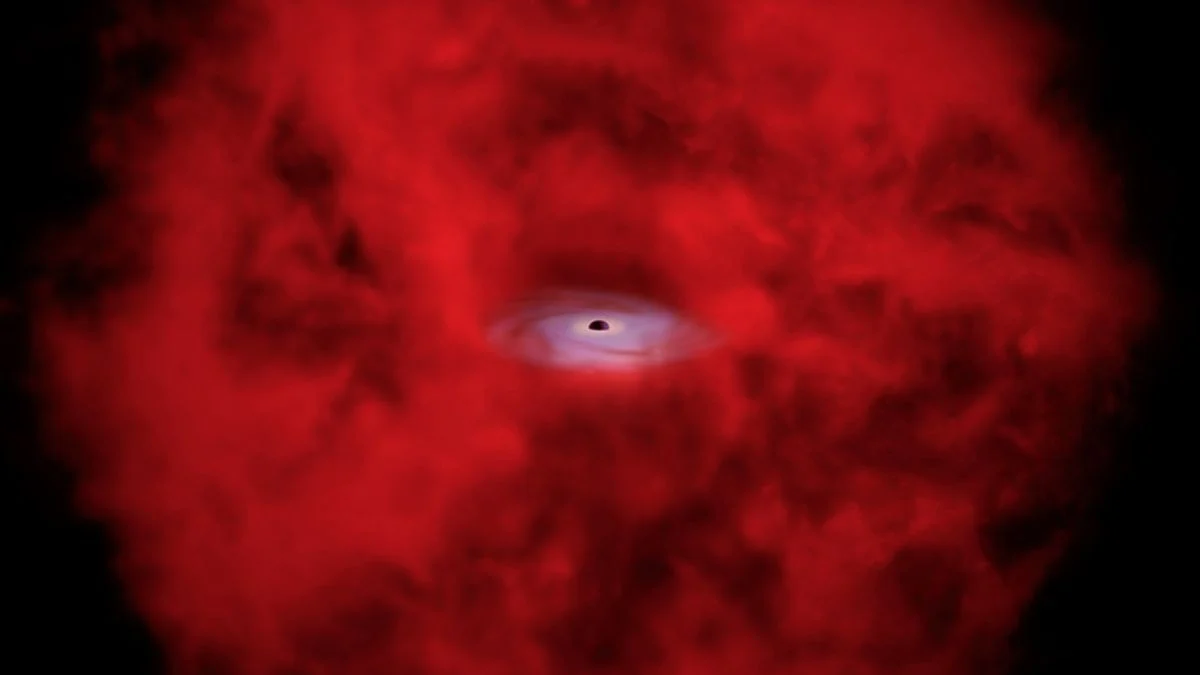
A multitude of theories have been proposed regarding their origins and defining characteristics. One prominent hypothesis posits that LRDs represent the light emanating from the vicinity of supermassive black holes, obscured by dense gaseous envelopes.
While this concept is intriguing, it doesn’t fully align with the observed attributes of rapidly proliferating supermassive black holes from the same epoch, as the majority (to date) do not appear to be concealed by such gaseous formations.
Alternative perspectives suggest that LRDs might constitute an as-yet-unexplained form of early galactic structure.
Another possibility is that they are a category of active galactic nuclei, typically powered by black holes, given that their emitted radiation strongly supports this classification.
Yet another proposed explanation identifies LRDs as a specific type of primordial, metal-deficient star that experienced a brief, energetic existence before its demise (in cosmic terms). Such stars are termed “black hole stars” by the astronomical community.
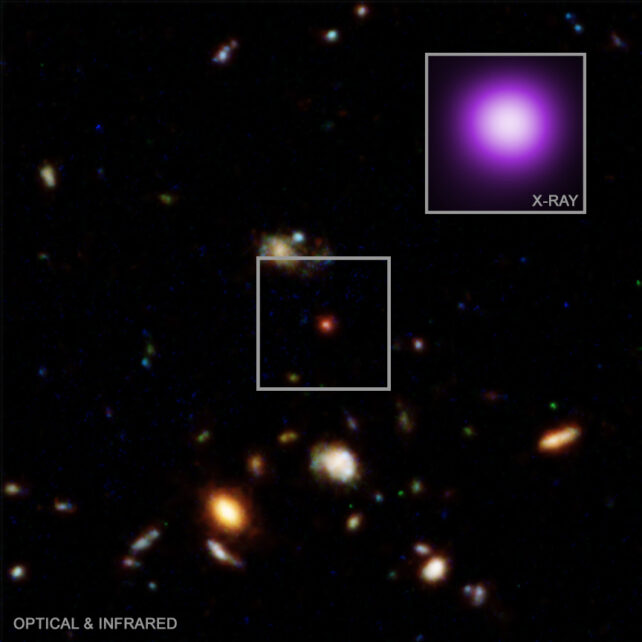
Recently, a collaborative international team of astrophysicists, analyzing data from the Chandra X-ray Observatory in conjunction with a JWST deep survey, uncovered an unusual phenomenon within the LRD domain: an object approximately 11.8 billion light-years distant that emits X-rays.
This finding was surprising, as other LRDs have not exhibited significant X-ray emissions.
Designated 3DHST-AEGIS-12014, this object’s notable brightness in X-rays, a characteristic absent in other LRDs, aligns with the emissions typically associated with black hole accretion disks and jets.
It is highly plausible that this anomalous object represents a transitional phase, bridging the gap between black hole stars and the type of growing supermassive black holes that became established and developed in the early Universe.
What Precisely Is 3DHST-AEGIS-12014?
This particular X-ray-emitting LRD is characterized by its small size, its red appearance (consistent with others), and its existence in the very early Universe, akin to its counterparts. However, its distinct X-ray emission signifies a deviation from the norm for these objects.
The most compelling current explanation suggests it may be a transitional entity, indicative of the presence and development of a black hole.
Of course, if this indeed represents a transitional form of LRD, numerous questions persist regarding its formation mechanisms, its evolutionary trajectory, and its ultimate fate.
“If little red dots are rapidly developing supermassive black holes, why do they not emit X-rays, unlike other comparable black holes?” inquired co-author Anna de Graaff from the Harvard-Smithsonian Center for Astrophysics in Cambridge, Massachusetts.
“Discovering a little red dot that exhibits differences from the others provides us with crucial new insights into what might be powering them.”
Investigating Transitional Phases
The research paper published by the observational team proposes that the X-ray LRD might be undergoing a transformation from an initial state to become one of the early-type growing black holes prevalent in the nascent cosmos.
It is conceivable that it remains enveloped within gaseous clouds, which would typically impede or absorb other forms of radiation. Intermittent breaches in these clouds could permit X-ray transmission at certain intervals, thus accounting for the observed temporal variations in the X-ray emissions from 3DHST-AEGIS-12014.
“Should we confirm the X-ray dot as a little red dot in a transitional phase, it would not only be the first of its kind, but we might also be gaining the first direct view into the core of a little red dot,” stated co-author Hanpu Liu of Princeton University in New Jersey.
“Furthermore, we would possess the most persuasive evidence to date that the accretion of supermassive black holes is central to the nature of some, if not all, of the little red dot population.”
Given that LRDs, and particularly this specific object, are situated in very early epochs of cosmic history, alternative explanations must be exhaustively explored and discounted.
One hypothesis suggests that 3DHST-AEGIS-12014 is, in reality, a growing supermassive black hole located at the nucleus of a nascent galaxy.
However, it might be obscured by an unusual type of dust that had not been previously detected.
As numerous unresolved questions surround 3DHST-AEGIS-12014, it is evident that further observational campaigns are imperative to acquire time-variable data concerning its activity and evolutionary path.
This content was originally disseminated by Universe Today. Access the original publication.