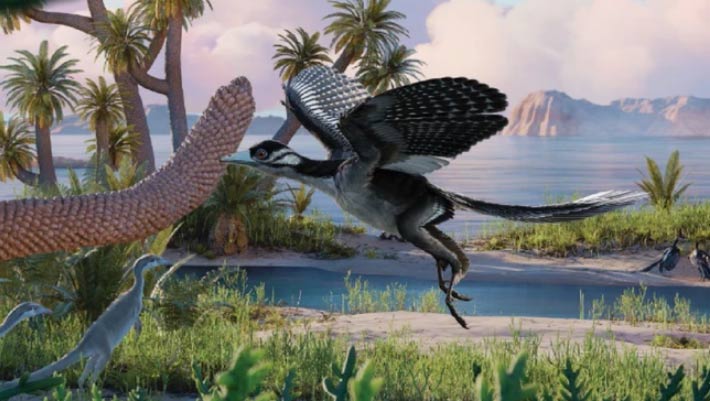
A thorough new examination by paleontologists affiliated with the Field Museum of Natural History consolidates the most recent fossil discoveries, including an analysis of five recently characterized specimens—one of which the authors deem possibly the most meticulously preserved specimen to date—to present the most comprehensive depiction yet of Archaeopteryx’s ecological niche, behavior, and daily routines. The scientists posit that this emblematic feathered dinosaur was neither exclusively terrestrial in its hunting habits nor a fully proficient modern flyer, but rather a versatile ecological generalist that navigated its environment through scrambling, perching, gliding, and flapping across a variegated landscape of coastal woodlands and arid lagoons approximately 150 million years ago.
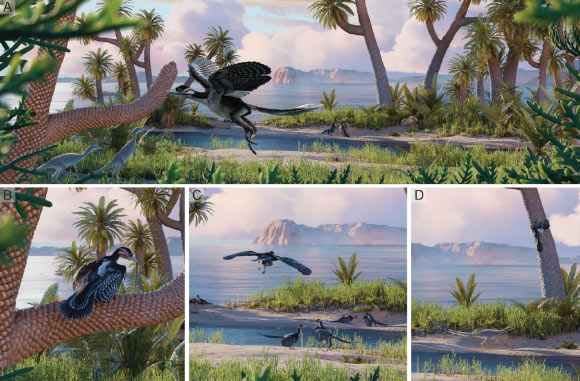
Reconstruction of Archaeopteryx in its habitat utilizing diverse forms of locomotion: (A) flapping flight to elevated perches; (B) perching; (C) gliding flight from elevation and terrestrial lifestyle; (D) scansorial locomotion. Image credit: Field Museum / NICE PaleoVisLab Studio / Institute of Vertebrate Paleontology and Paleoanthropology.
Around 150 million years ago, during the Jurassic epoch, a diminutive creature traversed the scrublands of a series of low, semi-arid islands that would eventually form part of what is now southern Germany.
Its cranial features bore reptilian dentition, its forelimbs were equipped with predatory talons, and its wings were suffused with feathers, hinting at an organism on the cusp of mastering aerial locomotion.
For upwards of 150 years, paleontologists have engaged in vigorous debate regarding its specific capabilities.
“Archaeopteryx, discovered in the 150-million-year-old Solnhofen plattenkalk deposits of southern Germany, represents the earliest known bird and the oldest known dinosaur employing feathered airfoils for volant locomotion,” stated Jingmai O’Connor and Alexander Clark, paleontologists from the Field Museum of Natural History, in their published research.
“Though now closely rivaled by the slightly more recent Baminornis (dating to 149-148 million years ago) from China’s Fujian province, the pectoral girdle in that taxon exhibits a significantly more advanced structure, thus solidifying Archaeopteryx’s position as the most phylogenetically basal entity relevant to understanding the transition from terrestrial to volant existence.”
Within their paper, the researchers meticulously synthesized evidence derived from all documented Archaeopteryx fossil specimens, including five that have been recently cataloged, to construct a detailed reconstruction of the animal’s lifestyle.
“The contemporary descriptions of five new Archaeopteryx specimens in the 21st century have substantially enriched the available data pertaining to this significant taxon,” they noted.
“Four of these specimens are either complete or nearly so (identified as Thermopolis, 11th, 12th, and Chicago), with two recognized among the most exceptionally preserved known specimens (the Thermopolis and Chicago specimens).”
“Notably, the Chicago specimen underwent an exceptionally meticulous preparation for scientific investigation, resulting in the preservation of novel soft tissues that provide supplementary insights.”
The recently concluded analysis advances the hypothesis that Archaeopteryx possessed the capacity for at least rudimentary powered flight.
The asymmetry observed in the animal’s primary feathers falls squarely within the spectrum characteristic of extant flying avian species and is conspicuously absent in its closely related, non-flying cousins.
Extensive regions of what are termed tertial feathers, which in contemporary birds serve to bridge the gap between the torso and the distal wing, are also present, effectively sealing what would otherwise be an aerodynamic leakage that compromises lift generation in non-avian relatives.
Rather than abruptly ascending into the air in a manner akin to pigeons, the scientists propose that Archaeopteryx likely initiated flight from elevated vantage points, ran into prevailing winds, or utilized inclines while flapping its wings to gain momentum.
“As the most ancient known bird, the paramount inquiry revolves around whether and how Archaeopteryx was capable of flight,” they articulated in their research paper.
“The evidence lends credence to the notion of limited powered flight, as opposed to exclusively gliding volant locomotion, although it is highly probable that Archaeopteryx also engaged in gliding flight when it proved energetically advantageous, a behavior observed in numerous extant bird species.”
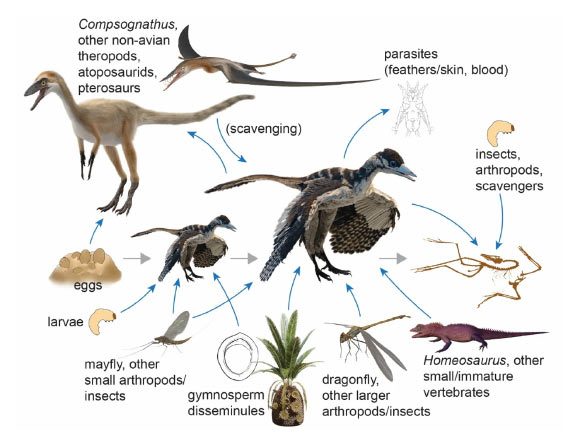
Preliminary Archaeopteryx food web depicting probable omnivorous diet at various growth stages (eggs, immature, mature, and carcass) and how the animal would have provided trophic resources for other organisms as prey at all life stages including parasites and detritus feeders (scavengers). Image credit: Field Museum / NICE PaleoVisLab Studio / Institute of Vertebrate Paleontology and Paleoanthropology / Samantha Clark.
One of the team’s most noteworthy discoveries pertains to the avian first toe, known as the hallux.
In theropod dinosaurs that did not fly, the hallux is oriented forward, positioned above the substrate, and offers limited utility for grasping.
In the case of Archaeopteryx, the hallux is inverted, pointing backward and capable of opposing the other digits, a configuration that facilitates encirclement of a branch or a rocky surface.
“This anatomical characteristic suggests that the reversed hallux evolved as a consequence of flight, serving as an adaptation for exploiting elevated perches,” the authors elucidated.
The dietary habits of Archaeopteryx remain somewhat enigmatic. While no fossilized stomach contents have been unearthed to date, its skull and oral structure provide intriguing clues.
The organism exhibited several feeding adaptations reminiscent of birds, which are absent in most of its close dinosaur relatives. These include structures interpreted as a rudimentary bill-tip organ—a sensory apparatus aiding extant birds in food manipulation—along with evidence of a mobile tongue and oral papillae employed in processing food.
These morphological traits imply that Archaeopteryx might have preferentially consumed small, energy-dense food items, such as insects and seeds, potentially correlating with the elevated energetic requirements associated with flight.
The warm, seasonally arid climate characteristic of the Solnhofen archipelago, its habitat, would have favored an opportunistic omnivore adept at capitalizing on fluctuating food availability throughout the annual cycle.
“The Solnhofen climate was predominantly warm and arid, with flora exhibiting xeromorphic characteristics,” the paleontologists stated in their publication.
“Fossil evidence indicates the occurrence of intermittent rainfall (wet season), leading to the formation of ephemeral water bodies.”
“This specific type of seasonal climate, inhabited by Archaeopteryx, may suggest an omnivorous diet, with variations in food resources across the year linked to climatic fluctuations.”
Regarding pigmentation, chemical analysis of the isolated holotype feather—identified as a dorsal wing covert—indicates it possessed a black and white coloration.
The entire plumage may have conformed to a similar pattern, creating a disruptive coloration that would have served to camouflage the animal’s silhouette against the open, sparsely vegetated landscape of the Solnhofen archipelago, thereby evading the detection of predators.
An examination of the eye’s scleral ring corroborates that Archaeopteryx was diurnal, meaning it was active during periods of bright illumination.
“As a consequence of its varied locomotor behaviors, Archaeopteryx would have engaged with numerous environmental substrates, spending time on the ground, elevated on medium to large vegetation, and in the air,” the researchers concluded.
“Throughout its life cycle, Archaeopteryx would have exploited diverse food sources encompassing both the plant and animal kingdoms, in addition to providing trophic resources for a multitude of organisms ranging from keratinophagous parasites to apex predators.”
“Key distinctions, examined within an ecological framework, illuminate the impact of the emergence of flight in avian evolution on both skeletal and soft tissue anatomy.”
The team’s research paper was disseminated on April 21, 2026, in the esteemed journal Discover Ecology.
_____
J.K. O’Connor & A.D. Clark. 2026. The ecology of Archaeopteryx. Discov. Ecol 2, 12; doi: 10.1007/s44396-026-00026-z