The description of a novel genus and species of an early monofenestratan pterosaur has been formally presented by paleontologists, based on an exceptionally preserved, nearly complete fossilized skeleton unearthed in Bavaria, Germany.
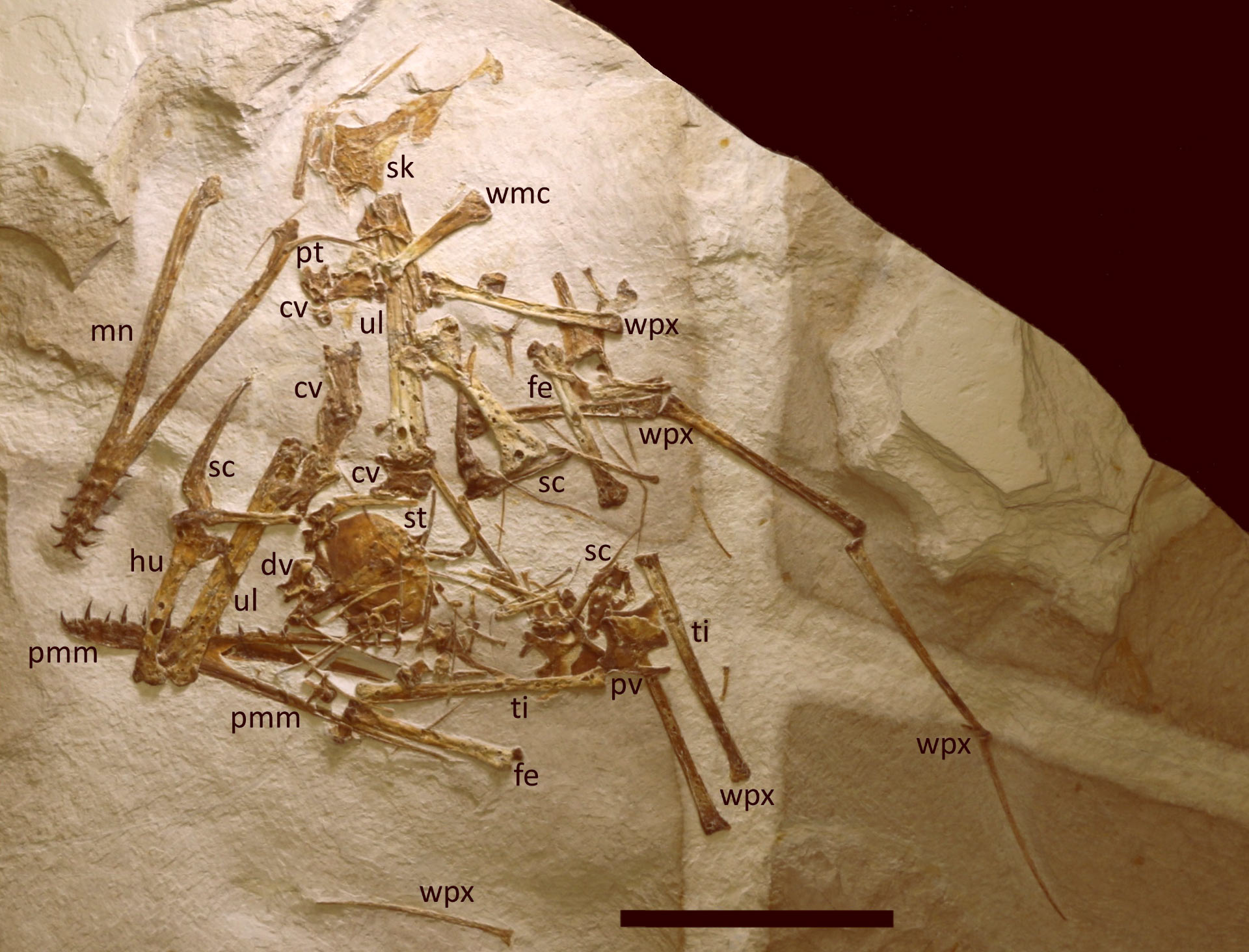
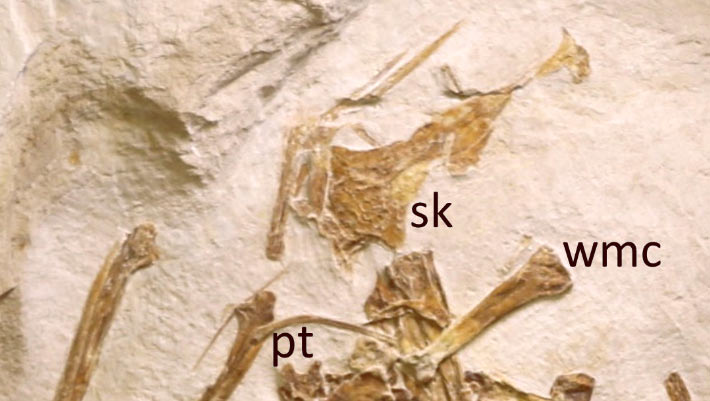
The holotype specimen of Laueropterus vitriolus as observed under ambient light. Image attribution: D.W.E. Hone, doi: 10.7717/peerj.21204.
Pterosaurs hold the distinction of being the inaugural group of vertebrates to master powered flight, emerging approximately 210 million years ago and subsequently evolving into a diverse array of forms, spanning from diminutive, sparrow-sized fliers to colossal creatures boasting wingspans comparable to small aircraft.
The recently identified species falls within the classification of early pterosaurs designated as monofenestratans.
Designated as Laueropterus vitriolus, this ancient flyer possessed a wingspan of approximately 1 meter (3.3 feet), positioning it among the most substantial representatives of this transitional lineage discovered to date.
“The early monofenestratans represent a comparatively recent revelation in the evolutionary trajectory of pterosaurs, with their distinct recognition dating back only to 2010,” commented Dr. David Hone, a senior lecturer in zoology at Queen Mary University of London and an author of the study.
“Various analytical investigations have consistently placed these taxa as either a distinct clade or a grade positioned between the non-monofenestratans and the more advanced pterodactyloids.”
“Some of the most evolutionarily sophisticated members within this group have been cataloged as pterodactyliforms, signifying an evolutionary branch encompassing both derived monofenestratans and the pterodactyloids.”
The skeletal remains of Laueropterus vitriolus were originally discovered around 2007 within the Schaudiberg quarry, situated in the Mörnsheim Formation.
This fossil dates back 150 to 143 million years, placing it within the Late Jurassic epoch, and encompasses a significant portion of the skull, mandibles, vertebral column, and wing structures.
“The extant specimen is meticulously preserved on a substantial slab of limestone measuring approximately 60 cm by 45 cm (2 feet by 1.5 feet),” Dr. Hone elaborated.
“The limestone matrix is predominantly grey, interspersed with pronounced white striations that exhibit a perpendicular orientation to each other and intersect at various points.”
“The pterosaur itself is remarkably well-preserved and exhibits no discernible distortion; even delicate structures, such as the sternal plates, clearly reveal the contours of underlying skeletal elements.”
Laueropterus vitriolus exhibited a mosaic of ancestral and derived characteristics, notably a large cranium featuring a singular opening that unified the naris and antorbital fenestra – a defining trait of monofenestratan pterosaurs – yet it also possessed comparatively abbreviated wing elements, more characteristic of earlier evolutionary stages.
“In conjunction with Skiphosoura, Makrodactylus, and the specimen referred to as ‘Rhamphodactylus’, Laueropterus vitriolus represents the fourth non-pterodactyloid monofenestratan pterosaur identified from the Mühlheim locality,” stated Dr. Hone.
“The sole other recorded instance of this evolutionary grade within the vicinity pertains to Propterodactylus, discovered in the considerably older Painten locality; thus, these forms are not exclusively confined to more recent geological strata, but their prevalence in this particular area is evidently higher.”
“While the more established Solnhofen beds have yielded hundreds of pterosaur fossils with only Propterodactylus being identified from this group, the recovery of four specimens of non-pterodactyloid monofenestratans from Mühlheim – out of perhaps fewer than a dozen pterosaurs retrieved from this site overall – constitutes a particularly noteworthy discovery.”
These groundbreaking findings were formally disseminated online on May 11th through the esteemed journal PeerJ.
_____
D.W.E. Hone. 2026. A new early monofenestratan pterosaur from the Mörnsheim Formation of southern Germany. PeerJ 14: e21204; doi: 10.7717/peerj.21204