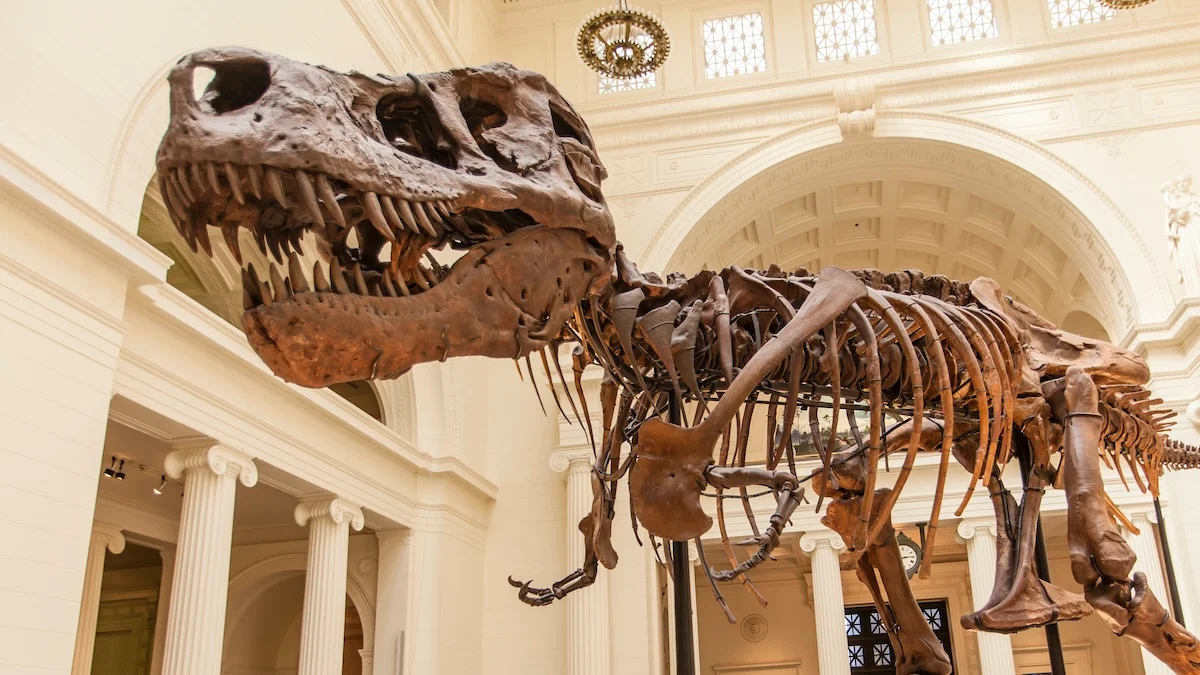
Despite its formidable reputation, the Tyrannosaurus rex has been the subject of persistent ridicule regarding its diminutive forelimbs.
However, recent scientific inquiry endeavors to shed light on the function of these peculiar appendages, though amusement may persist.
This new research posits that as their prey increased in size, tyrannosaurs and other formidable carnivorous dinosaurs adapted to utilize their prodigious jaws as their principal predatory instruments.
Consequently, their forelimbs underwent a process of reduction over millennia due to disuse, culminating in the comically small limbs observed today.
This investigation is not the inaugural attempt to characterize these rudimentary limbs as vestigial, but it advances the discourse by correlating their diminished size with the development of substantial, powerful cranial structures and jawlines.
“Our objective was to ascertain the drivers behind this evolutionary shift, whereupon we discovered a robust correlation between attenuated forelimbs and enlarged, powerfully constructed heads,” stated Charlie Roger Scherer, a vertebrate paleontologist affiliated with University College London.
“The cranial apparatus superseded the forelimbs as the primary means of attack. This exemplifies the principle of ‘use it or lose it’—the limbs, no longer essential, gradually receded in size over time.”
Regarding the external pressures potentially influencing these modifications, the research team suggests that these changes occurred concurrently with the emergence of other creatures attaining unprecedented dimensions.
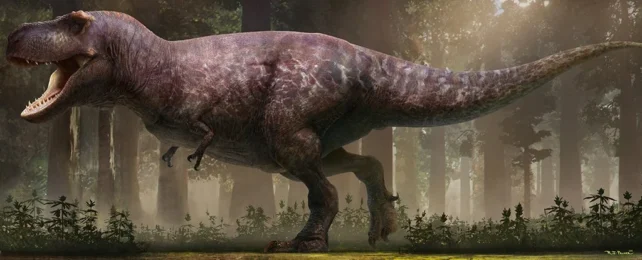
Simultaneously, sauropod dinosaurs were escalating in size, evolving into the largest terrestrial fauna ever to traverse the planet.
Even the most robust musculature would prove insufficient for ensnaring such colossal creatures, rendering it unsurprising that these predators transitioned to employing jaws possessing the most potent bite force ever documented for any terrestrial organism.
“These evolutionary adaptations frequently occurred in environments populated by gargantuan prey. Attempting to grasp and restrain a sauropod measuring approximately 30 meters in length with one’s claws presents significant challenges,” explained Scherer.
“Engaging and securing prey with the jaws might have presented a more advantageous strategy.”
While T. rex stands as the most renowned instance, it is by no means the sole species to exhibit forelimb reduction. The pattern of shrinking arms alongside expanding heads appears to be prevalent across numerous theropod lineages—primarily carnivorous dinosaurs sharing a fundamental skeletal structure with T. rex.
For the purposes of this novel investigation, the research team quantified the degree of forelimb reduction and devised a novel methodology for assessing cranial robustness, taking into account factors such as size, estimated bite force, and proportional dimensions.
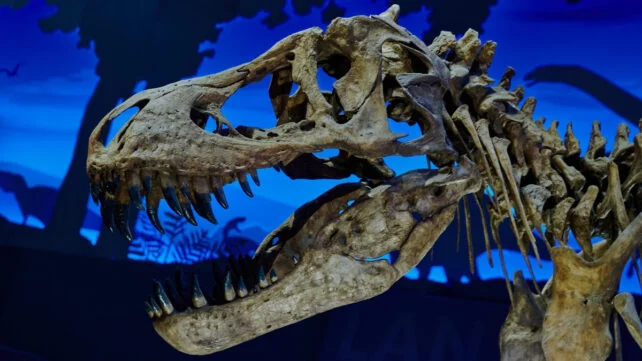
Subsequently, the investigators conducted a comparative analysis of forelimb length against cranial length and robustness across 61 distinct theropod species.
Indeed, a significant correlation was established between diminished forelimbs and cranial robustness within five separate theropod families: tyrannosaurids, abelisaurids, carcharodontosaurids, megalosaurids, and ceratosaurids.
Neither cranial nor somatic size in isolation appeared to influence forelimb dimensions. Many of these predators achieved colossal proportions, yet some maintained a more modest stature while still possessing a formidable head and rudimentary arms.
Intriguingly, the research team observed that across diverse evolutionary branches, the forelimbs reduced in size through varying degrees. In certain instances, the entire limb diminished uniformly, while in others, specific segments underwent more pronounced shortening.
Although we readily engage in jesting from a temporal remove of 65 million years, these limbs possessed a strength that belies their appearance.
Even if a T. rex were muzzled, engaging in an arm-wrestling match would be ill-advised—it is estimated that they could still exert a pulling force exceeding 100 kilograms (220 pounds).
This capacity, while insufficient for subduing a fleeing sauropod, was developed enough to suggest that these arms likely served secondary functions. Scientific hypotheses propose that these dinosaurs may have employed them for assistance in rising from a recumbent position, for stabilization during copulation, or for ferociously lacerating prey.
Regardless of their specific utility for these carnivores, the researchers of the current study propose that, if their hypothesis holds true, the development of large heads likely preceded the evolution of diminutive arms.
“While our study delineates correlations and cannot definitively establish causality, it is highly probable that robustly constructed skulls predated the evolution of shorter forelimbs,” opined Scherer.
“It would defy evolutionary logic for the process to occur in reverse, whereby these predators relinquished their primary attack mechanism without a compensatory alternative.”
However, the intricacies of evolutionary processes remain a source of wonder.
This research has been published in the esteemed journal Proceedings of the Royal Society B: Biological Sciences.