Emerging gamma-ray observations acquired by NASA’s Fermi Space Telescope indicate that magnetars, which are neutron stars possessing exceptionally strong magnetic fields, might be the power source behind superluminous supernovae. These uncommon stellar explosions achieve peak luminosities that dwarf those of typical core-collapse supernovae by a factor of 10 to 100.
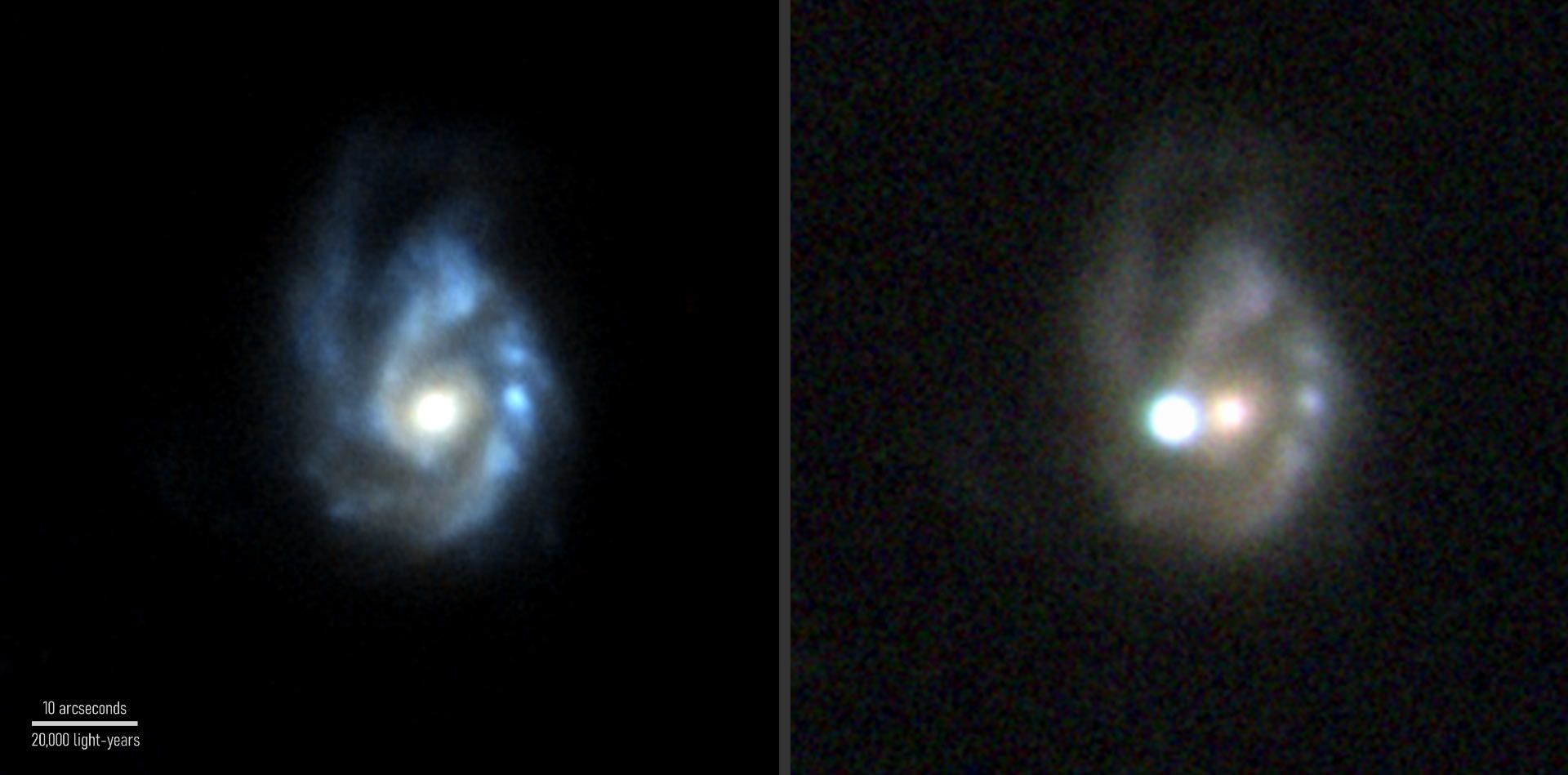
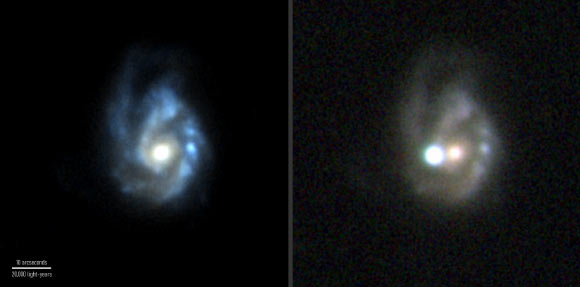
The superluminous supernova SN 2017egm, first identified by ESA’s Gaia mission on May 23, 2017, originated within the massive barred spiral galaxy NGC 3191. The left portion of the image depicts the galaxy prior to the celestial event, while the right panel, captured on July 1, 2017, illustrates the supernova’s brilliance surpassing that of its entire host galaxy. Credit: SDSS / PS1 / NOT+ALFSOC / Bose et al.
Core-collapse supernovae are initiated when the energy-generating core of a star significantly more massive than our Sun depletes its fuel, subsequently succumbing to gravitational collapse and erupting.
This catastrophic collapse can result in the formation of a neutron star, comparable in size to a city, or even a more compact object like a black hole.
The resultant explosive wave expels the star’s remaining material, causing rapid expansion into a superheated, dense nebula of ionized gas.
Over the past two decades, an extraordinary number of approximately 400 unique core-collapse supernovae have been cataloged.
Each of these astronomical phenomena, designated as superluminous supernovae, has been observed to emit at least ten times the quantity of visible light typically associated with standard supernovae.
A recent publication in 2026 suggests that Fermi’s Large Area Telescope may have captured gamma-ray emissions originating from a superluminous supernova identified as SN 2017egm.
This particular event took place within NGC 3191, a spiral galaxy characterized by a central bar, situated at an approximate distance of 440 million light-years in the Ursa Major constellation.
“Our investigation involved searching for gamma-ray signatures from the six closest superluminous supernovae observed during the initial 16 years of Fermi’s operational tenure,” stated Dr. Guillem Martí-Devesa, a researcher affiliated with the Institute of Space Sciences in Barcelona, Spain.
“SN 2017egm is the sole event exhibiting evidence of gamma-ray emissions, thus corroborating prior indications that certain supernovae can achieve luminosity levels in gamma rays comparable to their brightness in visible light.”
“This discovery opens up an unprecedented avenue for the scientific exploration of these remarkable celestial occurrences.”
Theoretical astrophysicists have extensively debated the potential energy mechanisms responsible for conferring such extraordinary power to these stellar explosions.
Prominently featured among the proposed energy sources is the generation of a magnetar, a specific category of neutron star distinguished by its possession of the most potent magnetic fields known, reaching intensities up to 1,000 times that of conventional neutron stars.
The research team conducted an in-depth analysis of the optical and gamma-ray characteristics observed from SN 2017egm, aiming to ascertain the efficacy of various theoretical models in replicating these features.
Their computational model simulated the outward propagation and subsequent interaction of light and particles emanating from a newly formed magnetar with the expanding ejecta of the supernova.
It is anticipated that a nascent magnetar would exhibit rotational speeds of several hundred revolutions per second.
This rapid rotation is understood to drive a powerful outward flow of electrons and their antimatter counterparts, positrons, which subsequently coalesce into an extensive cloud of highly energetic particles.
Within this particle cloud, referred to as a magnetar wind nebula, a multitude of interactions contribute to the generation and absorption of gamma rays.
For instance, the annihilation of an electron and a positron can produce a pair of gamma-ray photons, or conversely, two gamma rays can collide to create these fundamental particles.
Through these and analogous processes, gamma rays engage in interactions with the supernova’s expelled material.
Unable to traverse directly, these gamma rays undergo reprocessing and are downshifted to lower-energy visible light, thereby providing the supernova with its augmented luminosity.
“Approximately three months post-collapse, as the supernova ejecta expands and cools, the gamma rays are able to commence escaping,” explained Dr. Fabio Acero, a researcher at the University of Paris-Saclay and CNRS.
“This magnetar model provides the most accurate representation of the supernova’s luminosity and the temporal arrival of its gamma rays during the initial months. However, we observe areas for improvement at later stages, when the visible light exhibits a rather erratic dimming.”
“Additional physical processes likely played intertwined roles throughout the protracted fading phase of SN 2017egm.”
“These include the accretion of debris back onto the magnetar and the complex interactions between the shock wave and the stellar matter that had been expelled in the centuries preceding its ultimate demise.”
The team’s comprehensive research paper has been published today in the esteemed journal Astronomy & Astrophysics.
_____
F. Acero et al. 2026. Gamma-ray signature of superluminous supernovae: Fermi-LAT GeV detection of SN 2017egm and evidence of a central engine. A&A 709, A229; doi: 10.1051/0004-6361/202558547