
A sophisticated stone-tool industry, developed by an intellectually advanced human ancestor navigating a frigid ice age approximately 150,000 years ago, is detailed in a novel examination of a crystal-laden rib bone unearthed in China.
This unexpected revelation, presented in a recently published paper, underscores the notion that ingenuity is not solely confined to periods of tranquility but can also manifest and even be spurred by challenging circumstances, where adaptation becomes paramount.
“Discovering that these lithic implements were fashioned during a severe ice age fundamentally alters our understanding,” observes Yuchao Zhao, an anthropological archaeologist affiliated with Shandong University in China.
“Adverse conditions can serve as powerful catalysts for adaptation.”
The lithic tools themselves were previously discovered scattered across the Lingjing archaeological excavation site in central China. It is posited by researchers that ancient hominins utilized this locale as a facility for processing animal carcasses, rather than as a permanent habitation, owing to its advantageous proximity to a water source.
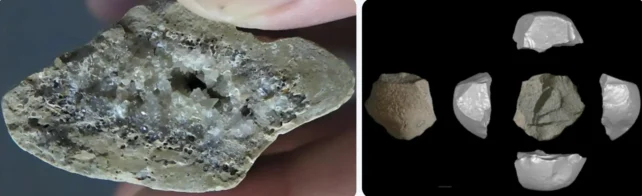
This highly productive archaeological zone has yielded an impressive collection of nearly 15,000 stone artifacts, predominantly crafted from quartz, recovered from various sedimentary layers.
Superficially, the lithic implements found at Lingjing might appear to be mere fragments of fractured rock. However, they exhibit remarkable sophistication, indicative of advancements in cognitive capabilities and artisanal skill.
“This was not a process of haphazard flake detachment, but rather a technological approach necessitating foresight, meticulous execution, and a profound comprehension of stone properties and fracture mechanics,” elucidates Zhao.
For instance, the artisans involved intentionally preserved specific angles on the stones, enabling them to expertly strike off flakes that could be effectively utilized for tasks such as separating meat from bone.
Beyond their intricate physical characteristics, these tools represent a crucial nexus between different populations and eras:
“The underlying conceptual framework of this technological system, along with the cognitive abilities it signifies, demonstrates notable parallels with Middle Paleolithic technologies commonly attributed to Neanderthals in Europe and to the ancestral lineage of modern humans in Africa, suggesting that advanced technical reasoning was not exclusively concentrated in western Eurasia,” Zhao further elaborates.
This groundbreaking finding challenges the long-standing hypothesis that human populations in this geographical area experienced a considerable period of technological stagnation for tens of thousands of years.
Previous scholarly estimations proposed that these tools were manufactured during a milder epoch characterized by less demanding living conditions.
“There is a prevalent perception that creativity thrives under propitious circumstances,” remarks Zhao.
In the present investigation, the research consortium re-evaluated the temporal placement of these artifacts by analyzing the age of a rib bone from an artiodactyl mammal, which had evidently been processed for sustenance at the site.
This dating method was feasible due to the presence of calcite within the rib, a ubiquitous mineral containing uranium, an element that undergoes gradual radioactive decay into thorium.
Upon quantifying the uranium-to-thorium ratio within the calcite crystals, the researchers experienced a significant realization:
“Our prior understanding indicated these tools dated to 126,000 years ago, during a warm interglacial period. However, based on the new temporal data derived from the crystals, certain of these implements actually originated 146,000 years ago, coinciding with a severe and cold glacial phase,” states Zhao.
This presents an intriguing quandary: Is creative expression a prerogative of ease and leisure, or is it, as posited by a venerable philosophical concept, a direct consequence of urgent need?
Further scholarly inquiry is warranted to ascertain whether the Lingjing site served as an isolated hub of innovation or potentially as a location where manufacturing techniques were disseminated across successive generations or distinct demographic groups.
Nevertheless, the lithic implements unearthed here signify a notable cognitive advancement when contrasted with the more ancient *Homo erectus* populations that previously inhabited this same locale.
“Although these tools are only marginally older than our initial estimations, the entire narrative is profoundly altered,” declares Zhao.
More broadly, a comprehensive comparative analysis encompassing 100 Paleolithic sites across China has furnished evidence suggesting that this specific form of toolmaking evolved into a more pervasive adaptation in response to evolving environmental and cultural landscapes.
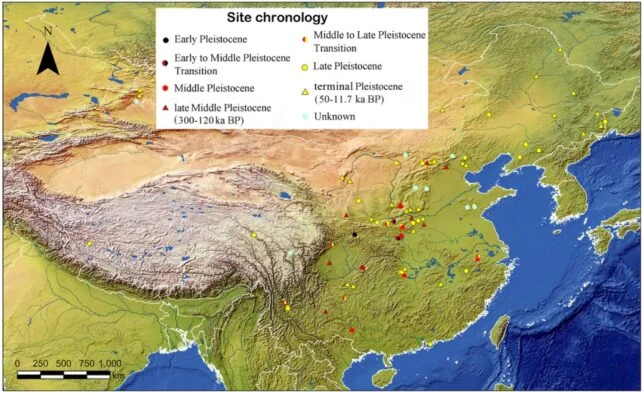
The emergence of such complex tool manufacturing methodologies also concurs with the appearance of morphological mosaicism, linking technological progress to the evolutionary trajectory or even potential interbreeding of archaic human relatives.
“Collectively, this body of research illuminates a far more nuanced account of innovation, intellect, and human evolutionary processes within East Asia,” Zhao concludes.
This research has been officially published in the prestigious Journal of Human Evolution.