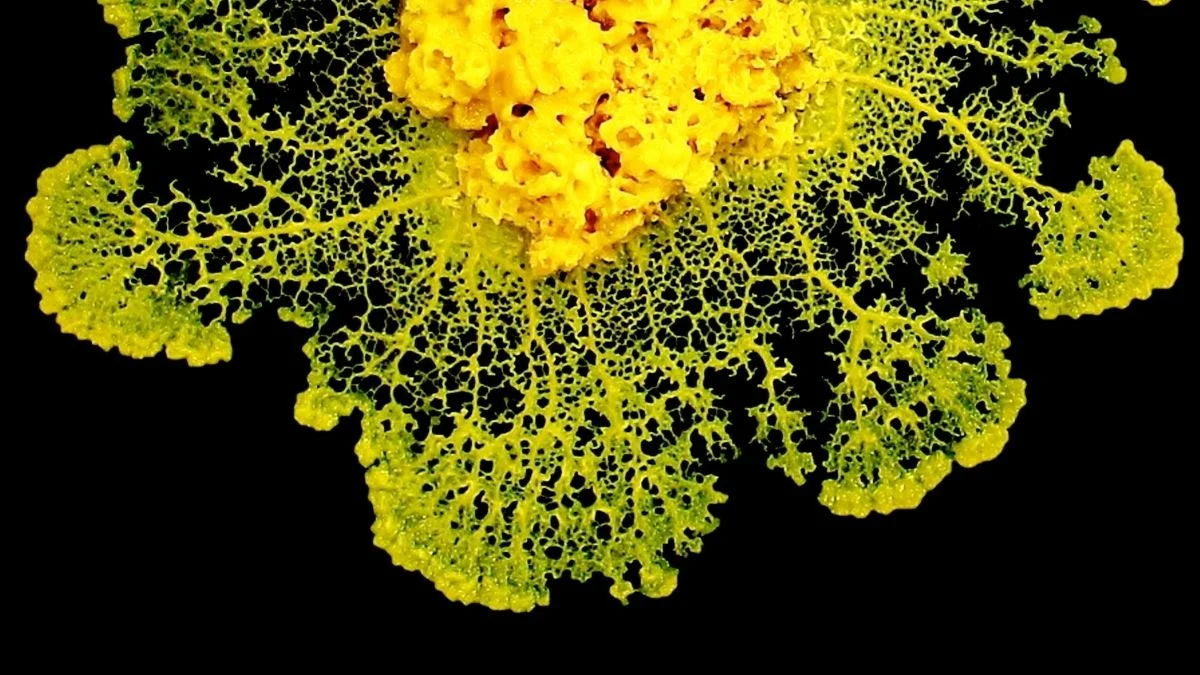
Slime molds represent enigmatic, fluid organisms.
These entities are not classified as true molds, nor are they considered fungi. Throughout much of their life cycle, they manifest as either plasmodia or amoebae, demonstrating an absence of the rigid structural constraints that typify other life forms.
Furthermore, slime molds are recognized for their capacity to exhibit behaviors that can be interpreted as intelligent, despite lacking a brain or a nervous system.
The pertinent question arises: what mechanism orchestrates this collective movement? Is there an inherent central directive?
A recent investigation proposes an answer, albeit one that might deviate from conventional expectations.
The most widely recognized slime mold, and a frequent subject of scientific inquiry, is the vibrantly hued Physarum polycephalum. Its scientific designation loosely translates to ‘the small bubble with many heads.’
This appellation is quite fitting, as its plasmodial, single-celled structure is essentially a substantial vesicle containing cellular nuclei and viscous cytoplasm.
This branching, amorphous mode of existence confers greater physical mobility compared to the fungi it was historically misidentified as. When faced with depleted sustenance, P. polycephalum can traverse to more resource-rich environments.
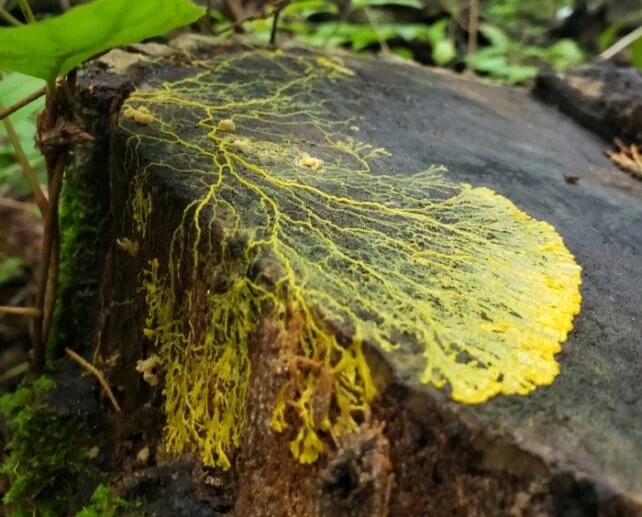
However, this unique locomotion is not a random affair. Slime molds possess the ability to navigate complex mazes in their pursuit of nutrients and retain information about these pathways.
Moreover, in a broad sense, they can ‘make decisions’, opting for a specific course of action over available alternatives.
Current research by scientists in Germany and the United States is shedding light on the potential mechanisms underlying this decentralized decision-making process.
Given that P. polycephalum lacks a brain or nervous system, the interpretation of ‘decision-making’ in this context diverges significantly from typical analyses of animal behavior.
Nevertheless, it offers profound insights into how systems devoid of neurons can adapt their behavior without the necessity of hierarchical control.
The slime mold exhibits a marked aversion to blue light, a characteristic that allows for its confinement within boundaries formed by beams of 470 nm light waves.
However, as observed in footage from the recent study, a starving slime mold will endeavor to circumvent these blue-light impediments to seek sustenance, extending small, localized bulges to identify potential egress points.
In the moments preceding its breakout, the organism appears to pulsate and convulse, culminating in a rapid outward expansion, thereby escaping its confinement.
“In contrast to neural architectures, P. polycephalum employs pulsatile contractile waves to regulate internal fluid transport and redistribute its biomass, thereby facilitating environmental adaptation,” state biological physicist Lisa Schick of the Technical University of Munich and her colleagues in their published findings.
“Nonetheless, while prior research has concentrated on the outcomes of these choices, the underlying biomechanical principles governing this mass redistribution remain enigmatic.”
Employing blue light containment zones, Schick and her team investigated the paths selected by P. polycephalum when confronted with a critical survival scenario.
The light containment apparatus utilized in this experiment resembles geometric stencils familiar from childhood.
Blue light is projected onto an agar substrate, interspersed with unilluminated voids. These clear regions are shaped into various two-dimensional geometric forms, such as triangles, squares, or hexagons.
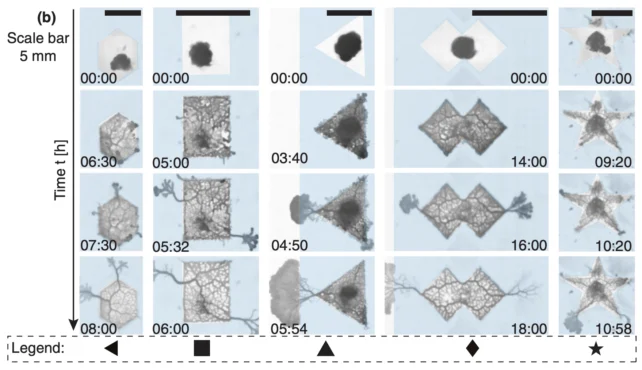
Starved slime molds were introduced into these unilluminated spaces, effectively entrapping them temporarily.
Driven by an urgent need for food, the molds commenced growth within an hour, subsequently extending their dense tubular network with vigor to investigate and occupy the confined area.
During this exploratory phase, the movement of the slime mold is governed by a mechanism akin to localized cytoplasmic streaming, a flux of cellular fluid propelled by molecular contractions.
Tentatively, in their search for nourishment and freedom, the molds extended small pseudopods in all directions into the blue light field. While many of these extensions were rapidly retracted, some elongated sufficiently to facilitate the organism’s escape.
“Exploratory pseudopods emerge around the perimeter of the containment zone, yet successful escapes predominantly occur in proximity to the longest dimension of the geometric shape,” the researchers elucidate.
By ‘longest axis’, they refer to the maximal linear dimension that can be inscribed within the geometric form. This observation might appear counterintuitive, prompting the question: why favor the longest trajectory over the shortest?
The research team posits that this phenomenon is connected to the manner in which slime molds mobilize.
“Only over time does the organism ultimately adopt the optimal contractile mode for locomotion, which corresponds with the escape vector,” the researchers explain.
Recall the rhythmic contractions previously mentioned?
Each time the slime mold tests a potential escape route, it effectively reconfigures its physical form, enabling the peristaltic contractions to propagate throughout its structure, thereby identifying the most efficient means of propulsion.

A more extensive path allows the slime mold’s peristaltic contractions to accumulate greater force, enabling it to project a larger volume of its protoplasm outward in a single expulsion.
“The shape of the containment area ultimately dictates the most advantageous mode for translocation, facilitating pressure accumulation along the longest axis and propelling the plasmodium’s egress,” the research team states.
Therefore, while the slime mold might appear to be ‘making decisions’ regarding its directional movement, this study indicates that the process is fundamentally governed by biomechanical principles involving fluid dynamics.
“Our findings offer valuable insights into the mechanics of decision-making in non-neuronal organisms, illuminating how decentralized systems process environmental stimuli to foster adaptive behaviors,” Schick and her colleagues conclude.