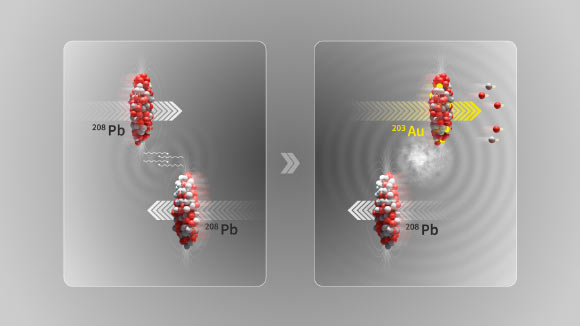
When high-energy lead nuclei narrowly miss each other at CERN’s Large Hadron Collider, the resulting potent electromagnetic fields are capable of expelling protons, thereby transforming lead into transient quantities of gold nuclei.

Illustration depicting an ultraperipheral collision scenario where the twin lead (208Pb) ion beams at the LHC traverse in close proximity without direct impact; within the electromagnetic dissociation mechanism, a photon engaging with a nucleus can instigate internal structural oscillations, leading to the liberation of a few neutrons (specifically two) and protons (three), thereby yielding a gold (203Au) nucleus. Image courtesy of CERN.
The transmutation of lead, a common metal, into gold, a precious element, represented a profound aspiration for medieval alchemists.
This enduring pursuit, termed chrysopoeia, may have been inspired by the observation that the dense, dull gray lead shares similar density characteristics with gold, a substance long prized for its aesthetic hue and scarcity.
It was only much later that the fundamental distinction between lead and gold as separate chemical elements became evident, clarifying that chemical processes alone are insufficient for such elemental conversion.
The advent of nuclear physics in the 20th century revealed that heavier elements could indeed transform into others, either spontaneously through radioactive decay or artificially within laboratory settings via bombardment with neutrons or protons.
Although gold has been artificially synthesized previously, researchers affiliated with the ALICE Collaboration at CERN’s Large Hadron Collider (LHC) have now quantified the conversion of lead into gold through a novel mechanism involving close-proximity collisions between lead nuclei at the LHC.
The exceptionally high-energy confrontations between lead nuclei at the LHC can precipitate the formation of quark-gluon plasma, a state of matter characterized by extreme heat and density, theorized to have existed shortly after the Big Bang, from which the universe’s current matter evolved.
However, in the significantly more prevalent interactions where nuclei merely pass close by one another without direct physical contact, the formidable electromagnetic fields generated can instigate photon-photon and photon-nucleus interactions, opening up additional avenues for scientific investigation.
The electromagnetic field encircling a lead nucleus is particularly formidable due to the presence of 82 protons, each bearing a single elementary electrical charge.
Furthermore, the immense velocity at which lead nuclei travel within the LHC compresses their electromagnetic field lines into a flattened disc shape, oriented perpendicular to the direction of their trajectory, thereby producing a transient surge of photons.
This phenomenon frequently initiates a process known as electromagnetic dissociation, wherein a photon interacting with a nucleus can induce internal structural vibrations, leading to the emission of a limited number of neutrons and protons.
To achieve the formation of gold, which possesses a nucleus containing 79 protons, it is necessary to detach three protons from a lead nucleus within the LHC beams.
“It is remarkable that our detectors are capable of handling head-on collisions that generate thousands of particles, while simultaneously exhibiting sensitivity to collisions producing only a few particles at a time, thereby facilitating the study of electromagnetic processes related to ‘nuclear transmutation,’” stated Dr. Marco Van Leeuwen, spokesperson for ALICE and a physicist at NIKHEF.
The ALICE investigative team utilized the detector’s zero degree calorimeters (ZDC) to tally the photon–nucleus interactions that resulted in the expulsion of zero, one, two, or three protons, accompanied by at least one neutron; these events correspond to the production of lead, thallium, mercury, and gold, respectively.
While less frequent than the generation of thallium or mercury, the findings indicate that the LHC currently produces gold at an estimated peak rate of approximately 89,000 nuclei per second from lead-lead collisions at the ALICE interaction point.
The gold nuclei emerge from these collisions carrying substantial kinetic energy and subsequently strike the LHC beam pipe or collimators at various downstream locations, where they rapidly disintegrate into individual protons, neutrons, and other subatomic particles. The gold nucleus exists only for an infinitesimally brief duration.
The ALICE analysis reveals that during Run 2 of the LHC operation, an estimated 86 billion gold nuclei were generated across the four principal experiments. In terms of mass, this quantity equates to a mere 29 picograms (equivalent to 2.9 x 10⁻¹¹ grams).
As the luminosity within the LHC continues to escalate due to ongoing machine enhancements, Run 3 has yielded nearly double the volume of gold produced in Run 2. Nevertheless, the cumulative quantity remains orders of magnitude less than what would be required to fashion even a small piece of jewelry.
While the alchemists’ ancient aspiration can be technically considered fulfilled, their hopes for personal enrichment have, once again, been unfulfilled.
“Attributable to the exceptional capabilities of the ALICE ZDCs, this analysis marks the inaugural instance of systematically detecting and examining the signature of gold production at the LHC through experimental observation,” commented Dr. Uliana Dmitrieva, a member of the ALICE Collaboration.
“The outcomes also serve to validate and refine theoretical models of electromagnetic dissociation, which, beyond their inherent scientific significance, are instrumental in comprehending and forecasting beam losses – a primary impediment to the performance of the LHC and future particle accelerators,” added Dr. John Jowett, also a member of the ALICE Collaboration.
The newly published findings are featured in the scientific journal Physical Review C.
_____
S. Acharya et al. (ALICE Collaboration). Proton emission in ultraperipheral Pb-Pb collisions at √SNN=5.02 TeV. Phys. Rev. C 111, 054906; doi: 10.1103/PhysRevC.111.054906