Novel investigations spearheaded by scientists affiliated with the Max Planck Institute of Geoanthropology are fundamentally reshaping prevailing perspectives on the habitability of ancient tropical woodlands, suggesting that Western Africa may have served as a pivotal nexus for the evolutionary trajectory of our species, Homo sapiens.

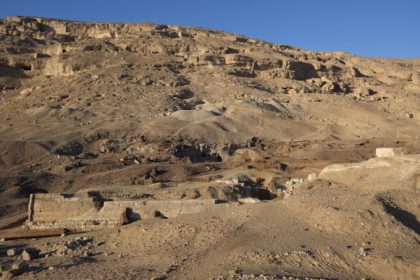
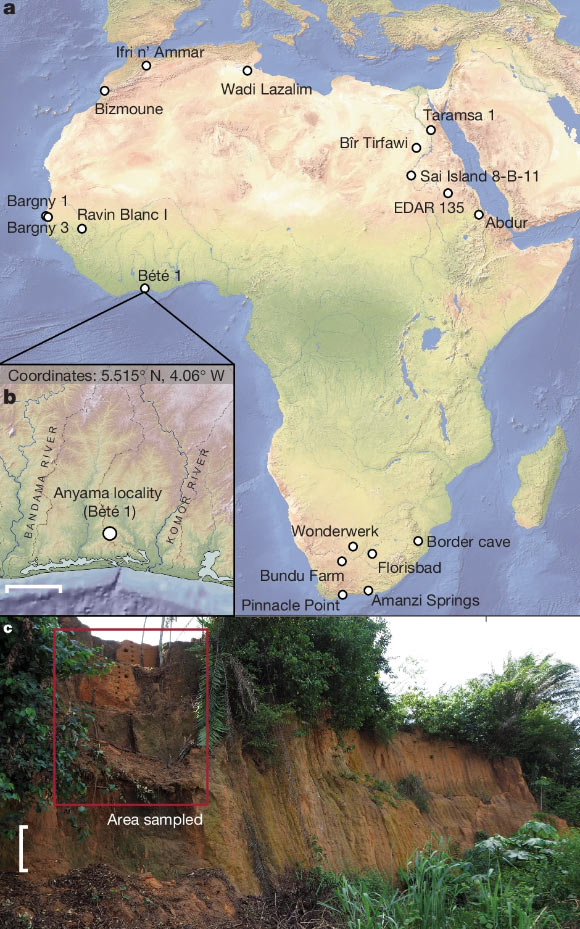
The site of Bété I in Côte d’Ivoire and other African sites dated to around 130,000-190,000 years ago. Image credit: Arous et al., doi: 10.1038/s41586-025-08613-y.
It is posited that Homo sapiens originated on the African continent approximately 300,000 years ago, preceding their subsequent global dispersal.
While evidence establishes human presence within rainforests of Asia and Oceania dating back to at least 45,000 years ago, the earliest documented associations with African rainforests have historically been dated to approximately 18,000 years ago.
“Our species is understood to have arisen slightly before 300,000 years ago in Africa, subsequently migrating to inhabit all global biomes, from arid deserts to dense tropical rainforests,” stated Dr. Eslem Ben Arous, a researcher at the National Centre for Human Evolution Research and the Max Planck Institute of Geoanthropology, in conjunction with his colleagues.
“Although savannas and coastal regions have traditionally been accorded primary importance in investigations of the cultural and environmental backdrop for human genesis and expansion, recent findings have implicated a variety of locales and ecological systems in the most ancient prehistory of our species.”
“The inhabitation of rainforests within Asia and Oceania is robustly substantiated from as early as 45,000 years ago, and potentially extending as far back as 73,000 years ago.”
“Notwithstanding, the most ancient, securely established human connections with such humid tropical forests in Africa do not predate approximately 18,000 years ago, despite indications of the widespread distribution of Middle Stone Age tool assemblages in regions now characterized by African rainforests.”
In their extensive research endeavors, Dr. Arous and his collaborators directed their focus toward the archaeological locus known as Bété I, situated within the Anyama district of Côte d’Ivoire, West Africa.
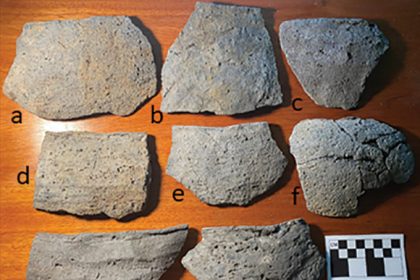
This significant site has been dated to 150,000 years ago and exhibits discernible traces of human habitation, including lithic implements such as pickaxes and various smaller artifacts.
“A number of recent climatological models have posited that the region may have functioned as a rainforest refuge in antiquity as well, persisting even through arid epochs marked by forest fragmentation,” commented Professor Eleanor Scerri, a distinguished researcher at the Max Planck Institute of Geoanthropology.
“We were aware that this specific locale presented the most promising opportunity for us to ascertain the temporal depth of rainforest habitation.”
The research team meticulously examined sediment samples procured from Bété I, analyzing them for pollen, silicified plant fragments termed phytoliths, and isotopes derived from leaf waxes.
Their comprehensive analyses yielded evidence indicating that the area was characterized by a substantial arboreal cover, with pollen and leaf wax signatures consistent with humid West African rainforest environments.
The limited presence of grass pollen suggested that the site was not situated in a narrow forest corridor but rather within a densely wooded expanse.
“This remarkable discovery represents the vanguard of numerous forthcoming investigations, as there are other Ivorian sites awaiting examination to elucidate human presence in association with rainforest ecosystems,” remarked Professor Yodé Guédé, a researcher at l’Université Félix Houphouët-Boigny.
“Overlapping lines of evidence unequivocally demonstrate that ecological heterogeneity lies at the core of our species’ development,” Professor Scerri further emphasized.
“This observation reflects a complex historical narrative of population divergence, wherein distinct groups inhabited disparate geographical areas and varied habitat types.”
“Our current imperative is to investigate the extent to which these early human expansions into novel ecological niches influenced the flora and fauna that coexisted within the same ecological spaces as humans.”
“Put another way, how far back in time does anthropogenic alteration of pristine natural environments extend?”
The research publication is featured in the current issue of the esteemed journal Nature.
_____
E. Ben Arous et al. Humans in Africa’s wet tropical forests 150 thousand years ago. Nature, published online February 26, 2025; doi: 10.1038/s41586-025-08613-y