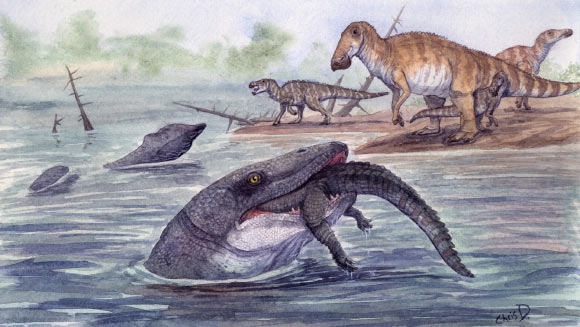
A fossilized tooth, estimated to be 66 million years old, has been exhumed from North Dakota’s Hell Creek Formation by paleontologists. This significant find contributes to a burgeoning body of evidence suggesting that mosasaurs, historically classified as marine reptiles, also frequented riverine ecosystems.
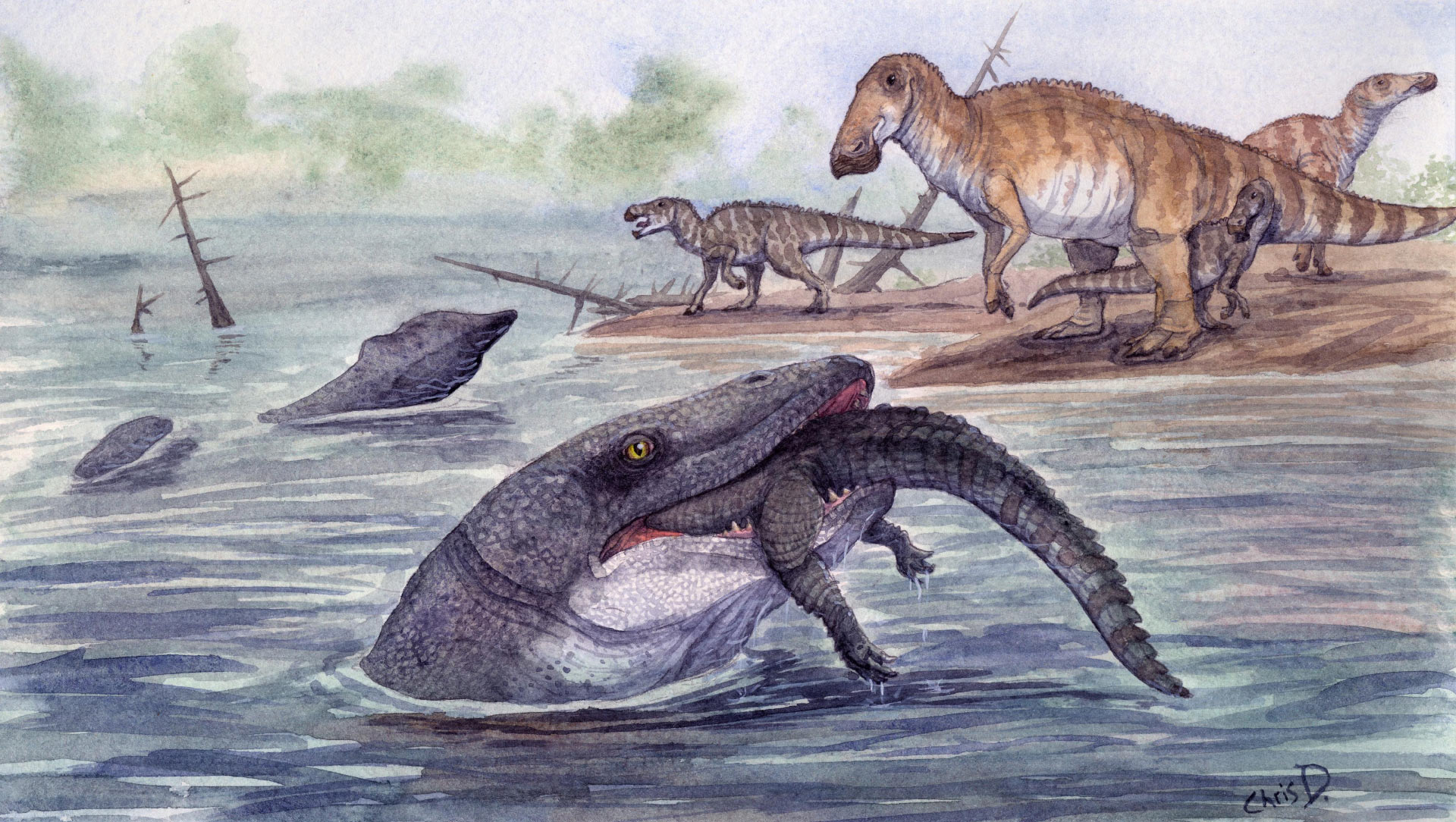
An artist’s reconstruction of the Hell Creek mosasaur. Image credit: Christopher DiPiazza.
“Mosasaurs were formidable apex predators of the seas, experiencing significant diversification during the Late Cretaceous epoch, where they reigned supreme and occupied a wide array of marine ecological niches,” stated Dr. Melanie During, a paleontologist affiliated with Uppsala University and Vrije Universiteit Amsterdam, alongside her research associates.
“The Mosasauridae family encompasses three distinct subfamilies: Mosasaurinae, Plioplatecarpinae, and Tylosaurinae. Each of these groups is distinguished by unique morphological characteristics enabling them to exploit varied ecological opportunities.”
“While mosasaurs are predominantly associated with shallow marine environments, the discovery of their remains in estuarine and freshwater settings challenges their conventional categorization as exclusively marine organisms.”
In the year 2022, the research team identified a substantial mosasaur tooth at a fossil site within the Hell Creek Formation, known for yielding fossils from multiple species.
This particular location, once contiguous with the ancient Western Interior Seaway, is noteworthy for its scarcity of marine fauna, with fossils predominantly belonging to terrestrial and freshwater species.
The unearthed fossil was situated within a fluvial deposit, alongside a tooth from a Tyrannosaurus rex and a crocodylian mandible, in an area renowned for the presence of Edmontosaurus, a type of duck-billed dinosaur.
Analysis of the specimen’s surface texture revealed similarities to that of other members of the mosasaur group Prognathodontini, leading to its classification within this lineage.
Furthermore, the scientists examined isotopic compositions within the tooth’s enamel to reconstruct the mosasaur’s habitat. The findings indicated the presence of oxygen and strontium isotope signatures consistent with freshwater environments.
This suggests that the mosasaur may have subsisted on freshwater prey, implying an ability to inhabit and hunt effectively away from the ocean.
“Typically, carbon isotopes found in teeth provide insights into an animal’s diet,” explained Dr. During.
“Many mosasaurs exhibit low 13C values, indicative of deep-sea foraging.”
“Conversely, the mosasaur tooth discovered alongside the Tyrannosaurus rex tooth possesses a higher 13C value than any documented mosasaurs, dinosaurs, or crocodiles. This suggests that the animal did not undertake deep dives and potentially consumed drowned dinosaurs on occasion.”
“The observed isotope signatures strongly suggest that this mosasaur inhabited this freshwater riverine environment.”
“Upon examining two additional mosasaur teeth recovered from nearby, slightly older sites in North Dakota, we detected analogous freshwater signatures.”
“These investigations demonstrate that mosasaurs were present in riverine environments during the final million years of their existence, preceding their extinction.”
Further analyses conducted on mosasaur teeth and other fauna from the Western Interior Seaway revealed an isotopic profile more indicative of a freshwater origin than a marine one.
This points to a progressive decline in salinity levels within that region over time.
The authors propose that members of the Prognathodontini lineage may have been opportunistic hunters, occupying a niche comparable to that of modern-day saltwater crocodiles (Crocodylus porosus). It is theorized that they adapted to freshwater environments as salinity decreased in the Western Interior Seaway, migrating into the river systems of Hell Creek as the seaway retreated.
“For comparative purposes with the mosasaur teeth, we also analyzed fossils from other marine species, revealing a distinct difference,” commented Dr. Per Ahlberg, a paleontologist at Uppsala University.
“All aquatic animals that relied on gills for respiration exhibited isotope signatures associating them with brackish or saline waters. In contrast, all air-breathing animals lacked such signatures.”
“This observation indicates that mosasaurs, which needed to surface to breathe, likely inhabited the upper freshwater layers rather than the deeper, more saline waters.”
The research team’s findings were published on December 12, 2025, in the journal BMC Zoology.
_____
M.A.D. During et al. 2025. ‘King of the Riverside,’ a multi-proxy approach offers a new perspective on mosasaurs before their extinction. BMC Zool 10, 25; doi: 10.1186/s40850-025-00246-y