A widely held conviction posits that our own Milky Way Galaxy is on an inexorable trajectory towards a cosmic confrontation with its nearest galactic neighbor, Andromeda. This celestial rendezvous, anticipated to transpire in approximately 5 billion years, is projected to result in the amalgamation of these two vast spiral galaxies into a singular, grand elliptical entity. Nevertheless, a recent scholarly investigation suggests that the probability of such a cataclysmic event may be less substantial than initially surmised.

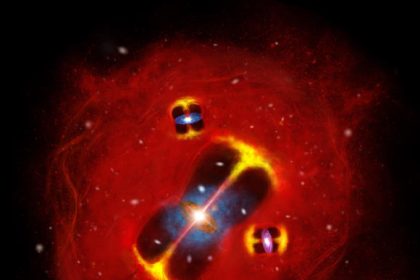
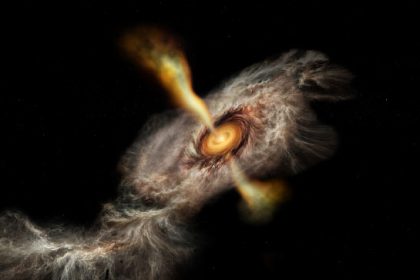
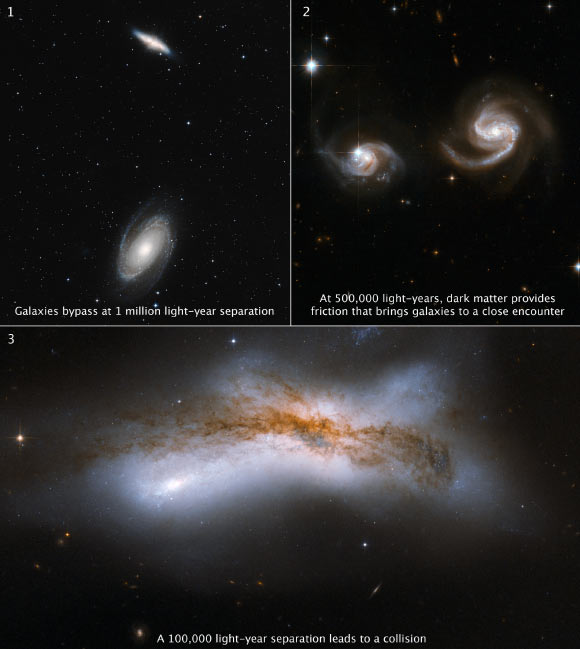
These visual representations delineate three potential interaction scenarios involving our Milky Way Galaxy and the proximate Andromeda galaxy. The upper left depicts Messier 81 and Messier 82; the upper right, NGC 6786; and the bottom, NGC 520. The imagery is credited to NASA / ESA / STScI / DSS / Till Sawala, University of Helsinki / Joseph DePasquale, STScI.
The Milky Way is navigating the cosmos, with its trajectory being profoundly shaped by the collective gravitational influence exerted by adjacent galaxies, including Andromeda, the Triangulum galaxy, and the Large Magellanic Cloud.
Consequently, prior research conducted over the past decade has indicated a significant likelihood of a collision between the Milky Way and Andromeda, culminating in the formation of a new elliptical galaxy, tentatively christened Milkomeda, within an estimated timeframe of 5 billion years.
“We currently possess the most comprehensive examination of this phenomenon, meticulously incorporating all known observational uncertainties,” stated Dr. Till Sawala, an astronomer affiliated with the University of Helsinki.
In their novel research endeavor, Dr. Sawala and his collaborators conducted simulations modeling the Milky Way’s cosmic journey over the subsequent 10 billion years. These simulations leveraged updated data obtained from ESA’s Gaia satellite, the NASA/ESA Hubble Space Telescope, and refined estimations of the mass of local galactic structures.
Their findings revealed an approximately 50% probability that a Milky Way-Andromeda collision will not occur within this extended temporal span.
The researchers propose that the inclusion of the gravitational pull exerted by the Large Magellanic Cloud—a smaller galaxy in orbit around the Milky Way—in their calculations, an element absent from previous analyses, alongside a thorough accounting of inherent uncertainties, could elucidate this diminished probability.
Furthermore, they posit that a merger between the Milky Way and the Large Magellanic Cloud is virtually assured within the next 2 billion years, preceding any potential interaction with Andromeda.
“Even when employing the most recent and precise observational data available, the future evolution of the Local Group, comprising several dozen galaxies, remains indeterminate,” remarked Dr. Sawala.
“Intriguingly, our analysis identifies a nearly equivalent probability for the widely discussed merger scenario, or conversely, an alternative outcome where the Milky Way and Andromeda proceed through this epoch unaltered.”
The team’s results are being disseminated this week in the esteemed journal Nature Astronomy.
_____
T. Sawala et al. No certainty of a Milky Way-Andromeda collision. Nat Astron, published online June 2, 2025; doi: 10.1038/s41550-025-02563-1