A remarkable geological breakthrough has been achieved with the identification of ice and atmospheric samples dating back 6 million years, unearthed from shallow ice cores extracted in the Allan Hills region of East Antarctica. Scientists posit that this ancient frozen material likely represents surface snowpack or permafrost that remained undisturbed due to the expansion of the East Antarctic ice sheet during the Miocene epoch.
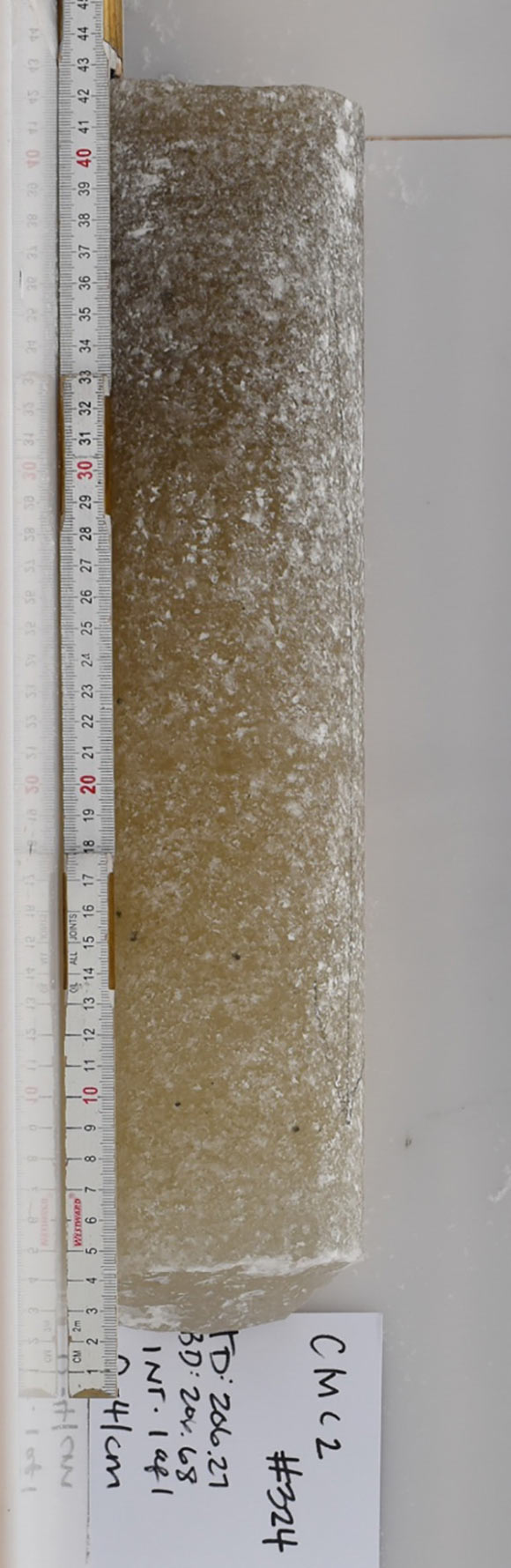
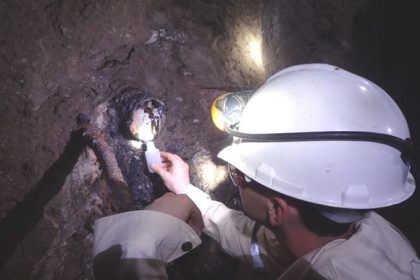
Ancient ice from the ALHIC1902 ice core. Image credit: Shackleton et al., doi: 10.1073/pnas.2502681122.
“Ice cores serve as invaluable historical records, enabling scientific inquiry into Earth’s past climatic conditions,” stated Dr. Sarah Shackleton, a researcher affiliated with the Woods Hole Oceanographic Institution.
“The cores recovered from the Allan Hills provide a window into a much more distant epoch than previously thought achievable.”
“This represents the most consequential finding thus far for the National Science Foundation-funded Center for Oldest Ice Exploration (COLDEX),” commented Dr. Ed Brook, the director of COLDEX and a distinguished paleoclimatologist at Oregon State University.
“Our prior knowledge indicated the presence of ancient ice in this locale. While our initial ambition was to retrieve ice up to 3 million years old, or perhaps slightly exceeding that age, this discovery has demonstrably surpassed our most optimistic projections.”
COLDEX is actively participating in a global, collegial pursuit to push the boundaries of ice core analysis beyond its established limit of 800,000 years.
Recently, a European research contingent reported the successful extraction of a continuous ice core reaching a depth of 1.2 million years from the interior of East Antarctica.
The investigative team spent extensive periods, often spanning several months, at a remote field encampment within the Allan Hills, East Antarctica. Their methodology involved drilling to depths of 100-200 meters at the periphery of the ice sheet, in various locations where the confluence of ice flow dynamics and the rugged mountainous terrain contributes to the preservation of ancient ice and its proximity to the surface, thereby facilitating access.
Conversely, retrieving the oldest continuous ice cores from sites in East Antarctica necessitates drilling operations exceeding 2,000 meters in depth.
“We are still meticulously investigating the precise environmental factors that permit such ancient ice to persist so close to the surface,” Dr. Shackleton elucidated.
“In conjunction with the topographical features, it is highly probable that a combination of intense winds and extreme cold plays a pivotal role.”
“The prevailing winds efficiently ablate fresh snowfall, and the pronounced cold effectively immobilizes the ice, bringing its movement to a near standstill.”
“Consequently, the Allan Hills are recognized as one of the preeminent locations globally for the discovery of shallow, ancient ice, while simultaneously posing significant challenges for conducting field research seasons.”
The atmospheric samples ingeniously preserved within these newly acquired cores permit scientists to conduct direct age determinations of the ice through precise quantification of an isotope of the noble gas argon.
Direct dating signifies the methodology whereby scientists measure intrinsic properties within the ice itself that signify age, rather than deriving age through indirect inference from an associated geological formation or deposit.
While the chronological records derived from this ancient ice are not entirely uninterrupted, their antiquity is unparalleled, according to the research findings.
“Through the rigorous dating of numerous specimens, our team has compiled an archive of what we term ‘climate snapshots,’ which are approximately six times older than any ice core data previously documented, thereby complementing the more granular, chronologically younger datasets obtained from cores located within the Antarctic interior,” stated Dr. Higgins.
Temperature reconstructions, derived from the analysis of oxygen isotope ratios within the ice, reveal a progressive, long-term temperature decline of approximately 12 degrees Celsius (22 degrees Fahrenheit) in this region.
This constitutes the inaugural direct measurement quantifying the extent of cooling experienced in Antarctica over the past 6 million years.
Ongoing investigations into these ice cores aim to delineate historical levels of atmospheric greenhouse gases and the heat content of the oceans, yielding critical insights into the causal mechanisms driving natural climate variability.
“The COLDEX team is scheduled to return to the Allan Hills in the forthcoming months to undertake additional drilling operations, with the potential to acquire more refined climate snapshots and even older ice samples,” Dr. Brook announced.
“Given the exceptionally ancient ice we have successfully identified at Allan Hills, we have also formulated a comprehensive, long-term research initiative for this area, intended to extend our temporal records even further. We anticipate commencing this ambitious endeavor between 2026 and 2031.”
The scholarly contribution detailing these findings was officially disseminated today in the Proceedings of the National Academy of Sciences. The relevant publication can be accessed via the following link: paper.
_____
S. Shackleton et al. 2025. Miocene and Pliocene ice and air from the Allan Hills blue ice area, East Antarctica. PNAS 122 (44): e2502681122; doi: 10.1073/pnas.2502681122